


Kansas CDL Practice Test: General Knowledge (KS) 6

4.9 out of 5 (44 votes)
80% Passing score
50 Questions
10 Mistakes allowed
As a Kansan looking to earn your Commercial Driver's License (CDL) in 2026, it's crucial to prepare thoroughly, and what better way to do so than with our Kansas CDL General Knowledge Practice Test! This is the sixth in our series of CDL practice tests, meticulously designed to streamline your preparation process. With 50 thoughtfully curated 2026 CDL test questions and answers, this Kansas CDL practice test simulates the real DMV test environment, providing an extensive overview of essential topics. You'll encounter questions on vehicle equipment, handling emergencies, accident procedures, pre-trip inspections, and more. An interesting aspect of this online Kansas CDL practice test is its inclusion of questions about hazardous materials. Although you're not seeking a HazMat endorsement now, this knowledge is vital for every aspiring commercial driver. One of the key benefits of our Kansas general knowledge CDL practice test is the variety of questions. By covering a broad spectrum of subjects, it ensures you're well-prepared for any question the DMV might pose in 2026. The consistency in the question set each time you take the drivers practice test reinforces your learning and aids in memory retention. Customization is another feature we take pride in. Our practice test allows you to focus on areas where you feel the need for extra practice. You can retake the test as many times as necessary to improve your understanding and confidence. Additionally, you can approach the test at your own pace and convenience, fitting study sessions into your schedule without hassle. Unlike the actual Kansas CDL test in 2026, our DMV practice test isn't timed. This allows you to delve deep into each CDL question, understanding the nuances without the pressure of a ticking clock. Such an approach not only aids in better learning but also helps in managing time effectively when you finally face the actual timed test. In conclusion, this sixth Kansas CDL practice test is a comprehensive tool designed to boost your chances of acing the Kansas CDL test in 2026! It's an invaluable resource for anyone serious about their CDL aspirations.
FREE CDL Practice Test App
Pass your Kansas CDL General Knowledge test with the NextDoorDriving app. Real questions and answers—100% free and ad-free.
Download on the App Store

Sample Kansas CDL Test Questions - General Knowledge

Question 1

Which statement about night driving and fatigue is correct?

  1. A High beams should be used continuously from 7 p.m. to 7 a.m.
  2. B Most drivers are more alert at night than during daylight hours
  3. C Many serious commercial-vehicle crashes occur between midnight and 6 a.m.
  4. D Road hazards are generally easier to identify at night

Correct answer: C – Many serious commercial-vehicle crashes occur between midnight and 6 a.m.

Driving through the night or during hours when you normally sleep raises the risk of drowsiness. The CDL manual notes that many serious crashes involving heavy motor vehicles occur between midnight and 6 a.m. Darkness also makes hazards harder to see, while fatigue can slow recognition and reaction.

Source: Kansas Commercial Driver’s License Manual — § 2.11, “Driving at Night” and § 2.23, “Staying Alert and Fit to Drive”
Question 2

For a truck operated in Kansas, what is the minimum tread depth required on a front tire?

  1. A 2/32 inch
  2. B 4/32 inch
  3. C 6/32 inch
  4. D 1/4 inch

Correct answer: B – 4/32 inch

Federal equipment rules require at least 4/32 inch of tread in a major groove on each front tire of a bus, truck, or truck tractor. Measurements are not made at tie bars, humps, or fillets. Other tires generally require at least 2/32 inch of tread in a major groove.

Source: Kansas Commercial Driver’s License Manual — § 2.1.3, “What to Look For”, 49 CFR § 393.75(b), (c) – Tires

Question 3

Which driver should be watched especially carefully as a possible traffic hazard?

  1. A A driver using a turn signal, because the signal confirms exactly where the vehicle will turn
  2. B A rental-truck driver who may be unfamiliar with the vehicle’s limited side and rear visibility

Correct answer: B – A rental-truck driver who may be unfamiliar with the vehicle’s limited side and rear visibility

Kansas CDL guidance identifies rental trucks as vehicles that deserve careful observation. Their drivers may not be accustomed to the restricted view along the sides and rear of a large truck. Recognizing such clues early gives a commercial driver more time to maintain space and respond safely if the other vehicle makes an unexpected movement.

Source: Kansas Commercial Driver’s License Manual — § 2.8.3, “Drivers Who Are Hazards”

Question 4

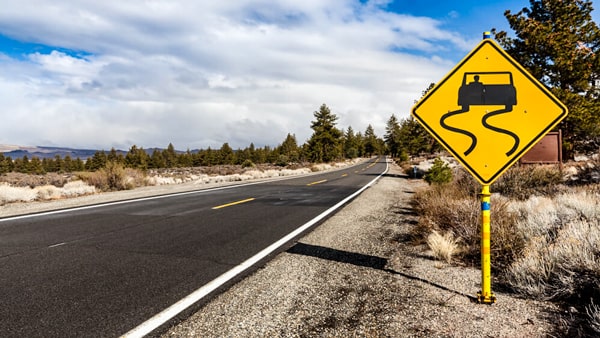
What does a SLIPPERY WHEN WET warning sign tell a commercial driver to do?

This sign warns drivers to  _________________.
  1. A Reduce speed and use extra care to avoid skidding on a wet surface
  2. B Avoid using the road whenever rain is falling
  3. C Watch for a shoulder where vehicles may become stuck
  4. D Expect the road to be equally slippery in all weather

Correct answer: A – Reduce speed and use extra care to avoid skidding on a wet surface

The sign warns that unexpected slippery conditions may exist when the pavement is wet. A commercial driver should reduce speed and make smooth steering and braking inputs because wet roads increase stopping distance and make skidding more likely. The sign is a warning, not a prohibition against driving in rain.

Source: Manual on Uniform Traffic Control Devices, 11th Edition with Revision 1 — § 2C.30, “Surface Condition Signs (W8-5, W8-7, W8-8, W8-11, W8-13, and W8-14)”, Kansas Commercial Driver’s License Manual — § 2.6.2, “Matching Speed to the Road Surface”

Question 5

At a Kansas all-way stop, another driver stopped first and has begun entering the intersection. To whom must you yield?

  1. A The driver who stopped first and is entering the intersection
  2. B A driver on your left, regardless of arrival order
  3. C A driver on your right, regardless of whether that driver has stopped
  4. D No one once you have made a complete stop

Correct answer: A – The driver who stopped first and is entering the intersection

After stopping, a driver must yield to a vehicle already in the intersection or approaching closely enough to be an immediate hazard. Thus, the driver who stopped first and has begun entering should be allowed to proceed. If two vehicles enter from different roadways at approximately the same time, the driver on the left yields to the driver on the right.

Source: K.S.A. 8-1528(b) – Stop Signs and Yield Signs; Duties of Drivers, K.S.A. 8-1526 – Vehicle Approaching or Entering Intersection

Question 6

According to CDL safety guidance, what is the leading cause of injury and death in roadway work zones?

  1. A Speeding traffic
  2. B Wet pavement
  3. C Poorly adjusted brakes
  4. D Reduced nighttime visibility

Correct answer: A – Speeding traffic

The CDL manual identifies speeding traffic as the leading cause of injury and death in roadway work zones. Drivers should observe posted speed limits while approaching and passing through these areas. They must also remain alert for narrow lanes, workers, equipment, sudden stops, and changing traffic patterns.

Source: Kansas Commercial Driver’s License Manual — § 2.6.7, “Roadway Work Zones”