


Louisiana CDL General Knowledge Test (LA) 5

5 out of 5 (42 votes)
80% Passing score
50 Questions
10 Mistakes allowed
As a Louisianian ready to advance your commercial driving skills, you've arrived at the right place for your fifth Louisiana CDL practice test. This unique general knowledge test is a crucial step in your preparation, offering a comprehensive set of 50 CDL test questions designed to thoroughly assess your knowledge. Achieving a score of at least 40 correct answers is your goal, a benchmark that ensures you're well-equipped for the actual CDL exam. Our Louisiana CDL general knowledge practice tests stand out with their customizable nature. You're in control here, shaping your study sessions to suit your needs. Focus on areas that challenge you, retake the CDL practice test to better your performance, and engage in these practice sessions whenever it fits your schedule. This flexibility is pivotal in creating an effective learning experience tailored just for you. Another critical aspect of our Louisiana CDL practice test is the immediate feedback and detailed explanations provided for each question. Understanding the reasoning behind each answer is vital. It's not just about knowing the right answer but grasping the rationale behind it. This depth of understanding is what will set you apart as a knowledgeable and prepared driver. Louisiana's roads have their own set of rules and signage, and our general knowledge practice test reflects this. The questions are designed with the state-specific regulations and signs of Louisiana in mind, ensuring that you're not just preparing for a general test but one that's relevant to the roads you'll be navigating. Remember, this isn't just another Louisiana CDL practice test. It's a critical step in your path to mastering the knowledge necessary for a Louisiana CDL in 2026, equipping you with confidence and comprehension specific to our state's roads. Let's get started!
FREE CDL Practice Test App
Pass your Louisiana CDL General Knowledge test with the NextDoorDriving app. Real questions and answers—100% free and ad-free.
Download on the App Store

Sample Louisiana CDL Test Questions - General Knowledge

Question 1

A blue highway sign displaying a fuel-pump symbol directs drivers to:

  1. A Gas or fuel service
  2. B A road-work zone
  3. C A temporary detour
  4. D A mandatory inspection station

Correct answer: A – Gas or fuel service

General service signs use a blue background with white symbols or lettering. A fuel-pump symbol identifies available gas or fuel service. Work-zone warning signs and detour signs use different colors and messages, so they should not be confused with blue service signs.

Source: Manual on Uniform Traffic Control Devices for Streets and Highways, 11th ed., Rev. 1 — § 2I.03, “General Service Signs for Freeways and Expressways”
Question 2

What is the primary goal when distributing cargo weight from the front to the rear of a commercial vehicle?

  1. A Balance the load to maintain safe axle weights
  2. B Place nearly all weight over the steering axle
  3. C Move as much weight as possible behind the drive axles
  4. D Stack the heaviest cargo on top

Correct answer: A – Balance the load to maintain safe axle weights

The Louisiana manual emphasizes balanced cargo distribution. Excessive steering-axle weight can make steering difficult and damage components, while moving weight too far rearward can leave the steering axle too lightly loaded. Too little weight on the drive axles can also reduce traction. Distribute the load to keep axle weights within safe limits.

Source: Louisiana Commercial Driver License Manual — § 3.2.4, “Balance the Weight”

Question 3

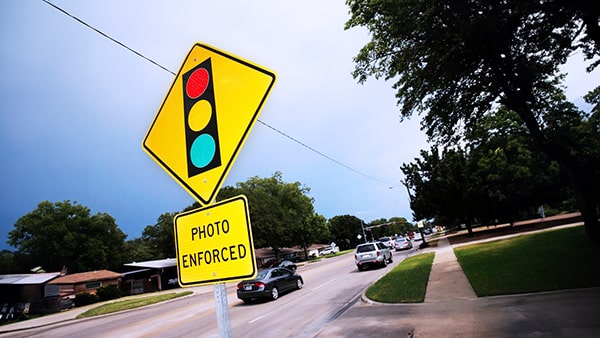
A yellow diamond-shaped sign showing the familiar red-yellow-green traffic-light symbol warns of:

This sign indicates that the driver is ___________.
  1. A A yield sign ahead
  2. B A stop sign ahead
  3. C A traffic signal ahead
  4. D A railroad crossing ahead

Correct answer: C – A traffic signal ahead

The Signal Ahead sign warns that a traffic signal is located ahead. It is especially important where the signal is not visible from a sufficient distance for drivers to respond. Recognizing the warning early gives a commercial driver time to monitor traffic and prepare for the signal indication.

Source: Manual on Uniform Traffic Control Devices for Streets and Highways, 11th ed., Rev. 1 — § 2C.35, “Advance Traffic Control Signs”

Question 4

Which items must be checked when inspecting each tire during the CDL vehicle inspection?

  1. A Tread depth
  2. B Tire condition
  3. C Tire inflation
  4. D All of these

Correct answer: D – All of these

Inspect every tire for adequate tread depth, proper inflation, and overall condition. Look for uneven wear, cuts, sidewall damage, and damaged or missing valve stems and caps. Use a tire gauge to verify inflation; kicking the tire or striking it with a mallet is not an acceptable pressure check during the CDL inspection.

Source: Louisiana Commercial Driver License Manual — § 11.2.4, “Wheels”

Question 5

At a railroad crossing with flashing red lights and a lowered gate, when may you proceed?

  1. A As soon as the train’s engine has cleared the roadway
  2. B When no train horn can be heard
  3. C After checking around the lowered gate
  4. D After the gate rises, the lights stop flashing, and the crossing is safe

Correct answer: D – After the gate rises, the lights stop flashing, and the crossing is safe

Stop when the red lights begin flashing and before the gate lowers across your lane. Remain stopped until the gate rises and the lights stop flashing, then proceed only after confirming that the crossing is safe. At a multiple-track crossing, make sure another train is not approaching on a different track.

Source: Louisiana Commercial Driver License Manual — § 2.15.2, “Warning Signs and Devices”

Question 6

Before backing with a helper, which hand signal is most important for both people to understand?

  1. A Pull forward
  2. B Turn right
  3. C Continue backing
  4. D Stop

Correct answer: D – Stop

Before backing begins, the driver and helper should agree on a set of clearly understood hand signals, especially a stop signal. The helper should remain near the rear where the driver can see them. A clear stop signal allows the helper to warn the driver when an obstacle, person, or clearance problem requires the maneuver to halt.

Source: Louisiana Commercial Driver License Manual — § 2.2.4, “Backing Safely”