


Maine CDL General Knowledge Test (ME) 5

4.9 out of 5 (49 votes)
80% Passing score
50 Questions
10 Mistakes allowed
Welcome to the Maine CDL General Knowledge Practice Test, your essential tool for acing the official CDL permit test in 2026! This fifth test in our series is designed to thoroughly prepare you for the challenges of the real general knowledge test. Comprising 50 carefully selected questions, this practice test mirrors the format and content of the actual exam. Each question is derived from the official Maine CDL driver's manual, the same source used for the real test. This ensures that what you study here aligns directly with what you'll face on test day. One of the key features of this Maine CDL practice test is its consistent question set. Every time you attempt the test, you'll encounter the same 50 permit test questions. This consistency is critical for reinforcing your knowledge and identifying areas that need more attention. To pass, you'll need to answer at least 40 questions correctly, but don't worry if you don't hit the mark on your first try. You can retake this general knowledge practice test as many times as necessary. This unlimited access allows you to learn at your own pace, building confidence and competence with each attempt. After completing this Maine CDL general knowledge test, you'll receive a detailed summary of your performance. This feedback is invaluable, highlighting the questions you missed and providing the correct answers for further study. This feature turns every attempt into a learning opportunity, ensuring that you're not just practicing, but actively improving. As you progress through these DMV practice tests, remember that they are more than just a study tool; they are a stepping stone to achieving your CDL in 2026 and advancing your career. With dedication and practice, you'll be well-prepared to succeed on the official Maine CDL permit test!
FREE CDL Practice Test App
Pass your Maine CDL General Knowledge test with the NextDoorDriving app. Real questions and answers—100% free and ad-free.
Download on the App Store

Sample Maine CDL Test Questions - General Knowledge

Question 1

A blue highway sign displaying a fuel-pump symbol identifies:

  1. A Gas or fuel service
  2. B Road construction
  3. C A detour route
  4. D All of these

Correct answer: A – Gas or fuel service

Blue signs are used to identify general services available to road users. The standard fuel-pump symbol specifically identifies gas or fuel service. It does not by itself indicate construction activity, a closed road, or a detour route.

Source: Manual on Uniform Traffic Control Devices, 11th ed. with Revision 1 — § 2I.02, “General Service Signs for Conventional Roads,” Figure 2I-1
Question 2

When fighting a vehicle fire, you should aim the extinguisher at the upper part of the flames.

  1. A True
  2. B False

Correct answer: B – False

Aim the extinguisher at the source or base of the fire rather than at the tops of the flames. Directing the extinguishing agent above the burning material may fail to control the fire. Stay as far from the fire as practical and follow the operating instructions printed on the extinguisher.

Source: Maine Commercial Driver License Manual — § 2.21.3, “Fire Fighting”

Question 3

What can happen if cargo is shifted so far rearward that too little weight remains on the front axle?

  1. A The steering axle may become too light to steer safely
  2. B The vehicle’s handling will improve
  3. C The drive-axle tires will automatically be overloaded
  4. D All of these

Correct answer: A – The steering axle may become too light to steer safely

Moving too much cargo toward the rear can leave insufficient weight on the steering axle. A lightly loaded steering axle may not provide enough control for safe steering. This differs from having too little weight on the drive axles, which can cause poor drive-wheel traction and wheel spin.

Source: Maine Commercial Driver License Manual — § 3.2.4, “Balance the Weight”

Question 4

During an inspection of the front of a trailer, which checks may be required?

  1. A Verify that an equipped header board is secure, undamaged, and strong enough to contain cargo
  2. B Verify that an equipped canvas or tarp carrier is mounted securely
  3. C Inspect the front of an enclosed trailer for cracks, bulges, or holes
  4. D All of these

Correct answer: D – All of these

Each listed check applies to the trailer’s front area when the relevant equipment or trailer type is present. An equipped header board must be secure, undamaged, and capable of containing cargo. A tarp carrier must be securely mounted, while the front of an enclosed trailer should be checked for structural damage such as cracks, bulges, or holes.

Source: Maine Commercial Driver License Manual — § 11.4.1, “Trailer Front—Header Board”

Question 5

Reaction distance is the distance a commercial vehicle travels:

  1. A After the driver recognizes a hazard but before the brakes are physically applied
  2. B From the moment the driver sees a hazard until the brain recognizes it
  3. C While the brakes are slowing the vehicle
  4. D From first seeing a hazard until the vehicle completely stops

Correct answer: A – After the driver recognizes a hazard but before the brakes are physically applied

Reaction distance is traveled after the driver recognizes the need to respond but before the brakes are physically applied. The distance traveled while the brain is identifying the hazard is perception distance. Braking distance begins after brake application, and total stopping distance includes perception, reaction, and braking distance.

Source: Maine Commercial Driver License Manual — § 2.6.1, “Stopping Distance”

Question 6

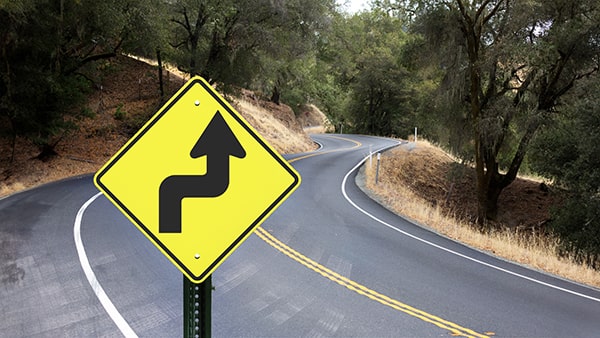
A yellow warning sign showing a sharp right turn immediately followed by a sharp left turn warns of:

This sign warns drivers to  _____________.
  1. A Two gentle curves beginning to the right
  2. B One sharp right turn only
  3. C One sharp left turn only
  4. D Two sharp turns, first right and then left

Correct answer: D – Two sharp turns, first right and then left

A Reverse Turn sign warns of two closely spaced changes in roadway alignment in opposite directions. The direction shown at the top of the symbol is encountered first, followed by the second turn. Reduce speed before entering the first turn and use a speed that permits control through both turns.

Source: Manual on Uniform Traffic Control Devices, 11th ed. with Revision 1 — § 2C.07, “Horizontal Alignment Signs (W1-1 through W1-5, W1-11, and W1-15)”, Maine Commercial Driver License Manual — § 2.6.3, “Speed and Curves”