


Washington CDL Practice Test (WA) 2026

4.9 out of 5 (80 votes)
80% Passing score
20 Questions
4 Mistakes allowed
Welcome to your first step in mastering the Washington CDL knowledge test. This initial DOL practice test features 20 multiple-choice questions designed to mirror the real CDL test format, requiring a minimum of 16 correct answers to pass. Tailored specifically to 2026 Washington's driving laws and regulations, this test ensures you're well-prepared for the state's unique rules and road signs. Our Washington DMV practice test not only helps you familiarize yourself with the types of driving test questions you'll encounter but also provides immediate feedback on each question. Detailed explanations accompany each CDL test answer, helping you understand why an answer is correct or incorrect and reinforcing your learning process. This feedback is crucial in helping you identify areas where you need further study and improving your overall understanding of the material. This Washington CDL practice test covers a wide range of topics, essential for any aspiring commercial driver. From pre-trip vehicle inspections and basic vehicle control to shifting gears and tackling hills and steep downgrades, you'll gain comprehensive knowledge. You'll also encounter 2026 DOL practice test questions on effective communication with other drivers, controlling speed, and drug and alcohol awareness, ensuring you're prepared for all aspects of driving a commercial vehicle. While this Washington DMV practice test is an invaluable resource, it's important to remember that it complements, rather than replaces, traditional drivers education and ELDT programs. In Washington, completing a state-certified drivers ed (Entry Level Driver Training) course is a prerequisite for obtaining your CDL in 2026. Utilizing these DOL practice tests alongside your drivers education course will help you identify and reinforce areas that might have been missed, ensuring a well-rounded preparation for the real Washington DMV permit test. By repeatedly taking this Washington CDL practice test, you'll become more confident and familiar with the test format, helping to reduce anxiety and improve your chances of success. Start your preparation with this comprehensive DOL practice test and give yourself the best chance of passing your Washington CDL knowledge test in 2026 on the first try!
FREE CDL Practice Test App
Pass your Washington CDL General Knowledge test with the NextDoorDriving app. Real questions and answers—100% free and ad-free.
Download on the App Store

Sample Washington CDL Test Questions - General Knowledge

Question 1

Backing a school bus is a preferred maneuver whenever it saves time.

  1. A True
  2. B False

Correct answer: B – False

Washington's Commercial Driver Guide strongly discourages backing a school bus. A driver should back only when there is no other safe way to move the bus and must never back while students are outside. If backing is unavoidable, follow the prescribed precautions, including using a lookout when available, checking mirrors and rear windows, and moving slowly and smoothly.

Source: Washington State Commercial Driver Guide — § 10.7.3, “Backing”
Question 2

Which cargo-inspection schedule is correct for a truck carrying an inspectable load?

  1. A Inspect only before starting the trip
  2. B Inspect within the first 50 miles and again after a break or the required time or mileage interval
  3. C Inspect during the trip only when hauling hazardous materials
  4. D Inspect every 6 hours or 300 miles

Correct answer: B – Inspect within the first 50 miles and again after a break or the required time or mileage interval

Federal cargo-inspection rules require an initial check within the first 50 miles. Cargo and its securement devices must then be reexamined whenever the driver's duty status changes, after three hours of driving, or after 150 miles, whichever occurs first. These checks allow necessary adjustments to prevent cargo from shifting or falling.

Source: Washington State Commercial Driver Guide — § 3.1, “Inspecting Cargo”, 49 CFR § 392.9(b) — Inspection of Cargo, Cargo Securement Devices and Systems

Question 3

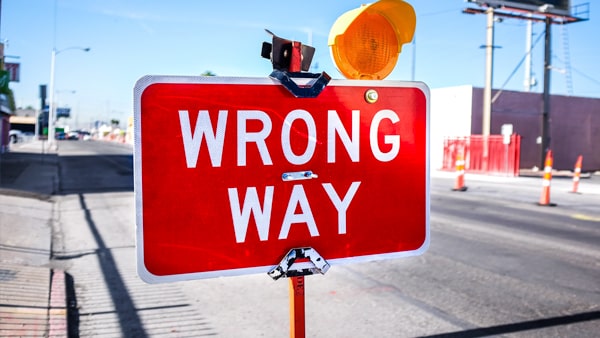
What does a red-and-white WRONG WAY sign tell a driver?

This sign warns drivers that  _________________.
  1. A An expressway entrance is ahead
  2. B Heavy traffic should be expected
  3. C The vehicle is traveling against the permitted direction of traffic
  4. D Travel may continue with extra caution

Correct answer: C – The vehicle is traveling against the permitted direction of traffic

A WRONG WAY sign is placed where a driver may be traveling in the prohibited direction on a one-way roadway or ramp. It supplements DO NOT ENTER signing and is positioned farther along the roadway to provide an additional warning. It does not merely advise caution or indicate an expressway entrance.

Source: Manual on Uniform Traffic Control Devices for Streets and Highways, 11th Edition with Revision 1 — § 2B.47, “WRONG WAY Sign (R5-1a)”

Question 4

Which list contains three cargo-related duties generally assigned to the driver?

  1. A Measuring cargo dimensions, choosing the delivery route, and planning the unloading order
  2. B Inspecting cargo, recognizing overloads or poor balance, and ensuring proper securement
  3. C Opening every sealed load, checking axle lubrication, and selecting placard colors
  4. D Opening sealed containers, planning the route, and verifying the receiver's schedule

Correct answer: B – Inspecting cargo, recognizing overloads or poor balance, and ensuring proper securement

For cargo that can be inspected, federal rules require the driver to verify proper distribution and securement and to perform required reinspections. The Washington guide also directs drivers to recognize overloads and poor weight balance. A sealed vehicle that the driver has been ordered not to open is excepted from the en-route inspection provisions, but that exception does not eliminate every cargo-related duty.

Source: Washington State Commercial Driver Guide — § 3, “Transporting Cargo Safely”, 49 CFR § 392.9(a), (b)(4) — Inspection of Cargo, Cargo Securement Devices and Systems

Question 5

If reflective triangles are used as the required emergency warning devices, how many must the vehicle carry?

  1. A 1
  2. B 2
  3. C 3
  4. D 4

Correct answer: C – 3

Federal equipment rules require covered trucks, truck tractors, and buses to carry approved warning devices for stopped vehicles. When reflective triangles are used, the vehicle must have three bidirectional emergency reflective triangles meeting the applicable safety standard. At least six fusees are an alternative where flame-producing devices are permitted.

Source: 49 CFR § 393.95(f), (g) — Emergency Equipment on All Power Units

Question 6

Which ability is affected first as alcohol begins influencing the brain?

  1. A Judgment and self-control
  2. B Kidney control
  3. C Physical coordination
  4. D Muscle control

Correct answer: A – Judgment and self-control

The Washington guide explains that alcohol first affects the part of the brain responsible for judgment and self-control. This early impairment may prevent a person from recognizing how intoxicated they are becoming. As blood alcohol concentration continues to rise, vision, coordination, and muscle control become increasingly affected.

Source: Washington State Commercial Driver Guide — § 2.22.1, “Alcohol and the Brain”