


West Virginia CDL General Knowledge Practice Test (WV) 2

4.8 out of 5 (82 votes)
80% Passing score
20 Questions
4 Mistakes allowed
Welcome to your second West Virginia CDL general knowledge practice test. This is an essential step in your journey to becoming a licensed commercial driver in our state in 2026. This DMV practice test, tailored specifically to West Virginia's driving laws and regulations, includes 20 multiple-choice learners permit test questions. To pass, you'll need to correctly answer at least 16 of them. This WV CDL practice test is constantly updated to ensure it reflects the most current rules and regulations for the year 2026. It doesn't matter whether you're aiming for a Class A or Class B license or what endorsements you're pursuing; you must always begin with the general knowledge test. The sample DMV questions you'll encounter here mirror those on the actual WV DMV written permit test, making this an invaluable tool in your preparation. Our West Virginia CDL general knowledge test practice covers a comprehensive range of topics. You'll find DMV written test questions on pre-trip vehicle inspections, basic vehicle control, shifting gears (including downshifting), managing hills and steep downgrades, communicating with other drivers, controlling speed, and drug and alcohol awareness. These are all critical areas you must be proficient in to ensure safety and compliance on the road. One of the standout features of our WV DMV practice test is the immediate feedback provided for each question. Not only will you know right away whether your answer is correct, but you'll also receive detailed explanations. This helps you understand the reasoning behind each answer, making it easier to grasp complex concepts and remember important information. Remember, you can take this WV learners practice test as many times as needed. The same set of CDL test questions will appear each time, allowing you to reinforce your knowledge through repetition. This approach ensures that you're thoroughly prepared for the actual WV permit test, giving you the confidence to succeed. Preparing for your CDL permit test doesn't have to be stressful. With this WV permit practice test, you'll gain a solid foundation in the general knowledge required for all commercial drivers in West Virginia. So, dive in, practice diligently, and you'll be well on your way to earning your CDL in 2026!
FREE CDL Practice Test App
Pass your West Virginia CDL General Knowledge test with the NextDoorDriving app. Real questions and answers—100% free and ad-free.
Download on the App Store

Sample West Virginia CDL Test Questions - General Knowledge

Question 1

What condition does this warning sign identify?
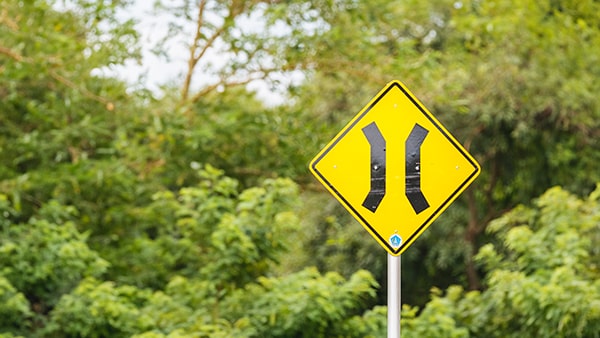
This sign warns drivers that _____________.
  1. A The roadway becomes narrower at a bridge ahead
  2. B The bridge ahead is structurally unstable
  3. C Only one direction of traffic may cross at a time
  4. D Drivers should increase speed before entering the bridge

Correct answer: A – The roadway becomes narrower at a bridge ahead

A Narrow Bridge sign warns that the available roadway width decreases at the bridge or culvert ahead. It does not by itself indicate an unstable structure or establish one-way traffic. Drivers should recognize that side clearance may be limited, particularly when operating a wide commercial vehicle.

Source: Manual on Uniform Traffic Control Devices for Streets and Highways, 11th Edition with Revision 1 — Ch. 2C, “NARROW BRIDGE Sign (W5-2)”
Question 2

Water is a safe choice for extinguishing which of these fires?

  1. A A fire involving energized electrical equipment
  2. B A gasoline fire
  3. C Neither fire
  4. D Both fires

Correct answer: C – Neither fire

Do not use water on energized electrical equipment or a gasoline fire. Water can conduct electricity and expose a person to shock, while gasoline can float on water and spread the flames. Water is generally used on Class A materials such as wood, paper, and cloth.

Source: West Virginia Commercial Driver’s License Manual with AAMVA Booklet — § 2.21.3, “Use the Right Fire Extinguisher”

Question 3

A fire extinguisher marked B:C is designed for which fires?

  1. A Electrical equipment and burning liquids
  2. B Wood, paper, and cloth only
  3. C Burning liquids only
  4. D Every fire regardless of the fuel

Correct answer: A – Electrical equipment and burning liquids

A B:C extinguisher is intended for burning liquids and fires involving electrical equipment. Common suitable extinguishing agents include dry chemicals and carbon dioxide. An A:B:C extinguisher also covers ordinary combustibles such as wood, paper, and cloth.

Source: West Virginia Commercial Driver’s License Manual with AAMVA Booklet — § 2.21.3, “Use the Right Fire Extinguisher”

Question 4

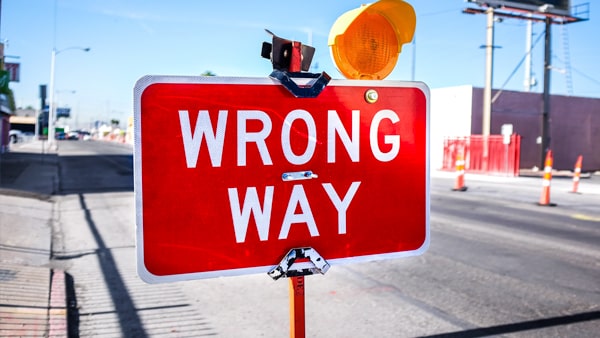
What does this sign tell the driver?

This sign warns drivers that  _________________.
  1. A An expressway entrance is ahead
  2. B Heavy traffic is expected ahead
  3. C The vehicle is traveling in a prohibited direction on a roadway or ramp
  4. D The driver may proceed in either direction with caution

Correct answer: C – The vehicle is traveling in a prohibited direction on a roadway or ramp

The Wrong Way sign warns that the vehicle is traveling in a prohibited direction, commonly on a one-way roadway or ramp. It is positioned to face traffic making a wrong-way movement. The driver must not continue in that direction and should correct the situation safely.

Source: Manual on Uniform Traffic Control Devices for Streets and Highways, 11th Edition with Revision 1 — § 2B.47, “WRONG WAY Sign (R5-1a)”

Question 5

When should a driver perform the vehicle inspection used to verify that a CMV is safe to operate?

  1. A At least once each week
  2. B Only at the beginning of each calendar day
  3. C Only when the previous driver reported a problem
  4. D Before driving the vehicle

Correct answer: D – Before driving the vehicle

Federal motor-carrier regulation requires the driver, before driving, to review the previous inspection report when applicable and be satisfied that the vehicle is in safe operating condition. A pre-trip inspection helps identify defects that could cause a breakdown or crash. Waiting for a weekly schedule or a previously reported problem is not sufficient.

Source: West Virginia Commercial Driver’s License Manual with AAMVA Booklet — § 2.1.5, “Seven-step Inspection Method”, 49 CFR § 396.13 — Driver inspection

Question 6

Unless an inspection exception applies, after the initial 50-mile cargo check, cargo and securement devices must be rechecked no later than:

  1. A 1 hour or 100 miles
  2. B 2 hours or 200 miles
  3. C 3 hours or 150 miles, whichever comes first
  4. D 4 hours or 400 miles

Correct answer: C – 3 hours or 150 miles, whichever comes first

The federal cargo-inspection rule requires an initial recheck within the first 50 miles. After that, the driver must reexamine the cargo and securement devices when duty status changes or after three hours or 150 miles of driving, whichever occurs first. The rule includes exceptions for certain sealed or inaccessible cargo.

Source: West Virginia Commercial Driver’s License Manual with AAMVA Booklet — § 2.1.6, “Inspection during a Trip”, 49 CFR § 392.9(b) — Inspection of cargo, cargo securement devices and systems