Idaho DMV Practice Test 3

4.8 out of 5 (373 votes)
80% Passing score
20 Questions
4 Mistakes allowed
Idaho’s Class D knowledge test is not something to treat like a quick vocabulary quiz with a steering wheel attached. It is based on the Idaho Driver’s Handbook, and the official exam covers the material Idaho actually expects new drivers to know: traffic laws, road signs, signals, pavement markings, safe driving practices, impaired driving rules, sharing the road, and the general responsibility of not turning everyday driving into everyone else’s problem. This Idaho DMV practice test gives you 20 multiple-choice questions built around those same handbook topics. The official Idaho DMV permit test is longer, with 40 questions, and you need 34 correct answers to pass. That is an 85% score, which sounds manageable right up until one missed detail becomes two, then four, then you are thinking way too hard about a pavement marking you have seen a hundred times. And, small but important bit: if you fail the knowledge test, Idaho requires a 3-day wait before you can retest, and the test fee has to be paid again. The point of this free DMV practice test is to make the real thing feel less unfamiliar. You will see questions that touch on Idaho driving laws, road signs, right-of-way rules, mobile device restrictions, safe following habits, and the kind of judgment calls that show up when you are driving through Boise, Idaho Falls, Coeur d’Alene, or a two-lane stretch where the view is doing its best to distract you. The official questions are not publicly released, so this Idaho DMV permit practice test does not pretend to be a leaked copy. Better than that, honestly, it is built from the source material the state uses. There is more to the license process than the written exam, too. New applicants, out-of-state transfer drivers, and anyone whose Idaho license has been expired for 25 months or more may need to take the Class D knowledge test. Idaho also requires a vision screening, with at least 20/40 vision in one eye, with or without corrective lenses. If you use glasses or contacts during the screening, your license will carry that restriction. After you finish this Idaho drivers license practice test, you will get a performance summary showing where you are solid and where the handbook deserves another look. That is the useful part. Not dramatic, not fancy, just a cleaner way to catch weak spots before the county testing office catches them for you.

FREE DMV Practice Test App
Study for your Idaho permit test or driver’s license with the NextDoorDriving app. 700+ DMV questions and answers, 100% free!
Download on the App Store

Sample Idaho Permit Test Questions

Question 1

The three-second following-distance rule measures the space:

  1. A. Beside your vehicle
  2. B. Between you and the vehicle ahead
  3. C. Behind your vehicle
  4. D. On every side of your vehicle

Correct answer: B. – Between you and the vehicle ahead

The three-second rule is used to estimate the gap between your vehicle and the one ahead. Begin counting when that vehicle passes a fixed object; you should reach the object no sooner than three seconds later. The handbook describes three seconds as a minimum and directs drivers to increase the interval at high speeds or in poor weather.

Source: Idaho Code § 49-638 – Following Too Closely, Idaho Driver’s Handbook — “Following Distances”

Question 2

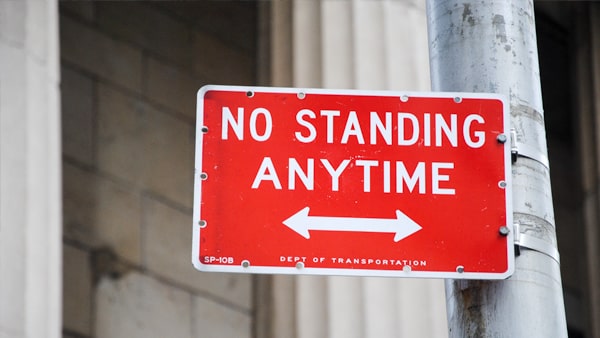
Which action is specifically prohibited by a NO STANDING ANY TIME sign?

A "no standing sign" at a certain location means:
  1. A. Driving past the sign without stopping
  2. B. Stopping because a traffic signal is red
  3. C. Waiting there in a stationary vehicle while remaining inside
  4. D. Stopping when directed by a police officer

Correct answer: C. – Waiting there in a stationary vehicle while remaining inside

The Idaho-adopted traffic-control manual defines standing as keeping a vehicle stationary while the driver continues to occupy it. A NO STANDING ANY TIME sign prohibits that type of waiting. It does not prevent a stop required to avoid a traffic conflict or obey an official direction, and permission for passenger loading depends on the applicable sign and local law.

Source: Idaho Manual on Uniform Traffic Control Devices — § 2B.52, “Parking, Standing, and Stopping Signs (R7 and R8 Series)”

Question 3

In Idaho, what must you do when a stopped school bus is displaying its required visual signals?

When a school bus has its lights flashing and its Stop arm extended, you must:
  1. A. Stop before reaching the bus and remain stopped as required
  2. B. Pass after the children have stepped off the bus
  3. C. Proceed whenever you are traveling behind the bus
  4. D. Reduce speed and pass without stopping

Correct answer: A. – Stop before reaching the bus and remain stopped as required

Drivers meeting or overtaking a stopped school bus must stop before reaching it when the required visual signals are operating. They may proceed when the bus resumes moving or the signals are no longer activated. Oncoming traffic is not required to stop on a highway with more than three lanes, but traffic traveling in the bus’s direction must stop.

Source: Idaho Code § 49-1422 – Overtaking and Passing School Bus, Idaho Driver’s Handbook — “Traffic Laws & the Rules of the Road”

Question 4

What does a steady circular green signal allow you to do?

  1. A. Slow and prepare for an immediate red signal
  2. B. Stop before entering every intersection
  3. C. Proceed if you can clear the intersection and yield where required
  4. D. Proceed straight but never turn

Correct answer: C. – Proceed if you can clear the intersection and yield where required

A steady green signal permits forward movement through the intersection. In Idaho, a driver turning left must yield to oncoming traffic and pedestrians in crosswalks. Do not enter unless enough space is available on the far side for your vehicle to pass completely through without blocking the intersection.

Source: Idaho Code § 49-802 – Traffic-Control Signal Legend, Idaho Driver’s Handbook — “Traffic Signals”

Question 5

Which statement about properly worn seat belts is correct?

  1. A. They help only when traveling faster than 40 mph
  2. B. They offer no benefit in low-speed crashes
  3. C. They are unnecessary during city driving
  4. D. They reduce the risk of serious injury or death in a crash

Correct answer: D. – They reduce the risk of serious injury or death in a crash

Properly worn seat belts reduce the chance of serious or fatal injuries in crashes. They also help drivers remain in position to control the vehicle during sudden maneuvers or on rough roads. Idaho generally requires occupants of qualifying vehicles to keep their safety restraints properly fastened whenever the vehicle is moving, subject to listed exceptions.

Source: Idaho Code § 49-673 – Safety Restraint Use, Idaho Driver’s Handbook — “Seat Belts & Shoulder Straps”

Question 6

Red faces on bidirectional pavement markers along an exit ramp warn that you are:

  1. A. Approaching a signalized intersection
  2. B. Entering a no-parking area
  3. C. Traveling against the ramp’s lawful direction
  4. D. Entering an ordinary no-passing zone

Correct answer: C. – Traveling against the ramp’s lawful direction

Red-facing raised pavement markers may be used to warn a driver who has entered an exit ramp in the wrong direction. Correctly traveling drivers see the white side of the bidirectional markers. If the red sides face you, stop in a safe location and avoid continuing into opposing traffic.

Source: Idaho Manual on Uniform Traffic Control Devices — § 2B.48, “Wrong-Way Traffic Control at Interchange Ramps”