Idaho Practice Drivers Test 4

4.9 out of 5 (331 votes)
80% Passing score
20 Questions
4 Mistakes allowed
Idaho’s Class D knowledge test is based on the Idaho Driver’s Handbook, so that is where the real questions come from: road rules, signs, signals, pavement markings, safe driving habits, impaired driving, sharing the road, and the general responsibility that comes with being the person behind the wheel. This Idaho drivers license practice test stays close to that territory, but in a shorter, easier-to-use format that lets you check your understanding before you walk into a county driver’s license office and make the official attempt. The real Idaho DMV test has 40 questions. You need 34 correct answers to pass, which is 85%, and if you fail, Idaho requires a 3-day wait before you can retest. You also have to pay the knowledge test fee again, which is a small fee, sure, but still. Nobody enjoys paying twice for the privilege of being told they mixed up a sign shape or forgot a rule from page who-knows-where of the handbook. This practice drivers test gives you 20 multiple-choice questions, with a passing score of 16 correct answers. It is not trying to pretend it is the official exam. It is doing something more useful, frankly: giving you a controlled way to rehearse the material, notice weak spots, and fix them while there is still time to fix them. The questions cover Idaho driving rules and safety basics, with extra attention on child safety seats, because that is one of those topics people tend to wave off until the wording gets specific and suddenly the “obvious” answer is not quite so obvious. The visual aids help too, especially with road signs and safety details that are easier to recognize than memorize cold. And after each question, you get instant feedback with explanations, not just a silent wrong answer sitting there making you guess what happened. Keep the bigger licensing process in the back of your mind as well. New Idaho applicants, out-of-state transfer applicants, and drivers whose Idaho license has been expired for 25 months or more may need the Class D knowledge test. Idaho also expects new credential applicants to bring the right paperwork, including proof of age and identity, Social Security number verification, proof of Idaho residency, and, for drivers under 18, school compliance and a liability signer. That part is not exciting, no. It is also not the part you want to discover you missed while standing at the counter. Use this free Idaho driving test practice as a serious warm-up. A low-pressure one, yes, but still serious.
FREE DMV Practice Test App
Study for your Idaho permit test or driver’s license with the NextDoorDriving app. 700+ DMV questions and answers, 100% free!
Download on the App Store

Sample Idaho Permit Test Questions

Question 1

Orange-and-black warning signs usually indicate:

  1. A. A permanent recreational area
  2. B. A work zone with workers or temporary roadway conditions
  3. C. A high-occupancy vehicle lane
  4. D. A hospital or emergency facility

Correct answer: B. – A work zone with workers or temporary roadway conditions

Work zones are commonly identified by orange signs, cones, drums, barricades, and arrow panels. Orange-and-black warning signs may alert drivers to workers, equipment, uneven pavement, narrow lanes, or shifting traffic patterns. Pay attention to every sign and be prepared to slow or stop.

Source: Idaho Driver’s Handbook — Highway & Vehicle Knowledge, “Work Zone Signs”

Question 2

Before changing lanes on an Idaho controlled-access highway, how long must you signal?

When changing lanes on a freeway, you should:
  1. A. Continuously for at least five seconds
  2. B. Only while crossing the lane line
  3. C. Only after entering the new lane
  4. D. No signal is needed if you sound the horn

Correct answer: A. – Continuously for at least five seconds

A lane change must be reasonably safe and accompanied by an appropriate signal. On a controlled-access highway, the signal must operate continuously for at least five seconds before the movement. Check mirrors and the blind spot in the direction of travel, then enter the lane gradually when it is clear.

Source: Idaho Code § 49-808(1), (2) – Turning Movements and Required Signals, Idaho Driver’s Handbook — Freeway Driving, “Changing Lanes”

Question 3

Under Idaho law, you must switch from high beams when following another vehicle within how many feet?

  1. A. 200 feet
  2. B. 300 feet
  3. C. 400 feet
  4. D. 100 feet

Correct answer: A. – 200 feet

When following another vehicle within 200 feet, use a beam other than the uppermost high-beam setting, except while actively overtaking and passing. When meeting an oncoming vehicle, low beams are required within 500 feet. These requirements limit glare for other drivers.

Source: Idaho Code § 49-923(2), (3) – Use of Multiple-Beam Road-Lighting Equipment

Question 4

At 55 mph on an Idaho two-lane road, what must be true before you enter the opposing lane to pass?

  1. A. You can increase speed regardless of roadway conditions
  2. B. The roadway is clearly visible and open far enough to complete the pass and return before coming within 200 feet of oncoming traffic
  3. C. Solid double-yellow lines separate the lanes

Correct answer: B. – The roadway is clearly visible and open far enough to complete the pass and return before coming within 200 feet of oncoming traffic

The opposing lane must be clearly visible and free of traffic for enough distance to complete the pass without interfering with any vehicle. You must return to an authorized lane as soon as practicable and before coming within 200 feet of oncoming traffic. Solid double-yellow markings do not permit passing.

Source: Idaho Code § 49-634 – Limitations on Overtaking on the Left, Idaho Driver’s Handbook — Traffic Laws & the Rules of the Road, “Passing”

Question 5

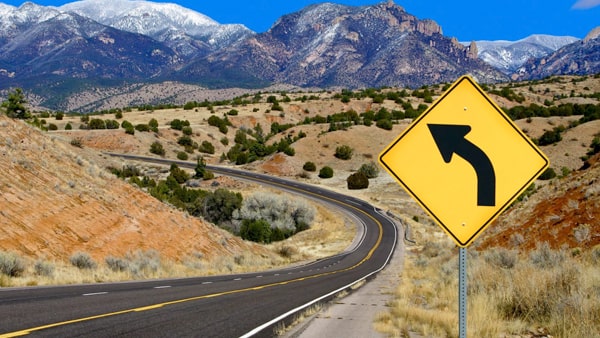
A yellow diamond sign showing a black arrow that bends to the left warns of:

This sign is used to warn drivers about:
  1. A. An intersection ahead
  2. B. Road construction ahead
  3. C. A left curve ahead
  4. D. A reduction in the number of lanes

Correct answer: C. – A left curve ahead

Yellow diamond-shaped signs warn drivers about unexpected roadway conditions. A black arrow bending left indicates that the road curves to the left ahead. Adjust your speed as needed before entering the curve and remain within your lane.

Source: Idaho Manual on Uniform Traffic Control Devices — Part 2C, “Warning Signs and Object Markers”, Idaho Driver’s Handbook — Highway & Vehicle Knowledge, “Warning Signs”

Question 6

When turning right from one two-way street onto another in Idaho, which lane should you enter?

  1. A. The left-hand lane
  2. B. The lane farthest from the curb
  3. C. The right-hand lane nearest the curb
  4. D. Any open lane

Correct answer: C. – The right-hand lane nearest the curb

Approach the turn in the right-hand lane and remain as close as practicable to the right curb or roadway edge. Enter the right-hand lane of the new street rather than swinging into another lane. Yield to pedestrians and other traffic with the right-of-way, and check for bicyclists between your vehicle and the curb.

Source: Idaho Code § 49-644(1)(a) – Required Position and Method of Turning, Idaho Driver’s Handbook — Traffic Laws & the Rules of the Road, “Right Turns”