


Idaho DMV Test Evaluation

4.6 out of 5 (1008 votes)
80% Passing score
10 Questions
2 Mistakes allowed
This Idaho DMV practice test gives you a clean, realistic read on where your permit-test knowledge stands before you deal with the official version at the county driver’s license office. It is a 10-question evaluation practice drivers test, with questions pulled from the same general territory Idaho expects you to know: traffic laws, road signs, signals, right-of-way rules, pavement markings, safe driving habits, impaired driving, and the basic responsibilities that come with being the person behind the wheel. You need 8 correct answers to pass this practice round, which is a decent little benchmark, even if it is not the whole mountain. The actual Idaho Class D knowledge test is bigger and stricter. It has 40 questions, and Idaho requires 34 correct answers to pass, so the real passing score is 85%. You can miss 6, not 8, which is a small detail that somehow becomes a much larger detail once you are taking the real DMV permit test. That is why this Idaho drivers license practice test works best as an early gauge. It tells you whether the material is settling in, and just as important, whether some of it is still floating around in that vague “I probably know this” zone. Expect road signs to matter. Idaho does not separate the standard Class D test into a neat little road-sign-only section with its own published passing score, but signs are still part of the knowledge test. Warning signs, regulatory signs, school zones, work zones, railroad crossings, traffic signals, sign colors and shapes: they all belong in the same pile of things Idaho can ask about. And, well, the pile is not tiny. There are also Idaho-specific licensing rules worth keeping in mind while you study. Applicants must pass a vision screening of at least 20/40 in one eye, with or without corrective lenses. If you fail the knowledge test, you wait 3 days, then pay the testing fee again. Drivers under 17 have extra requirements, including approved driver training and a supervised instruction period before licensing. Use this Idaho DMV practice test online as a serious warm-up, not a victory lap. It is short, yes, but it is built to expose the weak spots while they are still easy to fix.
FREE DMV Practice Test App
Study for your Idaho permit test or driver’s license with the NextDoorDriving app. 700+ DMV questions and answers, 100% free!
Download on the App Store

Sample Idaho Permit Test Questions

Question 1

Why should you maintain open space around your vehicle whenever possible?

Should you try to keep a "space cushion" around your vehicle whenever possible?
  1. A. It provides time and room to respond to a hazard or another driver’s mistake
  2. B. It prevents other vehicles from entering your lane
  3. C. It is useful only on city streets
  4. D. It is needed only when traffic is light

Correct answer: A. – It provides time and room to respond to a hazard or another driver’s mistake

Avoiding a collision requires time and room to react. Keep adequate space ahead and, when possible, on both sides and behind your vehicle. This space cushion provides room to stop, change position, or otherwise respond safely when traffic conditions change.

Source: Idaho Driver’s Handbook — Traffic Laws & the Rules of the Road, “Keep a Space Cushion”
Question 2

On an Idaho residential street, which action can help prevent a rear-end collision as you prepare to turn?

  1. A. Signal continuously for at least the last 100 feet before the turn
  2. B. Reduce the space between your vehicle and the vehicle ahead
  3. C. Tap the brakes repeatedly instead of signaling
  4. D. Slow abruptly without giving advance notice

Correct answer: A. – Signal continuously for at least the last 100 feet before the turn

For turns away from controlled-access highways, the signal must operate continuously during at least the last 100 feet before the turn. The signal warns surrounding traffic that you intend to change direction. Proper advance signaling gives a following driver more opportunity to respond to your slowing vehicle.

Source: Idaho Code § 49-808(2) – Turning Movements and Required Signals, Idaho Driver’s Handbook — Traffic Laws & the Rules of the Road, “Signaling”

Question 3

If alcohol will be served at an event, which transportation plan best protects against impaired driving?

  1. A. Drink coffee before driving home
  2. B. Ride with a friend who has not been drinking
  3. C. Take a cold shower before driving
  4. D. Stop drinking 30 minutes before leaving

Correct answer: B. – Ride with a friend who has not been drinking

Plan safe transportation before alcohol or drugs are consumed. The Idaho handbook recommends using a designated driver or arranging a ride to and from events where intoxicants are present. Coffee, cold showers, and briefly waiting after the last drink are not substitutes for a sober driver.

Source: Idaho Driver’s Handbook — What Affects Your Driving Privilege and Record, “Strategies to Prevent Impaired Driving”

Question 4

Before passing on an Idaho two-lane road, which condition must you verify?

  1. A. The vehicle ahead will maintain exactly the same speed
  2. B. The vehicle ahead will move aside when you signal
  3. C. There is enough clear roadway to pass safely and return before coming within 200 feet of oncoming traffic
  4. D. Oncoming drivers will slow down for your maneuver

Correct answer: C. – There is enough clear roadway to pass safely and return before coming within 200 feet of oncoming traffic

The passing lane must be visible and free of oncoming traffic for enough distance to complete the maneuver without interference. When using an opposing lane, the passing driver must return to an authorized lane before coming within 200 feet of an approaching vehicle. An overtaken driver also must not increase speed and, upon an audible signal, must give way to the right.

Source: Idaho Code § 49-634 – Limitations on Overtaking on the Left, Idaho Code § 49-632(1), (2) – Overtaking a Vehicle on the Left

Question 5

At an Idaho stop sign, where must you stop if there is no stop line but there is a marked crosswalk?

  1. A. Beside the stop sign
  2. B. Before entering the crosswalk on the near side of the intersection
  3. C. After the front wheels enter the crosswalk
  4. D. At least 15 feet before the corner

Correct answer: B. – Before entering the crosswalk on the near side of the intersection

When no marked stop line is present, stop before entering the crosswalk on the near side of the intersection. If there is neither a stop line nor a crosswalk, stop at the nearest point where you can see approaching traffic before entering the intersecting highway. After stopping, yield to traffic that presents an immediate hazard.

Source: Idaho Code § 49-807(2) – Stop Signs and Yield Signs

Question 6

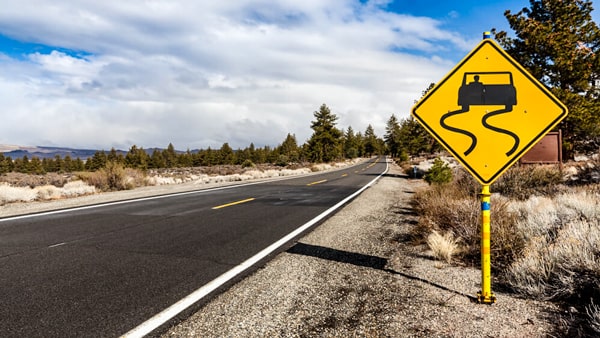
Which driving technique is safest on a slippery road?

When roads are slippery, you should:
  1. A. Look a shorter distance ahead
  2. B. Stop on a hill to test tire traction
  3. C. Reduce speed and make gentle stops and turns
  4. D. Maintain normal speed using cruise control

Correct answer: C. – Reduce speed and make gentle stops and turns

Slippery surfaces reduce the traction available for steering and braking. Drive more slowly, begin slowing much earlier than usual, and avoid sudden steering or braking movements. Gentle turns and stops reduce the chance that the tires will lose their grip on the roadway.

Source: Idaho Driver’s Handbook — Hazardous Conditions, “Winter Driving”