Missouri DMV Practice Test 7

4.8 out of 5 (156 votes)
80% Passing score
20 Questions
4 Mistakes allowed
Missouri permit prep is not just about recognizing a Stop sign or remembering who goes first at a four-way stop, although, yes, those details still matter. This 2026 Missouri DMV practice test gives you 20 questions built around the rules, signs, and everyday driving situations you are expected to know before you move toward a permit or license. Score 16 or higher, and you are in decent shape. Not finished, exactly — nobody should treat one practice test like a magic permission slip — but you will have a much clearer sense of whether the material is actually sticking. The Missouri part is important here. Driver testing and licensing are not handled by the same agency, which is one of those small administrative facts that can trip people up for no good reason. The Missouri State Highway Patrol gives the driver exam. The Department of Revenue issues the actual permit or license. After you pass the required tests, you receive a Driver Examination Record, and that record still has to go to a Missouri license office before anything becomes official. Also, for new drivers, the six-month GDL permit-holding period starts when the temporary instruction permit is issued, not when the test record is printed. It sounds like paperwork trivia until someone gets the timeline wrong. The questions in this Missouri DMV driving test practice are meant to keep you close to the real stuff: financial responsibility, proof of insurance, traffic laws, safe judgment, and road signs that you need to understand quickly, not after staring at them like they owe you money. It also gives you room to review Missouri’s hands-free electronic communication device rule. While driving, you cannot physically hold or support a phone, manually read or type messages, record or broadcast video, or watch videos while the vehicle is moving. Hands-free calls and voice-to-text are allowed, but the basic idea is pretty plain: keep the device out of your hands and your attention on driving. And then there is the skills test, which has its own quiet little scoring system. Missouri subtracts points for driving errors, and losing more than 30 points means failing. A crash you caused, hitting a pedestrian, dangerous driving, breaking traffic laws, or refusing instructions can also end the test. So use this Missouri practice permit test as a study tool, yes, but also as a reality check before the real DMV permit test.
FREE DMV Practice Test App
Study for your Missouri permit test or driver’s license with the NextDoorDriving app. 700+ DMV questions and answers, 100% free!
Download on the App Store

Sample Missouri Permit Test Questions

Question 1

A solid yellow center line is paired with a broken yellow line. When may you pass?

You may cross a double line to pass another vehicle if the line on your side is:
  1. A. When the solid line is on your side
  2. B. Whenever no vehicle is directly beside you
  3. C. When the broken line is on your side and the pass can be completed safely
  4. D. Only by driving onto the shoulder

Correct answer: C. – When the broken line is on your side and the pass can be completed safely

A broken line may be crossed for a passing maneuver, while a solid yellow line on your side marks a no-passing zone. Even with a broken line, the roadway ahead must be visible and free of oncoming traffic for enough distance to complete the pass safely. Never use the shoulder to pass.

Source: Mo. Rev. Stat. § 304.016.2, .3 – Passing regulations — violations, penalties, Missouri Driver Guide — Ch. 7, “Meanings of Pavement Markings”, Missouri Driver Guide — Ch. 7, “No Passing Zones”
Question 2

A pedestrian is crossing at an intersection without painted crosswalk lines. What should you do?

  1. A. Yield only if a crossing guard is present
  2. B. Yield when the pedestrian is on or approaching your side of the road
  3. C. Continue because an unmarked crossing gives no right-of-way
  4. D. Yield only if the intersection has traffic signals

Correct answer: B. – Yield when the pedestrian is on or approaching your side of the road

Drivers must recognize both marked and unmarked crosswalks. Yield when a pedestrian in a crosswalk is on your side of the road or approaching it closely enough to be endangered. Watch carefully at intersections even when no painted lines define the crossing area.

Source: Missouri Driver Guide — Ch. 4, “Sharing the Road with Pedestrians”, Missouri Driver Guide — Ch. 7, “Crosswalks and Stop Lines”

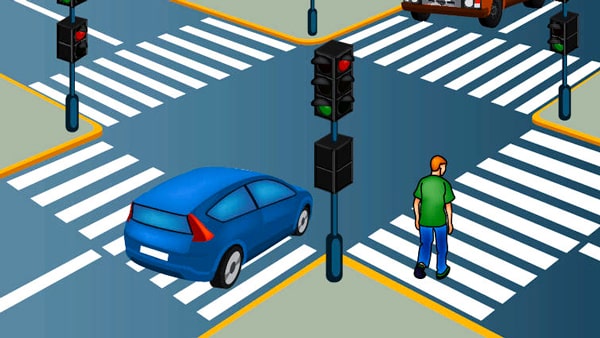
Question 3

Your circular signal turns green as a pedestrian enters the adjacent crosswalk. Before turning right, you must:

You are waiting at a red light to turn right, and a pedestrian on your right is waiting to cross the street you want to enter. Who has the right-of-way when your light turns green?
  1. A. Yield to the pedestrian
  2. B. Turn first because the light is green
  3. C. Yield only if the crosswalk is painted
  4. D. Sound your horn and continue

Correct answer: A. – Yield to the pedestrian

Missouri law allows a driver facing a circular green signal to proceed or turn unless a sign prohibits the movement. The turning driver must still yield to pedestrians lawfully within the intersection or an adjacent crosswalk. Wait until the pedestrian is clear of your intended path before completing the turn.

Source: Mo. Rev. Stat. § 304.281.1(1)(a), (c) – Rules for traffic where controlled by light signals — right turn on red light, when — violations, penalty

Question 4

How should you position the driver's seat before moving the vehicle?

  1. A. Recline it until your arms are fully extended
  2. B. Sit upright, close enough to reach the pedals, with your elbows in front of you
  3. C. Move it as far from the controls as possible
  4. D. Raise it until your feet no longer rest near the floor controls

Correct answer: B. – Sit upright, close enough to reach the pedals, with your elbows in front of you

Good driving posture helps you remain alert and maintain control of the vehicle. Sit upright with your back against the seat and position yourself close enough to reach the pedals easily. You should still be far enough from the steering wheel that your elbows remain in front of you while holding it.

Source: Missouri Driver Guide — Ch. 8, “Proper Posture While Driving”

Question 5

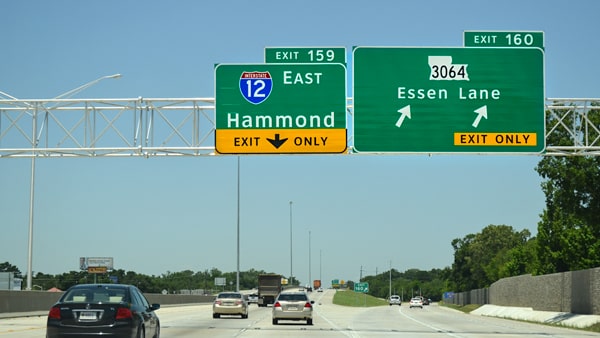
An overhead sign shows that your freeway lane serves only the upcoming exit. If you remain in that lane, you must:

If you see this sign above your lane, you:
  1. A. Stop before reaching the interchange
  2. B. Continue straight through the interchange
  3. C. Merge onto the shoulder
  4. D. Take the exit

Correct answer: D. – Take the exit

Overhead lane-control signs identify the movement permitted from each lane. If the sign shows that your lane is assigned only to the exit, staying in that lane will take you off the freeway. Move safely into a through lane well before the interchange if you intend to continue on the highway.

Source: Missouri Driver Guide — Ch. 7, “Lane Control”, Missouri Driver Guide — Ch. 6, “Leaving the Highway”

Question 6

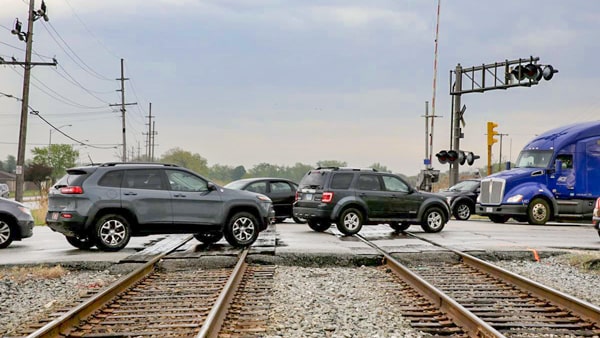
Congested traffic is backed up beyond a railroad crossing. When may you enter the crossing?

When traffic is slow and heavy and you must cross railroad tracks before reaching the upcoming intersection, you should:
  1. A. As soon as the vehicle ahead begins moving
  2. B. When the crossing lights are not flashing, even if traffic is stopped ahead
  3. C. Only when enough space is available to clear the tracks completely
  4. D. After sounding your horn

Correct answer: C. – Only when enough space is available to clear the tracks completely

Missouri law prohibits driving through a railroad crossing unless sufficient space exists to clear it completely. Wait before the tracks when congestion would force you to stop on them. Enter only after enough room opens on the far side for your entire vehicle.

Source: Mo. Rev. Stat. § 304.035.3 – Stop required at railroad grade crossing, when — commercial motor vehicles, speed at crossings — penalty