


Missouri Permit Practice Test 2

4.8 out of 5 (409 votes)
80% Passing score
20 Questions
4 Mistakes allowed
A Missouri permit practice test is most useful when it feels close enough to the real exam to expose what you actually know, not just what sounded familiar when you skimmed the guide. The official Class F written test is one part of Missouri’s driver examination process, along with the vision test, road sign test, and driving skills test. The testing itself goes through the Missouri State Highway Patrol, while the Department of Revenue handles the permit or license after you pass and bring in your Driver Examination Record. That little handoff matters, mostly because passing the test is not the same thing as already being legal to drive. This MO DMV practice test focuses on the written knowledge portion. The real Class F exam has 25 multiple-choice questions, and you need 20 correct answers to pass, which is 80%. Once you miss 6, that attempt is done. The questions come from the Missouri Driver Guide, and the coverage is broader than a few road signs and common-sense reminders. You are expected to understand traffic laws, safe driving practices, roadway markings, signs and signals, sharing the road, alcohol and drug rules, distracted driving, electronic communication restrictions, and the basic equipment and operation rules that tend to blend together if you study too quickly. This second Missouri learners permit practice test gives you 20 varied questions built around those same kinds of topics. Some questions may feel straightforward at first glance, and then — well, there is usually one detail doing more work than you expected. Seat belt requirements, right-of-way decisions, following distance, sign meaning, lane use, and ordinary safety rules all deserve more attention than people usually give them. That is the point of practicing before the official test, not after you have already donated an afternoon to a failed attempt. The test can be taken more than once, which is useful in a very practical, unglamorous way. If you get stuck, the hint can push you in the right direction without just handing over the answer. When you miss something, the explanation helps tie the correct answer back to the rule, so you are not just memorizing letters on a screen. Teen applicants can apply for a Class F instruction permit at 15 after passing the required written, vision, and road sign tests, with the proper adult signing permission at the license office. Adults seeking a first Missouri Class F license still need to satisfy the required testing unless a waiver applies. Either way, this practice permit test gives you a cleaner, more focused way to find weak spots before the official Missouri knowledge test makes them obvious.
FREE DMV Practice Test App
Study for your Missouri permit test or driver’s license with the NextDoorDriving app. 700+ DMV questions and answers, 100% free!
Download on the App Store

Sample Missouri Permit Test Questions

Question 1

You are preparing to turn right while a pedestrian using a guide dog begins crossing in front of you. What should you do?
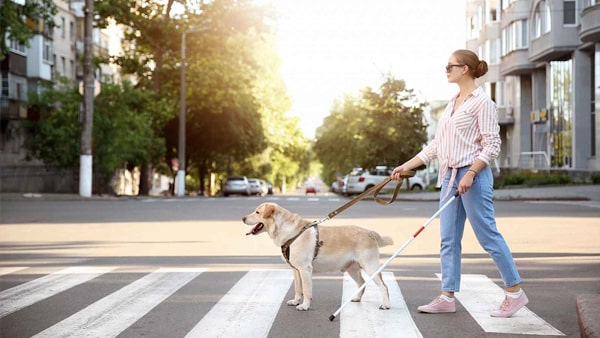
You want to make a right turn at the corner. A pedestrian with a guide dog is at the corner ready to cross the street in front of you. Before making your right turn, you should:
  1. A. Turn before the pedestrian reaches your lane
  2. B. Honk so the pedestrian knows when to stop
  3. C. Remain stopped and allow the pedestrian to clear your path
  4. D. Tell the pedestrian when it is safe to cross

Correct answer: C. – Remain stopped and allow the pedestrian to clear your path

Remain stopped and yield while the pedestrian crosses your path. Drivers must take necessary precautions when approaching a person using a guide dog or qualifying white cane. The driver guide also warns motorists making right turns to watch carefully for pedestrians approaching from the right.

Source: RSMo § 304.080 – Handicapped persons with white cane or dog, driver to take all necessary precautions — cane or dog not required to enforce rights, when, Missouri Driver Guide — Ch. 4, “Sharing the Road With Pedestrians”

Question 2

Glare from approaching headlights makes it difficult to judge your lane position. What roadway reference should you use?

When a car with bright headlights comes toward you at night, you should:
  1. A. The headlights of the approaching vehicle
  2. B. The pavement directly beneath the approaching vehicle
  3. C. The far side of the opposing lane
  4. D. The edgeline on your side of the road

Correct answer: D. – The edgeline on your side of the road

Oncoming headlight glare can make the roadway harder to see. Use the edgeline as a guide while continuing to monitor the road ahead. You should also use low beams within 500 feet of an approaching vehicle and drive slowly enough to stop within the area illuminated by your headlights.

Source: Missouri Driver Guide — Ch. 9, “Night Driving”

Question 3

After a train passes at a crossing with multiple tracks, what must you verify before proceeding?

  1. A. That the first train has cleared your lane
  2. B. That the train is completely out of sight
  3. C. That no train is approaching on any track and the crossing is clear
  4. D. That another vehicle has crossed ahead of you

Correct answer: C. – That no train is approaching on any track and the crossing is clear

Do not proceed until you can cross safely and there is enough space beyond the tracks for your entire vehicle. At a crossing with two or more tracks, look for another train before moving. A violation of Missouri’s railroad-crossing requirements under this section is a class C misdemeanor.

Source: RSMo § 304.035.1, .3, .6 – Stop required at railroad grade crossing, when — commercial motor vehicles, speed at crossings — penalty, Missouri Driver Guide — Ch. 7, “Railroad Crossing”

Question 4

An oncoming driver unexpectedly begins turning left across your path. How should you respond?

  1. A. Maintain speed because the other driver must yield
  2. B. Slow down or stop as needed to avoid a collision
  3. C. Honk while continuing at the same speed
  4. D. Accelerate through the conflict area

Correct answer: B. – Slow down or stop as needed to avoid a collision

The left-turning driver is required to yield to oncoming traffic that presents an immediate hazard. If that driver turns anyway, slow or stop as necessary to prevent a crash. Missouri’s defensive-driving guidance states that a driver should not intentionally allow a collision merely because another road user failed to yield.

Source: RSMo § 304.351.3 – Right-of-way at intersection — signs at intersections — violation, penalty — additional penalties — definitions — order of suspension, contents, appeal, Missouri Driver Guide — Ch. 8, “Defensive Driving”

Question 5

What action lets you check an area that is hidden from your mirrors before changing lanes?

  1. A. Look only in the inside rearview mirror
  2. B. Move closer to the vehicle ahead
  3. C. Briefly look over the appropriate shoulder
  4. D. Look straight ahead while signaling

Correct answer: C. – Briefly look over the appropriate shoulder

Blind spots are areas that cannot be seen in the rearview mirrors. Before changing lanes, use the inside and side mirrors and briefly look over the appropriate shoulder. Keep the shoulder check brief so that you can quickly return your attention to the roadway ahead.

Source: Missouri Driver Guide — Ch. 6, “Passing on Highways”

Question 6

In Missouri, what must a driver do when approaching a pedestrian using a qualifying white cane or guide dog?

  1. A. Yield only at a signal-controlled intersection
  2. B. Yield and take the precautions needed to protect the pedestrian
  3. C. Proceed if the pedestrian has not entered the driver’s lane
  4. D. Honk before passing the pedestrian

Correct answer: B. – Yield and take the precautions needed to protect the pedestrian

A driver approaching a person using a predominantly white or metallic cane, with or without a red tip, or a guide dog must yield. The driver guide directs vehicles to stop when such a pedestrian is crossing a street or highway. A driver who fails to take the required precautions may be liable for resulting injuries.

Source: RSMo § 304.080 – Handicapped persons with white cane or dog, driver to take all necessary precautions — cane or dog not required to enforce rights, when, Missouri Driver Guide — Ch. 4, “Sharing the Road With Pedestrians”