Wyoming Practice Permit Test 6

5 out of 5 (39 votes)
80% Passing score
20 Questions
4 Mistakes allowed
This Wyoming DMV practice test gives you a focused way to study before taking the real written exam. It is the sixth test in our Wyoming permit practice test series, with 20 multiple-choice questions covering the rules and driving judgment you are expected to know. To pass, aim for at least 16 correct answers. That number matters because it keeps the practice test from turning into casual clicking, which, let’s be honest, is how a lot of people accidentally “study” until the real test suddenly feels much less casual. This test puts extra attention on turn signals, and that is not just filler. Signaling is one of those basic driving topics that seems too obvious to study, then shows up in questions about lane changes, turns, merging, parking, traffic circles, and communicating with drivers who cannot read your mind. Wyoming roads add their own little personality to the situation, too. You may be dealing with icy highways near Jackson, wind along I-25 near Cheyenne, long rural stretches, or wildlife that has absolutely no interest in your schedule. Good signaling, safe spacing, right-of-way awareness, and speed control all matter more when the road around you is not doing anything politely. The real Wyoming permit test is administered through WYDOT Driver Services using the state’s automated testing system. WYDOT does not release the exact questions, so this WY permit test practice is built around the same topics and concepts rather than pretending it has a secret answer key tucked in a drawer somewhere. The point is to get familiar with the phrasing, the answer choices, and the kind of driving situations you are likely to see on the actual permit test. The written exam is only part of getting licensed in Wyoming. Applicants also complete a vision screening, generally needing 20/40 vision or better with both eyes, with or without correction, plus the required field of vision. Glasses, contacts, or a bioptic lens may lead to a corrective-lenses restriction, and some drivers may receive additional limits based on a specialist’s recommendation. For the skills test, you bring your own properly licensed, registered, and insured vehicle, and WYDOT expects it to be in working order — brakes, lights, mirrors, tires, horn, windshield wipers, seat belts, doors, and turn signals included. Some exam offices require appointments. Written tests are in English, with oral-audio testing available for applicants who have difficulty reading, and interpreters may be allowed for non-commercial tests. You may also need documents showing identity, legal presence, Wyoming residency, and Social Security number information. Use this Wyoming DMV practice test as a rehearsal, not a lucky guess machine. The more familiar the questions feel now, the less strange the real test will feel later.

FREE DMV Practice Test App
Study for your Wyoming permit test or driver’s license with the NextDoorDriving app. 700+ DMV questions and answers, 100% free!
Download on the App Store

Sample Wyoming Permit Test Questions

Question 1

Under Wyoming law, how far before a turn must a required turn signal be given continuously?

  1. A At least 50 feet
  2. B At least 100 feet
  3. C At least 300 feet
  4. D At least 400 feet

Correct answer: B – At least 100 feet

A required right- or left-turn signal must operate continuously during at least the last 100 feet traveled before the turn. Signaling early enough gives other road users notice of the intended movement. The turn itself must also be capable of being made with reasonable safety.

Source: W.S. 31-5-217(a), (b) – Turning movements and required signals

Question 2

Before starting down a steep grade covered with snow or ice, you should:

  1. A Follow another vehicle closely for traction
  2. B Accelerate before beginning the descent
  3. C Select an appropriate lower gear
  4. D Shift into neutral and coast

Correct answer: C – Select an appropriate lower gear

Select an appropriate low gear before starting down a steep grade, rather than attempting to shift after speed has built up. A lower gear provides engine braking and helps control speed. On snow or ice, slow down and avoid sudden changes in speed or direction.

Source: 2024 Wyoming Commercial Driver License Manual — § 2.16.2, “Select the Right Gear Before Starting Down the Grade”, Wyoming Rules of the Road — “Slippery surfaces,” “Snow or ice”

Question 3

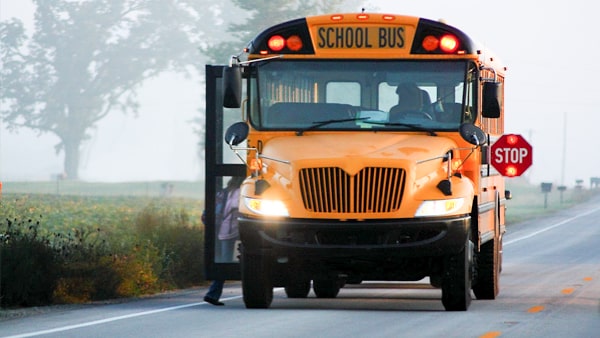
A school bus stops on a two-lane highway with its red lights flashing. What must an approaching driver traveling in the opposite direction do?

If a school bus stops to unload children on a two-lane highway, vehicles traveling in the opposite direction are:
  1. A Continue without stopping
  2. B Signal and pass at reduced speed
  3. C Stop, then proceed immediately at low speed
  4. D Stop until the bus moves or the red lights stop flashing

Correct answer: D – Stop until the bus moves or the red lights stop flashing

In Wyoming, drivers meeting or overtaking a stopped school bus from either direction must stop when its red lights are flashing. Drivers must remain stopped until the bus resumes motion or the red lights are no longer operating. The exception for a bus on a different roadway of a divided highway does not apply to an ordinary two-lane highway.

Source: W.S. 31-5-507(a), (d) – Meeting or passing stopped school bus; markings and visual signals

Question 4

The two-second following-distance check described in the Wyoming driver manual measures the space:

  1. A Beside your vehicle
  2. B Ahead of your vehicle
  3. C Behind your vehicle
  4. D Equally in every direction

Correct answer: B – Ahead of your vehicle

The time-based following check measures the cushion between your vehicle and the vehicle ahead. Begin counting when the other vehicle passes a fixed point and stop when your vehicle reaches it. Increase the following time substantially when rain, snow, ice or other conditions increase stopping distance.

Source: W.S. 31-5-210(a) – Following too closely, Wyoming Rules of the Road — “It makes sense to INCREASE your following distance”

Question 5

Which statement about safety-belt use in Wyoming is correct?

  1. A Belts are required only above 40 mph
  2. B Belts are unnecessary at low speeds
  3. C Belts are required only within cities
  4. D Belts must be worn regardless of speed when the law applies

Correct answer: D – Belts must be worn regardless of speed when the law applies

Each driver and passenger must wear a properly adjusted and fastened safety belt while a motor vehicle is moving on public streets and highways, subject to statutory exceptions. The requirement applies without regard to speed or whether the road is urban or rural. Proper child restraints are governed by separate requirements.

Source: W.S. 31-5-1402(a), (b) – Safety belts required to be used; exceptions; reduction in fine

Question 6

During heavy rain, tires riding on a thin film of roadway water can cause:

  1. A Improved steering response
  2. B Shorter stopping distance
  3. C Hydroplaning
  4. D Increased tire traction

Correct answer: C – Hydroplaning

Hydroplaning occurs when tires ride on a film of water instead of maintaining normal contact with the roadway. This reduces the traction needed for steering and braking. Slow down on wet roads, use low-beam headlights and increase the space between your vehicle and the one ahead.

Source: Wyoming Rules of the Road — “Slippery surfaces,” “Rain”