


Alabama DMV Sign Test 3

4.9 out of 5 (97 votes)
80% Passing score
20 Questions
4 Mistakes allowed
Getting ready for the Alabama driver’s license test sounds simple enough until you realize road signs are not just cute little roadside suggestions. They are part of the real Alabama knowledge test, right there alongside traffic laws and safe-driving rules, and the exam is based on the Alabama Driver Manual. Alabama does not make most Class D applicants take a separate road-sign-only test, which is nice, technically. But road signs still count toward your overall score, so ignoring them would be a strange little gamble. This Alabama DMV road signs test gives you 20 multiple-choice questions focused on the signs, shapes, markings, and signals Alabama drivers are expected to understand before they get too comfortable behind the wheel. You will review regulatory signs, warning signs, guide and informational signs, pavement markings, traffic signals, and roundabout rules, because apparently the road has opinions and it shares them through shapes and colors. To pass this practice permit test, you need at least 16 correct answers out of 20. The test also gets into the stuff that trips people up when they think they “basically" know signs. Sure, a Stop sign is not exactly a mystery novel. A triangular Yield sign is pretty recognizable too. But then come the less flashy signs, the ones that warn you about lane changes, curves, crossings, restrictions, and all the tiny details you only notice when a question makes you choose between two answers that both feel annoyingly possible. As you move through the Alabama DMV practice test, you get instant feedback after each question. Miss one, and you will see the correct answer with an explanation, which is better than finding out later at the ALEA office while mentally replaying your life choices. At the end, you get a results summary showing what you got right and what needs another look. Whether you are 15 and working toward a restricted learner license, 16 or older and getting ready for a learner license, or an adult applicant who just needs to pass the required exam, this Alabama road sign test helps you study the part of driving that is everywhere, all the time, quietly judging you from the shoulder.
FREE DMV Practice Test App
Study for your Alabama permit test or driver’s license with the NextDoorDriving app. 700+ DMV questions and answers, 100% free!
Download on the App Store

Sample Alabama Permit Test Questions

Question 1

In Alabama, what does a yellow-painted curb indicate?

  1. A. Parking beside the curb is prohibited
  2. B. The space is reserved for commercial vehicles
  3. C. Only vehicles displaying disability credentials may park there

Correct answer: A. – Parking beside the curb is prohibited

The driver manual lists a yellow-painted curb as a place where parking is prohibited. A driver must also follow any official parking signs posted at the location. Disability and commercial loading spaces require their own designated signs or markings.

Source: Alabama Driver Manual — Ch. 3, “Parking”
Question 2

When red warning lights flash at a railroad grade crossing, you must:

  1. A. Stop only when a train is visible
  2. B. Stop exactly 10 feet from the nearest rail
  3. C. Stop and wait until the lights stop and the tracks are clear
  4. D. Reduce speed and cross without stopping

Correct answer: C. – Stop and wait until the lights stop and the tracks are clear

Alabama law requires a driver to stop between 15 and 50 feet from the nearest rail when a signal warns of an approaching train. Do not proceed until crossing can be completed safely. Where gates accompany the lights, remain stopped until the gates are raised and the lights have stopped flashing.

Source: Ala. Code § 32-5A-150 – Obedience to Signal Indicating Approach of Train, Alabama Driver Manual — Ch. 4, “Railroad Crossings—Advanced Warnings”

Question 3

On a two-lane, two-way road, yellow centerline markings divide:

  1. A. Traffic traveling in opposite directions
  2. B. Lanes carrying traffic in the same direction
  3. C. The roadway from the right shoulder
  4. D. A bicycle lane from a travel lane

Correct answer: A. – Traffic traveling in opposite directions

A centerline runs through the middle of a two-way road and separates opposing traffic. The driver manual specifies yellow centerlines on two-lane highways. Whether passing is permitted depends on whether the yellow marking is broken or solid.

Source: Alabama Driver Manual — Ch. 5, “Pavement Markings”

Question 4

What do two solid yellow centerlines indicate?

  1. A. A center turn lane begins
  2. B. A bicycle lane borders the roadway
  3. C. Both lanes carry traffic in the same direction
  4. D. Opposing traffic is separated, and passing is prohibited both ways

Correct answer: D. – Opposing traffic is separated, and passing is prohibited both ways

Two solid yellow lines separate vehicles traveling in opposite directions and prohibit passing across the centerline in both directions. The driver manual’s pavement diagrams allow crossing such lines only as part of a left-turn maneuver. They do not mark lanes carrying traffic in the same direction.

Source: Alabama Driver Manual — Ch. 5, “Pavement Markings”

Question 5

A yellow diamond warning sign shows one vertical arrow pointing up and another pointing down. Which sign is this?

  1. A. Lane Ends
  2. B. Divided Highway Ends
  3. C. Two-Way Traffic
  4. D. Turn Left or Right

Correct answer: C. – Two-Way Traffic

In Alabama, the opposing-arrow warning sign marks the beginning of two-way traffic or reminds drivers that they are traveling on a two-way road. It may appear where a separated one-way roadway ends. Drivers should recognize that opposing vehicles will use the other side of the roadway.

Source: Alabama Driver Manual — Ch. 5, “Warning Signs”

Question 6

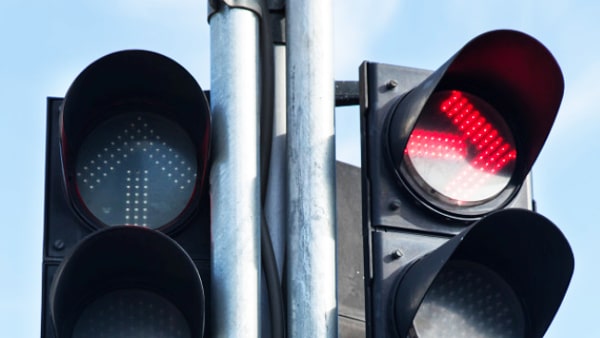
Under Alabama law, what may you do at a steady red arrow pointing right?

A red arrow pointing to the right on a traffic light means you may:
  1. A. Turn without stopping whenever the roadway looks clear
  2. B. Stop, then turn right unless a sign prohibits it, after yielding as required
  3. C. Wait for a green signal in every situation
  4. D. Follow the arrow without yielding to other road users

Correct answer: B. – Stop, then turn right unless a sign prohibits it, after yielding as required

The traffic-signal statute applies to colored lighted arrows and requires a stop for a steady red signal. After stopping, a right turn is permitted unless a sign prohibits it. The turning driver must yield to pedestrians in an adjacent crosswalk and to traffic lawfully using the intersection.

Source: Ala. Code § 32-5A-32(3)(a)–(b) – Traffic-Control Signal Legend