Connecticut DMV Practice Test 2

4.8 out of 5 (674 votes)
80% Passing score
20 Questions
4 Mistakes allowed
Connecticut takes the learner’s permit process seriously, and honestly, it should. Before you get anywhere near a road test, you have to pass the 25-question written knowledge test.  This free Connecticut permit test practice is built to help you walk into the CT DMV permit test with a better sense of what you actually know. It gives you 20 questions covering the rules that matter on Connecticut roads: seat belt laws, road signs, safe driving habits, and those everyday driving situations that can get worded in a slightly sideways way on the real DMV knowledge test. Not super hard, but easy to underestimate. Teen applicants who are 16 or 17 need to schedule an in-person knowledge-test appointment, bring the right identity documents, complete the application form, and have parental consent handled if a parent or legal guardian is not coming along. Adults 18 and older usually need an adult learner’s permit before getting a first Connecticut driver’s license, unless they are transferring a valid license from somewhere that qualifies. That adult permit is valid for 2 years, and most adults must hold it for at least 90 days before taking the road test. A bit of waiting, a bit of paperwork, the usual ritual. The official Connecticut learner’s permit test is not something you take from the couch. Testing is done in person, by appointment, at select DMV offices. Before the appointment, applicants are expected to complete the Connecticut Work Zone Safety Course, bring the certificate, show up with original documents, and pay the $40 license exam fee. After passing, the Class D learner’s permit costs $19. Fail the knowledge test, and you wait 7 days, reschedule, and pay the testing fee again. That is the part worth avoiding. This CT DMV practice test is free, works on a phone, tablet, or desktop, and includes visual learning aids where they actually help instead of just decorating the page. It is not a replacement for driver education or the Connecticut Driver’s Manual. Still, as a DMV permit practice test, it is a sharp way to find weak spots before the real Connecticut DMV learners permit test starts counting your mistakes.
FREE DMV Practice Test App
Study for your Connecticut permit test or driver’s license with the NextDoorDriving app. 700+ DMV questions and answers, 100% free!
Download on the App Store

Sample Connecticut Permit Test Questions

Question 1

A moving passenger vehicle has its four-way emergency flashers operating. What is the driver signaling?

If you see warning hazard lights on a moving passenger vehicle, it means:
  1. A The vehicle has priority over other traffic
  2. B All approaching vehicles must stop immediately
  3. C The vehicle is experiencing trouble or another emergency condition
  4. D The vehicle is preparing to make a normal turn

Correct answer: C – The vehicle is experiencing trouble or another emergency condition

Connecticut's manual directs drivers to activate emergency flashers when they are having vehicle trouble. The lights warn other road users that the vehicle may be moving unusually, slowing, or stopping. Drivers approaching such a vehicle should remain alert and adjust their speed or position as conditions require.

Source: State of Connecticut Driver's Manual — “Use Emergency Signals”
Question 2

Which scanning habit gives you the most time to respond to changing traffic conditions?

  1. A Looking well beyond the vehicle directly ahead
  2. B Watching only the rear of the vehicle ahead
  3. C Focusing continuously on the right edge of your lane
  4. D Focusing continuously on the centerline

Correct answer: A – Looking well beyond the vehicle directly ahead

Looking well down the road helps you identify traffic, people, signs, and other potential problems before you reach them. It gives you more time to slow, stop, or change lanes gradually. Continue checking nearby traffic and your mirrors rather than fixing your eyes on only one vehicle or location.

Source: State of Connecticut Driver's Manual — “Scanning,” “Look Ahead”

Question 3

Under Connecticut law, failure to wear a required seat belt:

You must use your seat belt:
  1. A Is permitted when a vehicle has air bags
  2. B Applies only to the vehicle's driver
  3. C Can result in a citation and fine
  4. D Is an offense only on interstate highways

Correct answer: C – Can result in a citation and fine

Connecticut requires drivers and passengers to use seat belts, subject to limited statutory exceptions. A violation by an operator who is at least 18, or a passenger in that operator's vehicle, carries a $50 fine. An operator under 18 and passengers in that vehicle are subject to a $75 fine for violations.

Source: CGS § 14-100a(c) – Seat safety belts, State of Connecticut Driver's Manual — “Connecticut Seat Belt Laws”

Question 4

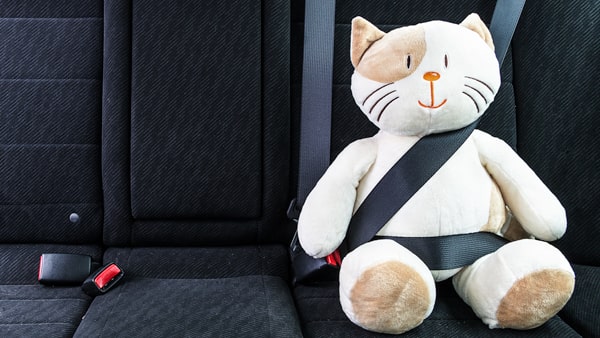
What is a primary benefit of wearing a seat belt correctly?

  1. A It prevents all crashes
  2. B It reduces the chance of being injured or killed in a crash
  3. C It prevents the driver from operating vehicle controls
  4. D It increases the force placed on the occupant

Correct answer: B – It reduces the chance of being injured or killed in a crash

A properly worn lap-and-shoulder belt helps keep an occupant inside the vehicle and in a safer position during a crash. Seat belts substantially reduce the chance of injury or death, but they do not prevent the collision itself. The shoulder belt should not be placed behind the back or under the arm.

Source: State of Connecticut Driver's Manual — “Seat Belt Safety Tips”

Question 5

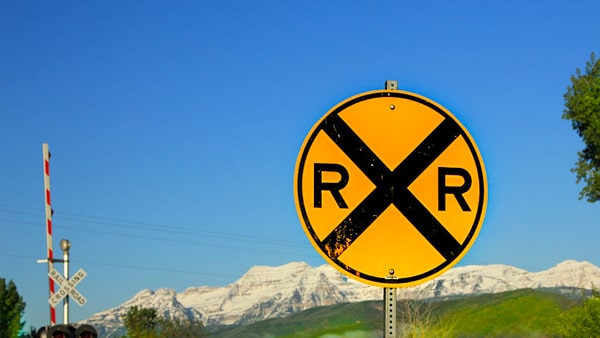
A round yellow sign displaying a black X and the letters “RR” warns that you are approaching:

This sign is a warning that you are approaching:
  1. A A four-way intersection
  2. B A pedestrian crossing
  3. C A railroad crossing
  4. D A blasting area

Correct answer: C – A railroad crossing

A circular yellow warning sign indicates that a railroad crossing is ahead. Slow down and look and listen for trains as you approach. Never begin crossing unless there is sufficient room on the far side for your entire vehicle to clear the tracks.

Source: State of Connecticut Driver's Manual — “Traffic Signs,” “Circle: Railroad Crossing”, State of Connecticut Driver's Manual — “Railroad Crossing Signs”

Question 6

A local traffic authority has marked an area as “No Parking” with curb or pavement markings. What must you do?

  1. A Keep the vehicle out of the marked area
  2. B Park there for no more than five minutes
  3. C Park there only while the engine is running
  4. D Use the area whenever nearby spaces are occupied

Correct answer: A – Keep the vehicle out of the marked area

In Connecticut, local authorities may designate curb markings, fire lanes, and pavement markings as No Parking areas. A driver must obey the restriction rather than treating the markings as a short-term loading area. Other signs may also prohibit or limit parking, and those posted instructions must be followed.

Source: State of Connecticut Driver's Manual — “Pavement Markings,” “Other Markings”, State of Connecticut Driver's Manual — “Parking,” “No-Parking Zones”