Connecticut DMV Sign Test 3

4.9 out of 5 (199 votes)
80% Passing score
20 Questions
4 Mistakes allowed
The Connecticut DMV road signs test is one of those things people tend to underestimate, mostly because signs feel familiar. You see them every day. Stop, yield, merge, school zone, lane ends. Fine. Except on the actual Connecticut learner’s permit knowledge test, “familiar” is not quite enough. You need to know what the sign means, what its shape tells you before you can read it, and how it fits into the wider rules from the Connecticut Driver’s Manual. This CT DMV road signs test gives you focused practice on the sign shapes, colors, and meanings that show up as part of the real permit test. Connecticut does not use a separate road-sign-only test for a standard Class D learner’s permit, which is worth knowing before you start studying in the wrong direction. Road sign questions are folded into the main 25-question knowledge test, along with traffic laws, safe driving rules, work zones, sharing the road, and driver responsibilities. You need 20 correct answers to pass, so you can miss up to 5 questions. That sounds like a little breathing room. It is, but not enough to treat signs like filler. This Connecticut road sign recognition test includes 20 questions, and the point is not just memorizing that an octagon means stop or a triangle means yield, although yes, please know those. The point is getting faster and more certain with the signs you’ll see on Connecticut roads: tight town streets, rural backroads, construction zones that appear at the least convenient moment, and I-95 ramps where the pace gets very real, very quickly. And there’s a bit of DMV housekeeping here, because there always is. Before taking the official knowledge test, Connecticut learner’s permit applicants must complete the free online Work Zone Safety Course, beginning January 1, 2026, and bring the printed completion certificate to DMV. You’ll also need to pass a vision test first, with glasses or contacts if you use them. Don't forget identity documents, Form R-229 for teen applicants, parental consent when required, and whatever else is sitting in that paperwork pile.  For now, practice. This test works online from your phone, desktop, or app, so you can study in small, realistic chunks instead of saving everything for one overconfident night before your appointment. That strategy has a reputation, and not a great one.

FREE DMV Practice Test App
Study for your Connecticut permit test or driver’s license with the NextDoorDriving app. 700+ DMV questions and answers, 100% free!
Download on the App Store

Sample Connecticut Permit Test Questions

Question 1

In Connecticut, what must you do before turning right at a steady red light when no sign prohibits the turn?

  1. A Stop and yield to pedestrians and other traffic
  2. B Wait for a red right-turn arrow
  3. C Move into the left lane
  4. D Slow down without stopping

Correct answer: A – Stop and yield to pedestrians and other traffic

A driver in the travel lane nearest the right edge may turn right on red unless an approved sign prohibits the movement. The driver must first stop and yield to pedestrians in the adjacent crosswalk and to traffic lawfully using the intersection. The turn may be made only with caution.

Source: C.G.S. § 14-299(b)(3) – Traffic control signals. Right turn on red

Question 2

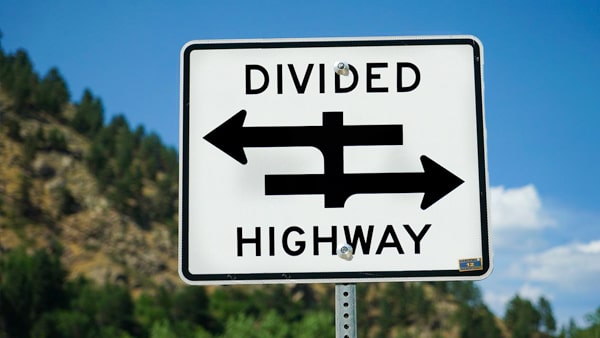
A rectangular sign showing two opposing arrows separated by a median symbol indicates that:

This sign means:
  1. A You must turn at the next intersection
  2. B You are approaching a T-intersection
  3. C The road ahead intersects a divided highway
  4. D The road passes over a divided highway

Correct answer: C – The road ahead intersects a divided highway

The Divided Highway Crossing sign warns that the road ahead meets a highway divided by a median or other physical separation. The crossing functions as two separate intersections because each roadway carries traffic on its own side of the divider. Watch the directional signs and permitted movements at each roadway.

Source: Conn. Agencies Regs. § 14-298-500 – Uniformity, Manual on Uniform Traffic Control Devices for Streets and Highways, 11th ed. — § 2B.50, “Divided Highway Crossing Signs (R6-3 and R6-3a)”

Question 3

Red raised pavement markers face you as you enter a one-way roadway or ramp. What do they indicate?

  1. A A busy intersection is ahead
  2. B A stop sign is nearby
  3. C You are traveling in a prohibited direction
  4. D A passing restriction is beginning

Correct answer: C – You are traveling in a prohibited direction

Connecticut pavement markings follow the adopted federal traffic-control standards. Red raised markers facing a driver may delineate a one-way roadway, ramp, or travel lane that must not be entered from that direction. Correct your direction safely and obey any DO NOT ENTER or WRONG WAY signs.

Source: Conn. Agencies Regs. § 14-298-600 – Uniformity, Manual on Uniform Traffic Control Devices for Streets and Highways, 11th ed. — § 3A.03, “Colors”

Question 4

Under normal signal control in Connecticut, when may you make a left turn while facing a steady red light?

  1. A When no opposing traffic is visible
  2. B When turning from a two-way road onto a one-way road
  3. C After the signal displays an indication permitting the movement
  4. D After the vehicle ahead makes the turn

Correct answer: C – After the signal displays an indication permitting the movement

Traffic facing a steady red signal must stop and remain standing until the next permitted indication. State law provides a limited exception for a cautious right turn after stopping and yielding, unless a sign prohibits it. It does not provide an equivalent left-turn-on-red exception for one-way streets.

Source: C.G.S. § 14-299(b)(3) – Traffic control signals. Right turn on red

Question 5

A solid white edge line on the right begins angling toward the center of the road. What does this indicate?

  1. A An intersection is immediately ahead
  2. B A work zone must be present
  3. C Traffic must turn left
  4. D The usable roadway is becoming narrower

Correct answer: D – The usable roadway is becoming narrower

A solid white edge line identifies the right edge of the roadway. When its path moves toward the center, the roadway edge is also moving inward, leaving less usable width ahead. Stay within the marked roadway and adjust your position for the narrowing area.

Source: Connecticut Driver’s Manual — Ch. 5, “Pavement Markings—Edge Lines”

Question 6

A yellow diamond sign with an arrow curving to the left warns that:

This sign is used to warn drivers about:
  1. A An intersection is ahead
  2. B Road construction begins ahead
  3. C The roadway curves left ahead
  4. D The number of lanes will change

Correct answer: C – The roadway curves left ahead

A left-curve warning sign indicates that the roadway bends to the left ahead. Warning signs alert drivers to conditions requiring extra attention and possible speed reduction. An advisory speed plaque may be posted below the sign to identify a recommended speed for the curve.

Source: Connecticut Driver’s Manual — Ch. 5, “Traffic Signs—Turns and Curves”