Maine DMV Practice Test 2

4.8 out of 5 (118 votes)
80% Passing score
20 Questions
4 Mistakes allowed
Maine’s permit test is not trying to be charming, which is probably for the best. It is a Class C knowledge test handled by the Maine Bureau of Motor Vehicles, and the real version gives you 30 questions pulled from the Maine Driver’s License Manual and Motorist Handbook and Study Guide. You need 24 correct answers to pass. That leaves room for 6 mistakes, which sounds generous for about eight seconds, and then you remember that road signs, right-of-way rules, OUI laws, and those tiny little safety details all count. This Maine BMV permit practice test gives you 20 questions to work through before you sit for the real thing. It covers the material Maine expects you to know: rules of the road, traffic laws, road signs, pedestrian and bicycle safety, distracted driving, safe vehicle handling, seat belt rules, and the kind of manual-based details that are easy to read once and immediately misplace somewhere in the back of your brain. So, yes, it is driving test practice — but useful driving test practice, not just a pile of random questions wearing a permit-test costume. The nice part is that this Maine BMV practice test is not timed. You can slow down, reread the question, argue with yourself a little, get it wrong, and then actually learn why. Take it once to see where you stand. Take it again to clean up the rough spots. Take it a third time if road signs are being dramatic. Nobody at the BMV needs to know. There are also a few licensing details worth keeping straight while you study. Applicants ages 15 through 17 must complete an approved driver education course before applying for a learner permit. Applicants 18 and older do not have that driver education requirement. After the permit is issued, drivers under 21 must hold it for 6 months and log 70 hours of practice driving, including 10 hours after dark, before taking the road test. Drivers 21 and older do not have that same 6-month wait or practice-hour log requirement. Use this Maine permit practice test alongside the official manual, because the manual is still the source. The practice test is where you find out whether the information is actually sticking — which, inconveniently, is the part that matters.
FREE DMV Practice Test App
Study for your Maine permit test or driver’s license with the NextDoorDriving app. 700+ DMV questions and answers, 100% free!
Download on the App Store

Sample Maine Permit Test Questions

Question 1

Your passenger car is operable and is not doing utility work. May you park beside a curb-parked vehicle if less than 10 feet of clear roadway would remain?

  1. A Yes, if you remain inside the car
  2. B Yes, while making a delivery
  3. C No
  4. D Yes, with a disability parking placard

Correct answer: C – No

In Maine, a vehicle may not be parked on a public way unless at least 10 feet of clear, unobstructed width remains for other traffic. Remaining in the car, making a delivery, or displaying a disability placard does not create an exception. The statute separately addresses unavoidable stops by disabled vehicles and certain utility work vehicles.

Source: 29-A M.R.S. § 2068(1)(B), (D) – Parking
Question 2

Why is alcohol-impaired driving a concern for every road user?

  1. A It affects only the impaired driver's vehicle
  2. B It endangers passengers and other people sharing the road
  3. C It is solely an enforcement concern for police
  4. D It concerns only people who consume alcohol

Correct answer: B – It endangers passengers and other people sharing the road

The Maine manual explains that alcohol impairs judgment, perception, coordination, concentration, and reaction time. These effects increase the likelihood of serious driving errors and crashes. An impaired driver can endanger passengers, other motorists, bicyclists, and pedestrians, regardless of whether those other road users have consumed alcohol.

Source: Maine Driver's License Manual — Part 3, “Alcohol and Other Drugs”; “How Drinking Impairs Driving”

Question 3

An oncoming vehicle turns left across your lane, but you have enough distance to brake safely. What should you do?

  1. A Maintain speed because you have the right-of-way
  2. B Slow down or stop as necessary to avoid a collision
  3. C Sound the horn while continuing at the same speed
  4. D Accelerate to challenge the turning vehicle

Correct answer: B – Slow down or stop as necessary to avoid a collision

Maine law requires the left-turning driver to yield when an oncoming vehicle is close enough to present an immediate hazard. Even when you have the right-of-way, the driver's manual advises using it sensibly rather than insisting on it. Reduce speed or stop when that action can prevent the collision.

Source: 29-A M.R.S. § 2053(5) – Right-of-way, Maine Driver's License Manual — Part 6, “Right-of-Way”

Question 4

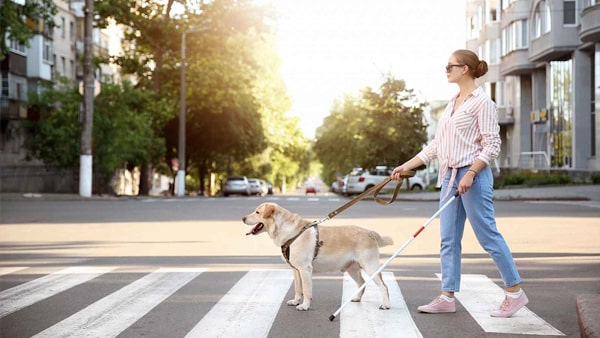
You are preparing to turn right as a pedestrian using a guide dog begins crossing in front of you. What should you do?

You want to make a right turn at the corner. A pedestrian with a guide dog is at the corner ready to cross the street in front of you. Before making your right turn, you should:
  1. A Turn off the engine until the pedestrian finishes crossing
  2. B Tell the pedestrian when it is safe to cross
  3. C Yield and wait until the pedestrian is out of danger
  4. D Sound the horn to announce your presence

Correct answer: C – Yield and wait until the pedestrian is out of danger

Maine law requires drivers to yield to visually impaired pedestrians using a guide or personal care dog. The driver's manual directs motorists to stop at least 10 feet away and wait until the person is out of danger. Failing to yield is a traffic infraction punishable by a fine of at least $50 and no more than $1,000.

Source: 29-A M.R.S. § 2056(9) – Pedestrians, Maine Driver's License Manual — Part 6, “Crosswalks”

Question 5

Which check must you complete before moving into another lane on a multilane highway?

Before changing lanes on a multi-lane highway you should:
  1. A Sound the horn
  2. B Switch on the headlights
  3. C Reduce speed regardless of traffic conditions
  4. D Check the mirrors and the blind spot beside the vehicle

Correct answer: D – Check the mirrors and the blind spot beside the vehicle

A lane change may be made only when it can be completed with reasonable safety. Check the rearview and side mirrors, then look over the appropriate shoulder for vehicles in the blind spot. Signal before moving and verify that the intended lane has enough clear space for the maneuver.

Source: 29-A M.R.S. § 2071(1) – Turning and signals, Maine Driver's License Manual — Part 6, “When You Change Lanes”

Question 6

Heavy rain or fog prevents you from seeing the road even after you slow down and use the wipers. What should you do?

  1. A Use high-beam headlights and continue
  2. B Pull off the road and wait for visibility to improve
  3. C Continue at a very low speed in the traffic lane
  4. D Use emergency flashers while continuing in the traffic lane

Correct answer: B – Pull off the road and wait for visibility to improve

In very heavy rain or thick fog, visibility may remain inadequate even at a low speed. Pull off the road, stop, and wait for conditions to improve. When stopping because of dense fog, use the emergency flashers to make the vehicle more visible to approaching traffic.

Source: Maine Driver's License Manual — Part 6, “How Well Can You See?—Rain, Fog, or Snow”; Part 8, “Fog”