Maine Permit Practice Test 4

4.9 out of 5 (83 votes)
80% Passing score
20 Questions
4 Mistakes allowed
Maine’s permit test is not just a quick check of whether you know what a Stop sign means. It reaches into the rules that new drivers are actually expected to understand, including learner permit requirements, intermediate license restrictions, provisional-license consequences, and the kind of passenger-safety details people often assume they already know. That assumption, by the way, is usually where the trouble starts. This Maine BMV permit practice test gives you 20 multiple-choice questions built around general driving knowledge, Maine licensing rules, safe driving habits, and child safety seat use. The child passenger material is worth taking seriously, not skimming in that “I’ve seen a car seat before” kind of way. Proper installation, safe use, and knowing how young passengers should be protected are part of responsible driving, especially if you ever transport children, which includes plenty of drivers who are not parents.   To pass this Maine practice permit test, you need at least 16 correct answers. The useful part is not just the score, though. After each question, you get immediate feedback with an explanation, so you can see what you missed and why the correct answer makes sense. It slows you down a little, yes, but in a good way. You are not just clicking through questions and hoping enough of them stick by accident. For younger drivers, the licensing details matter. A Maine learner permit holder must drive with a supervising driver seated beside them, and that driver must be licensed, at least 20 years old, and have held a valid license for at least two years. Permit holders under 21 generally need to hold the permit for at least six months, complete 70 hours of practice driving, including 10 hours after dark, and avoid handheld phone use while operating under the permit. And then there is the next stage, which is where people sometimes get fuzzy. Drivers licensed before age 18 receive an intermediate license for 270 days, with restrictions on passengers, driving between midnight and 5 a.m., and mobile phone use. New drivers under 21 also enter a two-year provisional period, where moving violations can lead to suspension. You can retake this Maine driving test practice as many times as needed, so use it like a proper study tool. Work through the explanations, notice the licensing rules that feel weirdly easy to forget, and build the kind of confidence that comes from knowing the material, not just recognizing a few familiar answers.
FREE DMV Practice Test App
Study for your Maine permit test or driver’s license with the NextDoorDriving app. 700+ DMV questions and answers, 100% free!
Download on the App Store

Sample Maine Permit Test Questions

Question 1

The posted limit is 55 mph, but the road is wet. What speed reduction does the driver manual give as a general guideline?

  1. A 20 to 25 mph below the limit
  2. B 5 to 10 mph below the limit
  3. C No reduction from 55 mph

Correct answer: B – 5 to 10 mph below the limit

The Maine manual gives a reduction of 5 to 10 mph as a general guideline for wet roads. This does not guarantee that 45 to 50 mph is always safe. State law requires a careful and prudent speed based on the road surface, traffic, visibility, and other existing conditions, which may require a greater reduction.

Source: M.R.S. Title 29-A, § 2074 – Rates of speed, Maine Driver’s License Manual — § 8, “Slippery Roads”

Question 2

Which ability does the driver manual define as making sound decisions about time, space, and distance—an ability alcohol impairs?

If you drive after drinking, you should be aware that the first thing alcohol affects is:
  1. A Hearing
  2. B Alertness
  3. C Vision
  4. D Judgment

Correct answer: D – Judgment

Good judgment is the ability to think clearly, make quick decisions, and properly evaluate time, space, and distance. Alcohol impairs that decision-making ability. This can affect choices about speed, following distance, passing, and responding to hazards even before a driver recognizes the extent of the impairment.

Source: Maine Driver’s License Manual — § 3, “How Drinking Impairs Driving”

Question 3

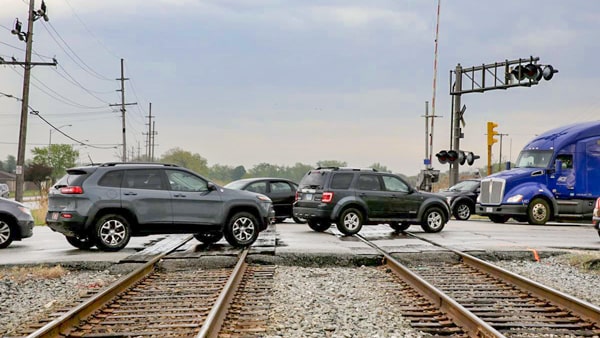
Traffic is backed up beyond a railroad crossing and would force you to stop on the tracks. What should you do?

When traffic is slow and heavy and you must cross railroad tracks before reaching the upcoming intersection, you should:
  1. A Stop between the crossing gates
  2. B Enter the crossing and wait for traffic to move
  3. C Wait before the tracks until you can clear the entire crossing
  4. D Sound your horn before joining the line

Correct answer: C – Wait before the tracks until you can clear the entire crossing

Never enter a railroad crossing when traffic would leave your vehicle stopped on the tracks. Wait before the crossing until enough space is available to drive completely across without stopping. When proceeding, look in both directions and remain alert for more than one track or train.

Source: Maine Driver’s License Manual — § 6, “Railroad Crossings”

Question 4

Under Maine’s implied-consent law, when must a driver submit to a chemical test?

  1. A When there is probable cause to believe the driver operated under the influence
  2. B Only after consulting an attorney
  3. C Only when a court first issues an order
  4. D Whenever any traffic citation is issued

Correct answer: A – When there is probable cause to believe the driver operated under the influence

M.R.S. Title 29-A, § 2521 requires testing when probable cause exists to believe a person operated under the influence. The test may analyze breath, blood, or urine, with a breath test ordinarily administered unless unreasonable. Refusal causes immediate suspension: 275 days for a first refusal, 18 months for a second, four years for a third, and six years for a fourth.

Source: M.R.S. Title 29-A, § 2521(1), (2), (5), (6) – Implied consent to chemical tests

Question 5

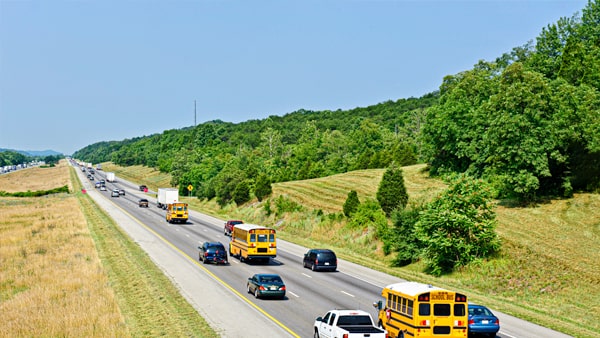
In Maine, a school bus stops with red lights flashing on the opposite side of a four-lane road separated only by a painted paved strip. What must you do?

If a school bus stops to unload children on a four-lane highway, divided by a four-foot paved strip, vehicles traveling in the opposite direction are:
  1. A Stop until the bus moves or its driver signals you to proceed
  2. B Stop briefly and then pass at reduced speed
  3. C Move onto the shoulder before passing
  4. D Continue because the paved strip separates the roadways

Correct answer: A – Stop until the bus moves or its driver signals you to proceed

Drivers meeting or overtaking a school bus with flashing red lights must stop before reaching it and remain stopped until the bus moves or its driver signals them to proceed. The opposite-direction exception applies when the roadway is separated by curbing or another physical barrier. A painted or paved center strip alone does not satisfy that exception.

Source: M.R.S. Title 29-A, § 2308(2), (3) – Overtaking and passing school buses

Question 6

Your tires begin hydroplaning and the vehicle starts to skid. What should you do?

  1. A Hold your speed steady until traction returns
  2. B Brake hard to force the tires through the water
  3. C Ease off the accelerator, avoid hard braking, and steer toward your intended path
  4. D Accelerate sharply to increase tire traction

Correct answer: C – Ease off the accelerator, avoid hard braking, and steer toward your intended path

Hydroplaning occurs when tires ride on a film of water and lose contact with the pavement. Ease off the accelerator and avoid hard braking while steering smoothly toward the direction you want to travel. Reducing speed in rain and maintaining properly inflated tires with adequate tread help prevent hydroplaning.

Source: Maine Driver’s License Manual — § 8, “Hydroplaning”; § 9, “Skids”