Maine DMV Sign Test 4

4.9 out of 5 (50 votes)
80% Passing score
20 Questions
4 Mistakes allowed
Maine road signs get their own practice test here because they deserve the attention, not because the real BMV exam separates them into some neat little road-sign-only category. It does not. On the actual Maine Class C written knowledge test, road sign questions are mixed in with rules of the road, traffic laws, pedestrian and bicycle safety, operating-under-the-influence laws, distracted-driving risks, and general safe-driving knowledge. The full test has 30 questions, and you need 24 correct to pass, so every missed sign question eats into the same 6-question cushion as everything else. That is where this Maine road sign practice test earns its keep. It gives you 20 multiple-choice questions focused on sign recognition, sign meaning, and the visual clues that drivers are expected to know before they get anywhere near the road test. Shape matters. Color matters. Symbols matter. And, yes, a green guide sign and a red regulatory sign are doing very different jobs, even if your brain tries to lump them all together after a long study session. The questions are built to feel familiar to the real Maine BMV written test, with a practical emphasis on the signs you are most likely to see in the Driver’s License Manual and on Maine roads. Some are obvious in the way stop signs are obvious. Others are quieter, stranger, more “wait, I should know this” than anyone wants to admit. A lot of the practice depends on images, which is good, because road signs are not really learned as vocabulary words. You recognize them by shape, color, symbol, and the tiny split-second instruction they give you. There are hints when you get stuck, and missed questions come with explanations, which is more useful than simply being told you were wrong and left to stew about it. Scoring 16 out of 20 is the target here. It will not cover the entire Maine permit test, obviously, because the real exam is broader than signs. But it gives you a tighter, cleaner way to drill one of the most visual parts of Maine driving test practice before you sit for the real thing.
FREE DMV Practice Test App
Study for your Maine permit test or driver’s license with the NextDoorDriving app. 700+ DMV questions and answers, 100% free!
Download on the App Store

Sample Maine Permit Test Questions

Question 1

Under Maine law, how does a steady red arrow differ from a steady circular red signal?
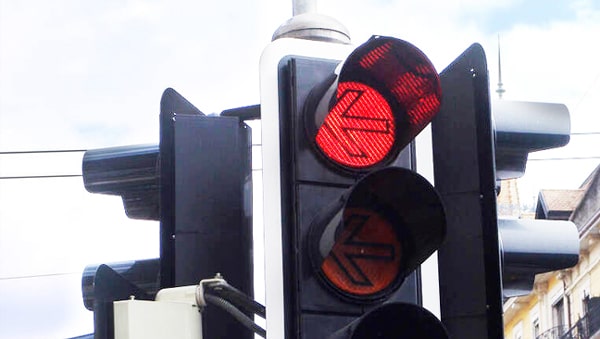
What is the difference between traffic lights with red arrows and those with solid red lights?
  1. A A red arrow prohibits movement in its direction, while a circular red may permit a right turn after stopping when allowed
  2. B A red arrow applies only to protected left-turn lanes
  3. C A red arrow controls left turns but never right turns
  4. D A red arrow controls right turns but never left turns

Correct answer: A – A red arrow prohibits movement in its direction, while a circular red may permit a right turn after stopping when allowed

A steady red arrow prohibits entering the intersection to make the movement shown by the arrow. At a steady circular red signal, a driver may turn right after stopping if no sign prohibits it. The driver must yield to pedestrians in the crosswalk and vehicles proceeding on a green signal.

Source: Me. Rev. Stat. tit. 29-A, § 2057(1)(C), (C-1) — Traffic-control devices, Maine Driver’s License Manual — § 6, “Traffic Signals”

Question 2

A yellow diamond sign containing a black plus symbol warns of what roadway feature?

This sign shows one type of:
  1. A An intersection ahead
  2. B A series of curves
  3. C A required right turn
  4. D A lane change

Correct answer: A – An intersection ahead

The plus-shaped symbol is an intersection-ahead warning sign. It indicates that another road crosses the roadway you are traveling on. Watch for cross traffic and any regulatory signs or signals as you approach.

Source: Maine Driver’s License Manual — § 6, “Warning Signs”

Question 3

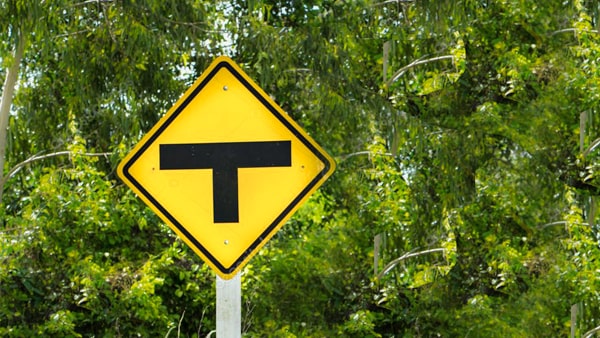
A yellow diamond sign with a black “T” symbol indicates:

This sign shows one type of:
  1. A A mandatory right turn
  2. B A T-intersection ahead
  3. C A lane ending ahead
  4. D A winding road ahead

Correct answer: B – A T-intersection ahead

The T-shaped symbol warns that the road ahead ends at another roadway. You will need to turn left or right as permitted when you reach the intersection. The warning sign does not replace any stop, yield, or other control posted there.

Source: Maine Driver’s License Manual — § 6, “Warning Signs”

Question 4

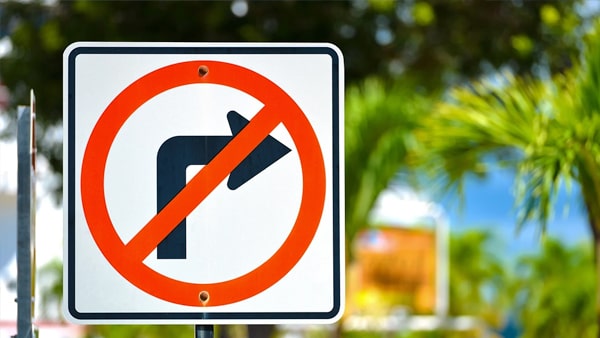
A right-turn arrow inside a red circle with a diagonal slash means:

This sign means:
  1. A No U-turn
  2. B No left turn
  3. C No right turn
  4. D No turns in either direction

Correct answer: C – No right turn

This is a regulatory sign prohibiting right turns at that location. Maine’s manual explains that a red circle and slash mean the displayed action is not allowed. Any other movement remains subject to the intersection’s lane markings, signs, and signals.

Source: Maine Driver’s License Manual — § 6, “Regulatory Signs”

Question 5

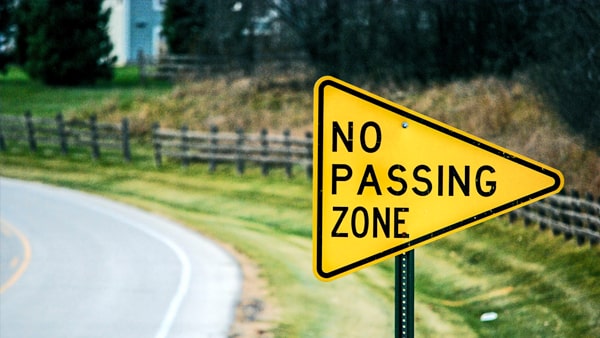
A yellow pennant-shaped sign placed on the left side of the road marks:

The sign with this shape and color is a _____________ sign.
  1. A The beginning of a no-passing zone
  2. B A wrong-way entrance
  3. C A railroad crossing
  4. D A required stop

Correct answer: A – The beginning of a no-passing zone

The yellow pennant identifies a no-passing zone and normally faces drivers from the left side of the roadway. Do not begin a pass where this sign applies. A white rectangular “DO NOT PASS” sign may also be posted on the right.

Source: Maine Driver’s License Manual — § 6, “Warning Signs”, Maine Driver’s License Manual — § 7, “Passing”

Question 6

At a stop sign with a marked stop line, where must you make your initial stop?

  1. A Past the crosswalk where cross traffic is visible
  2. B Directly beside the stop sign
  3. C Before crossing the marked stop line
  4. D At least five feet before the stop sign

Correct answer: C – Before crossing the marked stop line

Maine requires the stop to be completed before the vehicle enters the intersection. When a marked stop line is provided, stop behind it without allowing part of the vehicle to cross it. If no applicable line or crosswalk is present, stop at the nearest point where approaching traffic can be seen.

Source: Me. Rev. Stat. tit. 29-A, § 2057(8) — Traffic-control devices, Maine Driver’s License Manual — § 6, “Crosswalks and Stop Lines”