


Arizona Permit Practice Test 2

4.7 out of 5 (559 votes)
80% Passing score
20 Questions
4 Mistakes allowed
A lot of people underestimate the Arizona permit test until they are staring at a question about some oddly specific traffic rule and suddenly realizing the answer is not as obvious as it felt ten minutes ago. That is exactly why this AZ DMV practice test is useful. It gives you a practical way to study for the official Arizona MVD written knowledge test without turning the whole process into a stiff, joyless read-through of the driver manual. The real Arizona permit knowledge test includes 30 multiple-choice questions, and you need at least 24 correct answers to pass. Not impossible, no. But also not something to treat like a quick common-sense quiz, because Arizona expects you to know the rules before it hands you an instruction permit. This 20-question Arizona practice permit test focuses on the same kinds of material found in the Arizona Driver License Manual, including road signs, traffic signals, lane markings, seat belt rules, right-of-way, safe driving habits, alcohol and drug laws, and the general responsibilities that come with driving a vehicle around other actual humans. And Arizona, just to make things interesting, is not a one-setting driving state. You might be dealing with Phoenix traffic and heat one week, Flagstaff snow or mountain roads another, then long desert stretches where staying alert matters more than people think. So while this DMV learners permit practice test helps with test prep, it also pushes you toward the bigger point: understanding how Arizona’s rules work when the road is not being neat and convenient. Depending on your situation, the official test may be taken at an MVD office, through an Authorized Third Party provider, or, for eligible teens, through Permit Test @ Home with a parent or legal guardian administering it. Passing the online test is not the final step, though. You still have to visit MVD or an Authorized Third Party location to complete the permit issuance process. Bring the right documents, too. Proof of identity, Social Security number, authorized presence, and Arizona residency are not optional little extras. Applicants under 18 also need parent or guardian approval. Use this AZ drivers permit practice test to make your mistakes early, quietly, and without the fluorescent-light pressure of the real counter visit. That is the smart way to study.
FREE DMV Practice Test App
Study for your Arizona permit test or driver’s license with the NextDoorDriving app. 700+ DMV questions and answers, 100% free!
Download on the App Store

Sample Arizona Permit Test Questions

Question 1

Which fact can make a motorcycle harder for another driver to detect and judge accurately?

Which of these statements is true about motorcycles?
  1. A Its smaller size provides fewer visual cues about distance and speed
  2. B It must remain at the far-right edge of its lane
  3. C A car may safely share its traffic lane
  4. D It always has the right-of-way over other vehicles

Correct answer: A – Its smaller size provides fewer visual cues about distance and speed

A motorcycle's small profile can make it difficult to spot and can make it appear farther away or slower than it is. Its single headlight or taillight also provides fewer visual cues for estimating distance. Motorcycles may change position within their lane and are entitled to the lane space needed to maneuver.

Source: Arizona Driver License Manual and Customer Service Guide — Section 4, “Sharing the Road with a Motorcycle—Size”., Arizona Driver License Manual and Customer Service Guide — Section 4, “Sharing the Road with a Motorcycle—Lane Position”.

Question 2

Under Arizona law, when may a person open a vehicle door on the side exposed to moving traffic?

  1. A During daylight hours
  2. B When a nearby traffic signal is red
  3. C When opening it is reasonably safe and will not interfere with traffic
  4. D After activating the vehicle's hazard lights

Correct answer: C – When opening it is reasonably safe and will not interfere with traffic

A vehicle door may be opened only when it is reasonably safe and will not interfere with the movement of other traffic. A door on the traffic side also may not remain open longer than necessary to load or unload a passenger. Daylight, hazard lights, or a nearby red signal do not replace this safety requirement.

Source: A.R.S. § 28-905 — Opening vehicle door.

Question 3

A broken yellow line runs beside a solid yellow line. When may you pass another vehicle?

You may cross a double line to pass another vehicle if the line on your side is:
  1. A When the solid yellow line is on your side
  2. B When both lines are solid yellow
  3. C When the broken yellow line is on your side and the road ahead is clear
  4. D When a solid white line is on your side

Correct answer: C – When the broken yellow line is on your side and the road ahead is clear

A driver may pass when the broken yellow line is on that driver's side and the roadway ahead is clear. The marking alone does not guarantee that a pass is lawful or safe. The driver still needs adequate visibility and distance and may not pass at a prohibited curve, hill, intersection, railroad crossing, bridge, tunnel, or no-passing zone.

Source: Arizona Driver License Manual and Customer Service Guide — Section 3, “Pavement Markings—Solid and Broken Yellow Lines”., A.R.S. § 28-725 — Limitations on overtaking on the left., A.R.S. § 28-726(A) — Limitations on driving to left of roadway center.

Question 4

In Arizona, which statement correctly describes the general occupant-restraint requirement?

  1. A Only drivers who are at least 18 must wear a safety belt
  2. B Front-seat occupants of covered vehicles must buckle up, and the driver must ensure passengers under 16 are properly restrained
  3. C Safety belts are required only while traveling at the speed limit
  4. D Safety belts are required only on state highways and freeways

Correct answer: B – Front-seat occupants of covered vehicles must buckle up, and the driver must ensure passengers under 16 are properly restrained

In a covered passenger vehicle manufactured for model year 1972 or later, each front-seat occupant must have the installed safety belt properly adjusted and fastened while the vehicle is moving. The driver must also require passengers under 16 to be properly restrained. Children covered by the child-restraint law and certain medical or occupational situations are exceptions under the statute.

Source: A.R.S. § 28-909(A), (B), (F) — Vehicle restraints required; exceptions; civil penalty.

Question 5

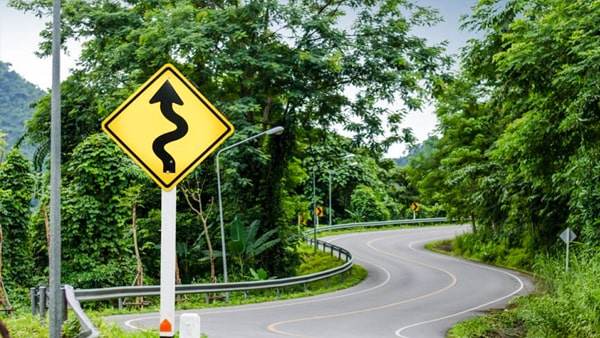
A yellow diamond-shaped sign containing a winding arrow means:

This sign tells you that:
  1. A Turns are prohibited on the road ahead
  2. B The roadway becomes narrower ahead
  3. C A sequence of curves or turns is ahead
  4. D The pavement may be slippery when wet

Correct answer: C – A sequence of curves or turns is ahead

A winding-road warning sign indicates that multiple curves or turns are ahead. The sign allows drivers to prepare for the changing roadway alignment. A smaller advisory-speed plaque may appear below it to identify a safe speed for traveling through the curves.

Source: Arizona Driver License Manual and Customer Service Guide — Section 3, “Warning Signs—Turn, Curve and Winding Road Signs”.

Question 6

In Arizona, when may a vehicle displaying a disability license plate use a reserved accessible parking space?

  1. A Whenever the plate is displayed, regardless of who is present
  2. B Only when the driver is the person with the disability
  3. C When the vehicle is transporting the person to whom the plate was issued
  4. D Whenever an immediate family member has a disability

Correct answer: C – When the vehicle is transporting the person to whom the plate was issued

A vehicle displaying a valid disability plate may use a reserved space when it is transporting the person to whom the plate was issued. The plate does not authorize use of the space when that person is absent. No vehicle may stop, stand, or park in the striped access aisle beside an accessible space.

Source: A.R.S. § 28-884(A), (C) — Parking space for persons with physical disabilities; prohibition; access aisle.