


Arkansas DMV Practice Test 6

5 out of 5 (35 votes)
80% Passing score
20 Questions
4 Mistakes allowed
This Arkansas drivers practice test is built for the part of test prep that actually matters: knowing the rules well enough that you are not just guessing your way through the Arkansas DMV test. It gives you 20 questions, with this sixth test in the series leaning into turn signals, which sounds almost too simple until you remember how much of safe driving comes down to telling other people what you are about to do before you do it. A signal is not decoration. It is a warning, a courtesy, and, yes, one of those small habits the real test expects you to understand. To pass this Arkansas DMV practice test, you will need at least 16 correct answers. That makes it a useful checkpoint before you schedule the actual DMV learners permit test through Arkansas State Police Driver Examination. And here is the slightly unglamorous but important bit: Arkansas knowledge and skills exams are handled through official testing locations, with appointments scheduled through the Arkansas State Police system. This is not the same as casually knocking out an official first-time permit exam from your couch, nice as that would be. Once you finish the DMV permit test online, you can review the questions you missed with explanations and hints. That review is where the studying tends to happen, honestly. The score tells you how you did; the missed-answer breakdown tells you what still needs work before you sit for the real written exam. That is especially useful because a failed non-commercial knowledge exam in Arkansas means waiting 5 days before rescheduling, and each written exam costs $5. Not a disaster, obviously, but still annoying in the very specific way avoidable errands are annoying. There are a few office-day details worth keeping in mind, too. Arkansas instruction permit and driver license applicants must pass a vision test before a permit or license is issued. Applicants also need the right documents, and the requirements are different for drivers under 18 and those 18 or older. Later at the revenue office, expect proof of legal presence, identity, Social Security documentation, a photo, and possibly REAL ID paperwork if you are going that route. So, no, this Arkansas free DMV practice test will not organize your documents or improve your eyesight. Rude, but true. It will help you walk into the written test with a firmer grip on Arkansas driving rules, road safety, and the little details that tend to trip people up.
FREE DMV Practice Test App
Study for your Arkansas permit test or driver’s license with the NextDoorDriving app. 700+ DMV questions and answers, 100% free!
Download on the App Store

Sample Arkansas Permit Test Questions

Question 1

In Arkansas, how far before a turn must you continuously signal?

  1. A At least 50 feet
  2. B At least 100 feet
  3. C At least 300 feet
  4. D At least 400 feet

Correct answer: B – At least 100 feet

A turn signal must be given continuously during at least the final 100 feet traveled before turning right or left. The same statutory distance applies before changing lanes. Signaling communicates your intended movement, but the turn or lane change must also be made with reasonable safety.

Source: Ark. Code Ann. § 27-51-403(a)–(b) — Signals for turning, stopping, changing lanes, or decreasing speed required, Arkansas Driver License Test Study Guide — Ch. 5, “Signaling to Change Directions”
Question 2

Under Arkansas law, when may a driver stop in a place where stopping is otherwise prohibited?

  1. A To unload packages quickly
  2. B When necessary to avoid conflict with other traffic
  3. C To discharge passengers
  4. D Whenever the stop lasts less than five minutes

Correct answer: B – When necessary to avoid conflict with other traffic

The prohibition on stopping, standing, or parking in specified places includes an exception when stopping is necessary to avoid conflict with other traffic. A driver may also stop when complying with a police officer or traffic-control device. Loading packages, discharging passengers, or limiting the stop to five minutes does not create a general exception.

Source: Ark. Code Ann. § 27-51-1302(a) — Stopping, standing, or parking prohibited in specified places

Question 3

Which practice is part of defensive driving?

  1. A Watch only the vehicle directly ahead
  2. B Remain alert and look well ahead for changing conditions
  3. C Expect other drivers to correct your mistakes
  4. D Wait until the last moment to respond to a hazard

Correct answer: B – Remain alert and look well ahead for changing conditions

Defensive driving requires attention to the roadway and surrounding conditions. The study guide recommends looking at least 15 seconds ahead—about one city block in town or one-quarter mile on a highway. Looking well ahead helps reduce last-minute braking and sudden steering movements.

Source: Arkansas Driver License Test Study Guide — Ch. 4, “Stay Alert—Looking Ahead”

Question 4

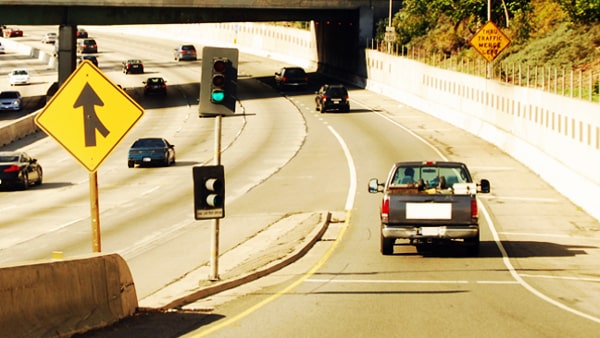
When using an acceleration lane to enter a high-speed roadway, you should try to merge at:

When entering a freeway entrance that allows you to accelerate to merge, you should drive at:
  1. A About 10 mph slower than traffic
  2. B Approximately the same speed as traffic on the roadway
  3. C The lowest speed allowed on the roadway
  4. D A speed faster than every vehicle already on the roadway

Correct answer: B – Approximately the same speed as traffic on the roadway

Use the entrance ramp to build speed and try to enter at approximately the same speed as other traffic. Check the roadway, mirrors, and blind spot for a safe opening before merging. If you must wait for a gap, leave enough ramp space to accelerate before entering the traffic lane.

Source: Arkansas Driver License Test Study Guide — Ch. 5, “Adjusting to the Flow of Traffic—Merging With Traffic”

Question 5

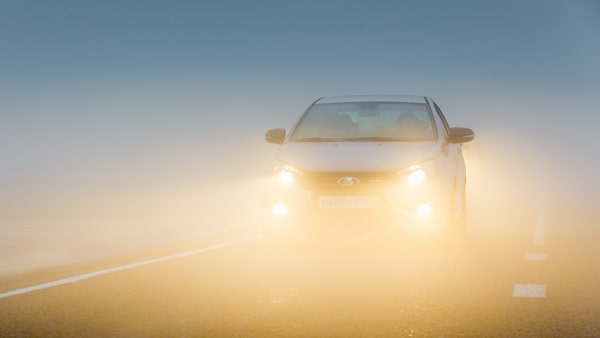
Which headlights should you use while driving in dense fog?

When it is very foggy, you should slow down and turn on your:
  1. A Low-beam headlights
  2. B High-beam headlights
  3. C Parking lights only
  4. D No headlights if it is daytime

Correct answer: A – Low-beam headlights

Use low-beam headlights in fog, snow, or heavy rain. High beams reflect from moisture in the air, creating glare that makes the roadway more difficult to see. Headlights also help other road users see your vehicle; parking lights alone are not intended for driving.

Source: Arkansas Driver License Test Study Guide — Ch. 5, “High and Low Beam Headlights”

Question 6

Before returning to the right lane after passing, what should you verify in the rearview mirror?

  1. A The front of the vehicle you passed is visible and there is enough clearance
  2. B The other driver has activated a turn signal
  3. C Your headlights are switched to high beam
  4. D The other vehicle has begun slowing down

Correct answer: A – The front of the vehicle you passed is visible and there is enough clearance

Leave enough room between your vehicle and the one you passed before returning to the right lane. Check the rearview mirror for the front of the passed vehicle and signal before changing lanes. At night, seeing both of that vehicle's headlights in the mirror indicates sufficient clearance to return.

Source: Arkansas Driver License Test Study Guide — Ch. 6, “Passing Procedures”