


Arkansas Road Signs Test Simulator

4.9 out of 5 (41 votes)
80% Passing score
25 Questions
5 Mistakes allowed
The Arkansas permit test has a funny way of making ordinary driving rules feel suddenly suspicious. That Stop sign? Easy. That pavement marking you’ve ignored for years from the passenger seat? Less charming now. This Arkansas permit test simulator is built for that exact gap—the one between “I basically know how roads work” and “oh, right, the exam wants the actual rule.” Each round gives you 20 multiple-choice questions pulled from a larger bank, so the practice does not go stale after one pass. You need 16 correct answers to pass this DMV practice test, which keeps things close to the real Arkansas knowledge test standard: 20 correct out of 25, or 80%. So, yes, this version is a little shorter. It is not, however, a free little victory lap dressed up as studying. And while road signs get plenty of attention here, they are not floating off in their own separate universe. Arkansas does not use a separate road-sign-only test for the standard Class D instruction permit path. Sign questions are part of the full knowledge exam, mixed in with traffic laws, pavement markings, signals, right-of-way, work zones, school zones, railroad crossings, safe driving rules, distracted driving laws, and all the other material that sounds obvious until it is worded like a test question. That is where this Arkansas drivers practice test earns its keep. You get the repetition you need, but with enough variation to keep your brain from coasting. Missed answers are shown at the end, along with the correct ones, which is mildly humbling—fine, very humbling—but useful. That little review screen is where wrong guesses turn into rules you actually remember. This practice test works for first-time applicants, teens starting the Arkansas licensing process at 14, adults getting licensed, and drivers who just want a cleaner read on the rules before dealing with the real thing. Use it as a warm-up, a reality check, or a last pass before scheduling through Arkansas State Police Driver Examination. Just do not treat it like a casual road-sign game. The actual permit test is broader than that, and honestly, it knows when you only skimmed.
FREE DMV Practice Test App
Study for your Arkansas permit test or driver’s license with the NextDoorDriving app. 700+ DMV questions and answers, 100% free!
Download on the App Store

Sample Arkansas Permit Test Questions

Question 1

What does a dashed white line between two travel lanes indicate?
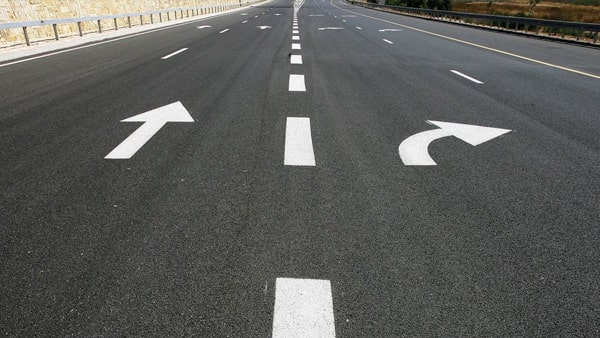
A broken white center line on the roadway means:
  1. A. Turning is prohibited
  2. B. Drivers must reduce speed
  3. C. Both lanes are in a no-passing zone
  4. D. Drivers may change lanes when it is safe

Correct answer: D. – Drivers may change lanes when it is safe

A dashed white line separates lanes traveling in the same direction. The Arkansas guide permits drivers to cross it for a lane change when the movement is safe. Before changing lanes, check mirrors, look over your shoulder for vehicles in the blind spot, and signal in advance.

Source: Arkansas Driver License Study Guide — Ch. 3, “Lanes of Traffic—White Lane Markings”, Arkansas Driver License Study Guide — Ch. 4, “Changing Lanes”

Question 2

After stopping at a stop line, an obstruction prevents you from seeing cross traffic. What should you do next?

  1. A. Wait five seconds and then enter the intersection
  2. B. Sound the horn and proceed
  3. C. Listen for traffic and enter without moving forward
  4. D. Move forward slowly for a better view and proceed when safe

Correct answer: D. – Move forward slowly for a better view and proceed when safe

You must first make a complete stop before reaching the marked stop line. If an obstacle blocks your view, pull forward carefully until you can see approaching traffic and pedestrians. Enter the intersection only when it is safe and after yielding as required.

Source: A.C.A. § 27-51-601 — Stop Signs and Yield Signs, Arkansas Driver License Study Guide — Ch. 2, “Traffic Control Signs—Stop Signs”, Arkansas Driver License Study Guide — Ch. 3, “Crosswalks and Stop Lines”

Question 3

What is the normal top-to-bottom order of the circular indications on a vertical traffic signal?

From top to bottom, the following is the proper order for traffic lights:
  1. A. Red, yellow, green
  2. B. Red, green, yellow
  3. C. Green, red, yellow
  4. D. Green, yellow, red

Correct answer: A. – Red, yellow, green

On a standard vertical signal face, the circular red indication is above the circular yellow and green indications. Circular yellow is positioned between red and green, making the normal sequence red, yellow, then green. Standardized placement helps drivers recognize an indication by position as well as color.

Source: Manual on Uniform Traffic Control Devices for Streets and Highways, 11th ed., Rev. 1 — § 4E.04, “Positions of Signal Indications Within a Vertical Signal Face”

Question 4

Which pavement marking creates a no-passing restriction for traffic in both directions?

  1. A. A broken white line
  2. B. A double solid yellow line
  3. C. A broken yellow line
  4. D. A solid white edge line

Correct answer: B. – A double solid yellow line

A double solid yellow centerline marks opposing lanes and prohibits passing from either direction. The Arkansas guide distinguishes this from a broken yellow centerline, which may be crossed to pass when the opposing lane is clear. The double line may be crossed for a permitted driveway turn when no opposing traffic is approaching.

Source: Arkansas Driver License Study Guide — Ch. 3, “Lanes of Traffic—Yellow Lane Markings”

Question 5

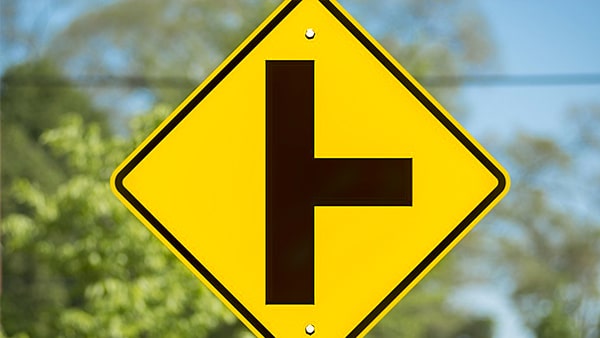
A yellow diamond sign has a vertical roadway symbol with a short branch entering from the right. What does it mean?

This sign means:
  1. A. All traffic must turn right
  2. B. A side road enters from the right
  3. C. All traffic must continue straight
  4. D. Right turns are prohibited

Correct answer: B. – A side road enters from the right

The Side Road warning sign alerts drivers that another roadway intersects from the direction shown by the short branch. In this case, the side road enters from the right. Because it is a warning sign rather than a turn-control sign, it does not require all traffic to turn.

Source: Manual on Uniform Traffic Control Devices for Streets and Highways, 11th ed., Rev. 1 — Ch. 2C, “Intersection Warning Signs”

Question 6

A yellow diamond warning sign shows one vertical arrow pointing up and another pointing down. Which sign is this?

  1. A. Lane Ends
  2. B. Divided Highway Ends
  3. C. Two-Way Traffic
  4. D. Turn Left or Right

Correct answer: C. – Two-Way Traffic

The Two-Way Traffic sign warns that vehicles ahead travel in opposite directions on the same roadway. It may appear where a divided or one-way roadway changes to two-way operation. Remain on the proper side of the roadway and be prepared for oncoming traffic.

Source: Manual on Uniform Traffic Control Devices, 2009 ed., Revs. 1–3 — § 2C.44, “Two-Way Traffic Sign (W6-3)”