Georgia DDS Practice Test

4.7 out of 5 (317 votes)
80% Passing score
20 Questions
4 Mistakes allowed
Georgia’s knowledge exam has a little more structure than many new drivers expect, and that structure matters. It is not just one big pool of questions where a strong score in one area can cover a weak spot somewhere else. The Georgia DDS permit test is split into two separate sections: a 20-question Road Rules Test and a 20-question Road Signs Test. To pass, you need at least 15 correct answers on each one. So, yes, you could understand right-of-way perfectly and still run into trouble if the signs section is shaky. That is the part people sometimes underestimate. This Georgia permit practice test is designed to make that format feel familiar before you are sitting for the real thing. It walks through the rules and signs that show up in the Georgia driver’s manual: traffic signals, standard highway signs, lane use, safe following distance, right-of-way, and the legal basics that sound simple until the question is worded in a slightly different way. And, because Georgia tests road signs separately, the sign questions deserve more than a quick last-minute glance. You need to recognize signs, signals, and markers with enough confidence that you are not pausing over every shape and symbol. That is why GA DDS practice test work is worth taking seriously. Not dramatically, not with flashcards taped to every wall, but seriously enough. The goal is to catch weak spots while they are still easy to fix, especially in the road signs section where 15 out of 20 is the line. Whether you are a first-time teen applicant, an adult getting licensed, or transferring into Georgia and trying to understand how the state handles permits, this Georgia DDS test practice gives you a cleaner, calmer way to prepare. It's good to start thinking about the other steps in the licensing process, too. For teen drivers, the process starts early. Georgia offers the Class CP Learner’s Permit, also called an Instructional Permit, at age 15. Applicants ages 15 to 17 must pass the knowledge exam and vision exam, meet school enrollment requirements, and have a parent, legal guardian, or responsible adult sign the application. Adults have their own version of the process, although the test itself is still part of the same basic gatekeeping. First-time Class C applicants age 18 and older must pass the knowledge exam and vision screening, get a non-commercial learner’s permit before the road test, and later pass the road skills test. Before that road test, adults also sign off on 40 hours of supervised driving, including 6 hours at night.   So if you are ready to start driving yesterday, this permit practice test will get you one step closer.
FREE DMV Practice Test App
Study for your Georgia permit test or driver’s license with the NextDoorDriving app. 700+ DMV questions and answers, 100% free!
Download on the App Store

Sample Georgia Permit Test Questions

Question 1

When parking downhill beside a curb in Georgia, how should you position the front wheels?

Turn your front wheels toward the curb when you are parked:
  1. A. Away from the curb
  2. B. Straight ahead
  3. C. Toward the curb
  4. D. Toward the center of the roadway

Correct answer: C. – Toward the curb

When parking downhill beside a curb, turn the front wheels toward the curb. This helps keep the vehicle from rolling into traffic if it begins to move. Set the parking brake and secure the transmission before leaving the vehicle.

Source: Georgia 40-Hour Parent/Teen Driving Guide — Sessions 14–16, “Parking on a Hill”
Question 2

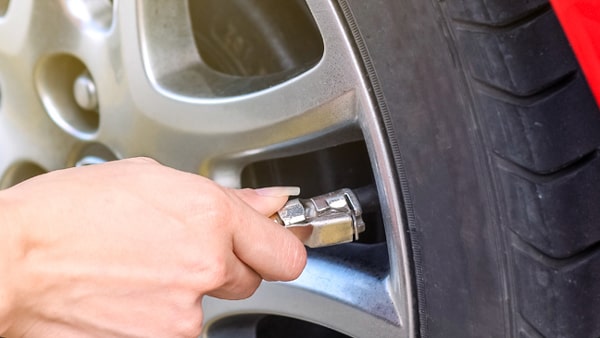
Your tire pressure does not match the vehicle manufacturer’s recommended PSI. What should you do?

If your tires are not inflated to the pressure recommended by the manufacturer, it may cause:
  1. A. Lower every tire to the same arbitrary pressure
  2. B. Ignore it unless a tire appears completely flat
  3. C. Inflate each tire to the maximum number printed on its sidewall
  4. D. Use a gauge and adjust the pressure to the recommended PSI shown on the vehicle

Correct answer: D. – Use a gauge and adjust the pressure to the recommended PSI shown on the vehicle

Check tire pressure with a tire-pressure gauge before driving. The Georgia manual directs drivers to use the recommended PSI shown on the vehicle’s door jamb and to add or release air until the pressure matches. The maximum pressure molded into a tire’s sidewall is not necessarily the vehicle manufacturer’s recommended operating pressure.

Source: Georgia Department of Driver Services Drivers’ Manual — § 8, “Tire Pressure”

Question 3

If your vehicle becomes disabled on an expressway, which actions are recommended?

  1. A. Move off the highway if practical and keep the traveled lanes clear
  2. B. If an emergency stop is necessary, activate hazard lights and raise the hood
  3. C. Avoid walking along the expressway to search for help
  4. D. All of the above

Correct answer: D. – All of the above

If practical, move a disabled vehicle off the highway while leaving free passage for traffic. When an emergency requires stopping on an expressway shoulder, the manual recommends activating the hazard lights and raising the hood to indicate difficulty. It also warns drivers not to walk along the expressway in search of assistance.

Source: Georgia Department of Driver Services Drivers’ Manual — § 5, “Stopping, Standing, and Parking”, Georgia Department of Driver Services Drivers’ Manual — § 8, “Tips for Expressway Driving”

Question 4

An emergency vehicle using a siren and flashing lights approaches from behind. What must you do?

  1. A. Move as close as possible to the right edge, clear of an intersection, and stop
  2. B. Accelerate until you are ahead of surrounding traffic
  3. C. Stay in your lane and reduce speed without stopping
  4. D. Stop immediately in the intersection

Correct answer: A. – Move as close as possible to the right edge, clear of an intersection, and stop

Georgia law requires drivers to yield to an approaching emergency vehicle using the required audible and visual signals. Move parallel to and as close as possible to the right-hand edge or curb, remain clear of intersections, and stop. Stay stopped until the emergency vehicle passes unless directed otherwise by a law enforcement officer.

Source: O.C.G.A. § 40-6-74(a) — Operation of Vehicles on Approach of Authorized Emergency Vehicles

Question 5

Before making a left turn across opposing traffic in Georgia, what must you verify?

  1. A. Most of the oncoming vehicles have already passed
  2. B. Every approaching vehicle is at least 500 feet away
  3. C. Approaching vehicles are preparing to turn right
  4. D. No oncoming vehicle is close enough to make the turn hazardous

Correct answer: D. – No oncoming vehicle is close enough to make the turn hazardous

A driver turning left must yield to an oncoming vehicle that is already in the intersection or is close enough to present an immediate hazard. Wait until the available gap allows the turn to be completed safely. An approaching vehicle's right-turn signal does not cancel this yielding duty.

Source: O.C.G.A. § 40-6-71 – Yield When Turning Left; Georgia Department of Driver Services Drivers' Manual — Section 5, “Laws Governing Right-of-Way” and “How To Make A Left Turn”

Question 6

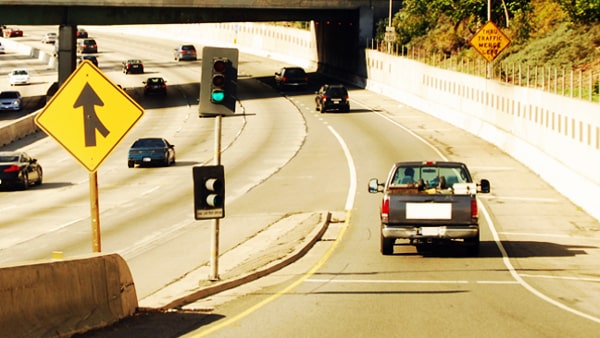
How should you use an acceleration lane when entering an expressway?

When entering a freeway entrance that allows you to accelerate to merge, you should drive at:
  1. A. Remain about 10 mph below expressway traffic
  2. B. Adjust to approximately the speed of expressway traffic before merging
  3. C. Reach the posted limit even when traffic is moving more slowly
  4. D. Accelerate beyond the speed of vehicles already on the expressway

Correct answer: B. – Adjust to approximately the speed of expressway traffic before merging

Use the acceleration lane to adjust your speed to the traffic already on the expressway. Merge only after checking for an adequate opening and confirming that the movement is safe. Traffic traveling on the expressway has the right-of-way over vehicles entering from a ramp.

Source: Georgia Department of Driver Services Drivers' Manual — Section 8, “Entering Expressways”