


Montana DMV Practice Test 3

5 out of 5 (40 votes)
80% Passing score
20 Questions
4 Mistakes allowed
Montana’s permit test rewards drivers who know the rules, not drivers who skimmed the handbook once and hoped that would carry them through. This free Montana DMV practice test gives you 20 questions built around the material new drivers actually need: road signs, right-of-way, safe following distance, distracted driving, basic traffic laws, and the kind of Montana-specific licensing details that can quietly matter more than people expect. The practice test is meant to feel direct and useful, not padded out with filler. You answer a question, get feedback right away, and see an explanation when something goes sideways. That immediate correction helps because Montana’s driving rules are not just test material. They are tied to the way the state moves new drivers through the licensing process, especially teens working through the Graduated Driver Licensing program. And yes, that part deserves attention, even if it is not the most thrilling reading you will do today. Montana allows different starting points depending on age and driver education. A student who is at least 14½ may qualify for a Driver Ed Learning Permit while enrolled in a state-approved traffic education program. At 15, a teen can pursue the learner permit route through an MVD exam station, and approved driver education may allow some applicants to qualify for a license before 16. For most drivers, though, 16 is the general minimum licensing age unless an approved exception applies. The GDL process itself has three stages: the non-commercial learner permit, the first-year restricted license, and the full-privilege driver license. During the learner stage, the teen must drive with proper supervision, usually with a parent, guardian, approved adult, or licensed driver education instructor in the seat beside them. Before moving to the first-year restricted license, the permit must be held for at least six months, and a parent or guardian must certify 50 hours of supervised driving, including 10 at night. The driver also needs to stay violation-free. This MT DMV practice permit test requires an 80% to pass, so you need 16 correct answers out of 20. The point is not just to squeeze past the real DMV permit test. It is to get comfortable with Montana driving laws before the licensing steps start stacking up — permit, supervised hours, restrictions, then finally the full license.
FREE DMV Practice Test App
Study for your Montana permit test or driver’s license with the NextDoorDriving app. 700+ DMV questions and answers, 100% free!
Download on the App Store

Sample Montana Permit Test Questions

Question 1

A yellow left-curve sign with a 25 mph advisory plaque indicates:
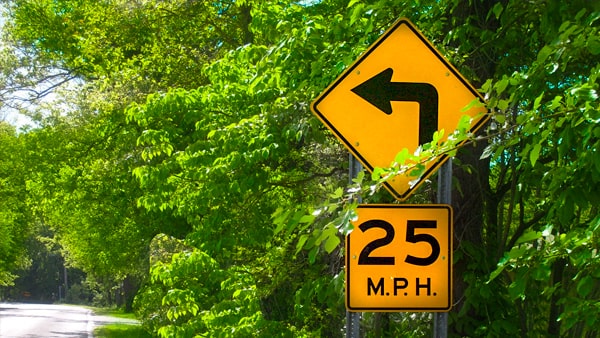
This sign means:
  1. A A left curve with a minimum speed of 25 mph
  2. B A right curve with a 25 mph speed limit
  3. C A right curve with an advisory speed of 25 mph
  4. D A left curve with an advisory speed of 25 mph

Correct answer: D – A left curve with an advisory speed of 25 mph

The yellow warning sign shows that the road curves left. The plaque below it gives a suggested safe speed of 25 mph for the curve; it does not establish a minimum speed. Reduce speed further when snow, ice, rain, or other conditions make the roadway less safe.

Source: Montana Driver Manual — Ch. 3, “Warning Signs”, Montana Driver Manual — Ch. 5, “Controlling Speed”
Question 2

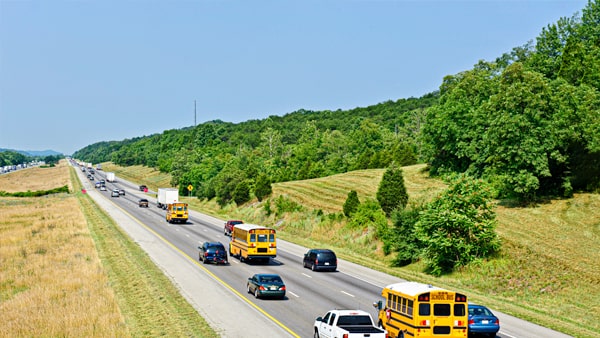
A school bus is stopped with red lights flashing on a four-lane highway that is not separated into different roadways. What must an approaching driver in the opposite direction do?

If a school bus stops to unload children on a four-lane highway, divided by a four-foot paved strip, vehicles traveling in the opposite direction are:
  1. A Stop about 30 feet away and wait until the red lights stop
  2. B Stop briefly and then pass with caution
  3. C Drive onto the shoulder to pass the bus
  4. D Continue without stopping

Correct answer: A – Stop about 30 feet away and wait until the red lights stop

In Montana, drivers approaching a stopped school bus from either direction must stop approximately 30 feet away when its red lights are flashing. They may not proceed until those lights stop operating. The different-roadway exception does not apply here. A first violation carries a $500 to $1,000 fine, 50 to 100 hours of community service, or both.

Source: MCA § 61-8-351(1)(a), (7), (9)(a)(i) – Meeting or Passing School Bus -- Vehicle Operator Liability for Violation -- Penalty

Question 3

What color scheme is normally used for warning signs marking hazards such as curves or narrow bridges?

  1. A Black symbols on a white background
  2. B Black symbols on a yellow background
  3. C White symbols on a blue background
  4. D White symbols on a green background

Correct answer: B – Black symbols on a yellow background

Standard warning signs are generally yellow with black lettering or symbols. They alert drivers to conditions ahead that may require extra attention, such as curves, intersections, or narrow roadways. A smaller yellow-and-black plaque may provide an advisory speed for the condition.

Source: Montana Driver Manual — Ch. 3, “Warning Signs”

Question 4

When parking uphill next to a curb, turn the front wheels:

When parking your vehicle facing uphill with a curb, you should point your front wheels:
  1. A Toward the curb
  2. B Away from the curb
  3. C In either direction
  4. D Straight ahead

Correct answer: B – Away from the curb

Turn the front wheels away from the curb when parking uphill. Set the parking brake and place an automatic transmission in park or a manual transmission in gear. If the vehicle begins rolling backward, the turned wheel should contact the curb rather than allowing the vehicle to roll into traffic.

Source: Montana Driver Manual — Ch. 4, “Parking on a Hill” and “General Guidelines”

Question 5

When making a right turn at an intersection, which path should you follow unless traffic-control devices direct otherwise?

  1. A Begin near the center line and finish in the left lane
  2. B Approach and turn as close as practicable to the right curb or edge
  3. C Finish in any lane that appears open
  4. D Swing left before beginning the turn

Correct answer: B – Approach and turn as close as practicable to the right curb or edge

Montana law requires both the approach for a right turn and the turn itself to be made as close as practicable to the right-hand curb or roadway edge. This prevents a wide, sweeping turn across other lanes. Follow a different course only when official traffic-control devices direct it.

Source: MCA § 61-8-333(1)(a), (3) – Required Position and Method of Turning at Intersections

Question 6

Which period requires special caution because visibility is reduced and drivers may be traveling during normal sleeping hours?

  1. A Morning daylight
  2. B Afternoon daylight
  3. C Dusk and nighttime
  4. D All periods have identical visibility conditions

Correct answer: C – Dusk and nighttime

Drivers cannot see as well at night and must adjust their speed to the distance illuminated by their headlights. Dusk also requires headlights and increased attention as available light decreases. The manual advises avoiding late-night driving when you would normally be asleep because drowsiness can impair safe driving.

Source: Montana Driver Manual — Ch. 5, “Night Driving”, Montana Driver Manual — Ch. 6, “Fatigue”