


Montana Road Signs Test

4.9 out of 5 (48 votes)
80% Passing score
10 Questions
2 Mistakes allowed
The Montana permit test is built around the things a new driver is expected to understand before getting behind the wheel: traffic laws, safe driving habits, road signs, signals, pavement markings, and the everyday rules that keep drivers from turning ordinary mistakes into bigger problems. It is not only a road signs test, although signs carry plenty of weight. They are part of the larger Class D knowledge test, and Montana expects you to know what they mean, what action they require, and how they fit into real driving. This Montana DMV practice test gives you a practical way to study that whole mix without bouncing around the driver manual hoping the important parts stick. The questions are multiple choice and focus on the same kinds of topics covered in the Montana Driver Manual, including warning signs, regulatory signs, right-of-way, traffic signals, impaired driving, sharing the road, and basic road-rule judgment. Some of it feels straightforward. Some of it is straightforward, honestly. And then you get a sign shape, a lane marking, or a wording detail that makes it clear why practice matters. The real Montana knowledge test is commonly listed as 33 multiple-choice questions, with 27 correct answers needed to pass. That means you can miss up to six. Six sounds like a comfortable cushion until you start losing points to things you half-remembered: the difference between a warning sign and a regulatory sign, what a particular pavement marking allows, or when a driver must yield instead of just slow down and hope for the best. Road sign questions deserve their own attention because Montana’s rules do not stop at simple recognition. You need to understand standard warning and regulatory signs and know what a driver should do when approaching them. A practice test helps turn that from vague familiarity into something more reliable, which is the whole point. The licensing process sits around the test, too. Teen drivers go through Montana’s Graduated Driver Licensing program, including learner-permit rules, supervised driving requirements, and first-year restrictions. Adults still need the written test, vision screening, documents, and road test. New residents with a valid out-of-state license may have different steps. Use this Montana permit practice test as a focused run-through of the material that actually matters before the exam: signs, traffic laws, safe driving, and the licensing basics people tend to skim until they suddenly need them.
FREE DMV Practice Test App
Study for your Montana permit test or driver’s license with the NextDoorDriving app. 700+ DMV questions and answers, 100% free!
Download on the App Store

Sample Montana Permit Test Questions

Question 1

According to the Montana Driver Manual, what does a yellow-painted curb permit?

  1. A Stopping only long enough to load or unload while staying with the vehicle
  2. B Unlimited parking for buses
  3. C Parking by emergency vehicles only
  4. D Parking by vehicles displaying disability credentials only

Correct answer: A – Stopping only long enough to load or unload while staying with the vehicle

A yellow curb permits stopping only long enough to load or unload. The driver must remain with the vehicle while using the area. It is not a general parking space, and other posted restrictions must also be followed.

Source: Montana Driver Manual — Ch. 4, “No Parking Zones”
Question 2

Your light is green, but traffic ahead prevents you from clearing the intersection. What should you do?

  1. A Enter and wait inside the intersection
  2. B Drive around the stopped vehicles
  3. C Wait outside until there is room to pass completely through
  4. D Enter because the green light gives you priority

Correct answer: C – Wait outside until there is room to pass completely through

Do not enter an intersection unless you can travel through it without stopping inside. Wait for traffic ahead to clear, even when your signal is green. This keeps your vehicle from blocking cross traffic when the signal changes.

Source: Montana Driver Manual — Ch. 4, “Driving Rules—Right-of-Way”

Question 3

After stopping at a stop sign, your view of cross traffic is blocked. What should you do next?

  1. A Wait five seconds and then enter
  2. B Sound your horn and proceed
  3. C Listen for traffic without moving forward
  4. D Edge forward slowly until you can see, then proceed when safe

Correct answer: D – Edge forward slowly until you can see, then proceed when safe

First make the complete stop required by Montana law at the proper location. If the cross-street view remains blocked, the driver manual advises edging forward slowly until crossing traffic can be seen. Enter only after you have checked that it is safe.

Source: MCA § 61-8-344(3) – Vehicles to Stop at Stop Signs, Montana Driver Manual — Ch. 5, “Scanning—Intersections”

Question 4

Your signal turns green while a vehicle or pedestrian is still lawfully in the intersection. What must you do?

  1. A Proceed because cross traffic must leave immediately
  2. B Yield before entering the intersection
  3. C Sound your horn and continue
  4. D Yield only if you are turning

Correct answer: B – Yield before entering the intersection

Montana's signal law permits movement on green but requires drivers to yield to vehicles and pedestrians lawfully within the intersection or an adjacent crosswalk. Allow them to clear your path before entering. A green light does not provide an unconditional right to proceed.

Source: MCA § 61-8-207(1)(a) – Traffic Control Signal Legend

Question 5

In Montana, how should you approach an intersection with an inoperative traffic signal?

  1. A Wait for the signal to be repaired
  2. B Continue unless a police officer arrives
  3. C Stop as though stop signs control the approaches
  4. D Proceed normally if no vehicles are visible

Correct answer: C – Stop as though stop signs control the approaches

State law requires a driver approaching an inoperative electronic traffic-control device to stop in the same manner required at a stop sign. The driver manual advises treating the intersection as though stop signs face all directions. Follow any instructions given by a police or highway patrol officer.

Source: MCA § 61-8-212 – Inoperative Traffic Control Device, MCA § 61-8-344(3) – Vehicles to Stop at Stop Signs, Montana Driver Manual — Ch. 3, “Traffic Signals”

Question 6

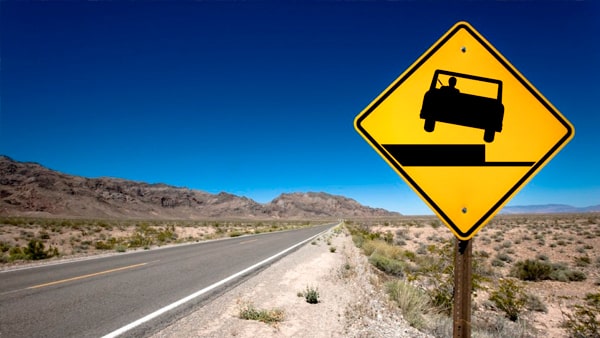
A SHOULDER DROP-OFF sign is posted ahead. If your right wheels leave the pavement, what is the safest response?

What should you be most concerned about when you see this sign?
  1. A Brake hard and immediately steer left
  2. B Accelerate until both wheels return to the pavement
  3. C Stop on the shoulder before adjusting your steering
  4. D Ease off the accelerator, steer parallel, slow down, and then ease back onto the road

Correct answer: D – Ease off the accelerator, steer parallel, slow down, and then ease back onto the road

The Montana Department of Transportation identifies the SHOULDER DROP-OFF warning sign as W8-9A. If your right wheels leave the pavement, the driver manual instructs you to release the accelerator and steer parallel to the roadway. After slowing, ease back onto the pavement when it is safe.

Source: Montana Department of Transportation Sign Catalog — W8-9A, “Shoulder Drop-Off”, Montana Driver Manual — Ch. 7, “Drift or Run off the Road”