


Montana Driving Test Practice 6

4.9 out of 5 (35 votes)
80% Passing score
20 Questions
4 Mistakes allowed
A Montana practice written driving test should feel tied to the actual licensing process, not like a pile of recycled road-rule questions with “Montana” pasted on top. This one gives you 20 questions focused on real driving knowledge, including the correct use of turn signals, which is one of those basic habits people think they already understand. Sometimes they do. Sometimes they signal halfway through the turn, drift across a lane first, or forget that a driver behind them cannot read minds across a snowy two-lane road. The Montana permit practice test requires 16 correct answers to pass, so it gives you a clear benchmark without turning the whole thing into a guessing game. The questions are built to reflect the kind of details that matter on Montana roads: highway speeds, rural intersections, city traffic, livestock crossings, snowplow operations, and all the small judgment calls that sit between “I know the rule” and “I can actually use it while driving.” Visual aids are worked into many of the questions, too, which helps with situations that are awkward to explain in text alone, like tricky intersections or multi-lane roundabouts. Afterward, you can review missed answers with explanations and hints, which is where a lot of the real learning happens, frankly. For teen drivers, the written test sits inside Montana’s Graduated Driver Licensing program. A Driver Ed Learning Permit may be available at age 14½ for students in a state-approved traffic education program who meet the attendance and testing requirements. A standard learner permit is generally handled through a driver exam station, with eligibility depending on age and driver education status. The Montana Driver Manual is still the study anchor here, and yes, that includes the parts people skim because they look obvious. Adult applicants 18 and older have a more direct route, but not an automatic one. They must pass the written test, vision test, and road test, and the written test comes before the driving test. New Montana residents have their own timing issue: if they move to the state with a valid out-of-state non-commercial license, they generally need to start the Montana license application process within 60 days. Some may avoid testing by bringing a hard copy of that valid license, while qualifying applicants from Taiwan or the Republic of Korea may transfer under Montana’s reciprocity agreements. So, the MT driving test practice is not just a warm-up. It is a practical check on whether the rules, the process, and the road situations are actually sticking.
FREE DMV Practice Test App
Study for your Montana permit test or driver’s license with the NextDoorDriving app. 700+ DMV questions and answers, 100% free!
Download on the App Store

Sample Montana Permit Test Questions

Question 1

Alcohol-impaired driving is best described as:

  1. A A minor traffic concern
  2. B A serious traffic-safety problem
  3. C Safe after only a few drinks
  4. D A danger only to the impaired driver

Correct answer: B – A serious traffic-safety problem

Alcohol-impaired driving is a serious safety problem because alcohol consumption, even in small amounts, increases the chance of a crash. Impairment can interfere with the abilities needed to operate a vehicle safely. Montana law prohibits driving or being in actual physical control of a vehicle on a public way while under the influence of alcohol.

Source: MCA § 61-8-1002(1)(a) – Driving Under Influence, Montana Driver Manual — Ch. 6, “Drinking & Driving”
Question 2

Before opening a parked vehicle’s door on the traffic side, you should:

  1. A Check behind you for vehicles, bicyclists, and pedestrians
  2. B Open the door and require traffic to stop
  3. C Give a left-turn hand signal
  4. D Sound the horn

Correct answer: A – Check behind you for vehicles, bicyclists, and pedestrians

Check carefully for approaching vehicles, bicyclists, and pedestrians before opening a door next to traffic. Montana law prohibits opening a vehicle door unless it is reasonably safe and will not interfere with other traffic. A door on the traffic side may not remain open longer than necessary for loading or unloading passengers.

Source: MCA § 61-8-368 – Opening and Closing Vehicle Doors, Montana Driver Manual — Ch. 4, “Parking—General Guidelines”

Question 3

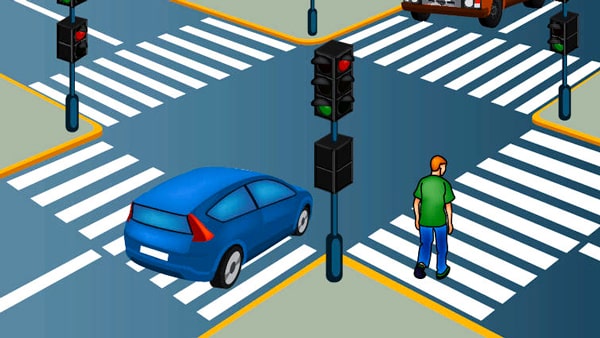
Your light turns green as a pedestrian receives a WALK signal and enters the crosswalk beside you. Before turning right, what must you do?

You are waiting at a red light to turn right, and a pedestrian on your right is waiting to cross the street you want to enter. Who has the right-of-way when your light turns green?
  1. A Yield until the pedestrian is clear of your path
  2. B Proceed if the crosswalk has no painted lines
  3. C Turn first because you have a green light
  4. D Sound your horn and enter the crosswalk

Correct answer: A – Yield until the pedestrian is clear of your path

In Montana, a green signal permits a right turn, but the turning driver must yield to pedestrians lawfully within the adjacent crosswalk. A pedestrian facing a WALK signal may proceed across the roadway. Wait until the pedestrian is safely outside the path of your turn before moving.

Source: MCA § 61-8-207(1)(a), (1)(c) – Traffic Control Signal Legend, MCA § 61-8-208(1) – Pedestrian Control Signals

Question 4

At a Montana intersection without traffic signals, a pedestrian is crossing within an unmarked crosswalk. Who must yield?

  1. A The pedestrian, because the crosswalk is not painted
  2. B The pedestrian, unless the driver is turning
  3. C The driver must yield to the pedestrian
  4. D Whichever road user reaches the center of the roadway last

Correct answer: C – The driver must yield to the pedestrian

When signals are absent or not operating, a driver must yield to a pedestrian crossing within a marked crosswalk or an unmarked crosswalk at an intersection. The driver must slow or stop if necessary. A pedestrian may not suddenly enter the path of a vehicle that is too close for its driver to yield.

Source: MCA § 61-8-502(1)(a) – Pedestrians' Right-of-Way in Crosswalk -- School Children -- Pedestrian-Actuated Devices

Question 5

Which action demonstrates defensive observation while driving?

  1. A Keeping exactly one car length behind every vehicle
  2. B Watching only the vehicle directly ahead
  3. C Scanning ahead, to both sides, and behind your vehicle
  4. D All of the above

Correct answer: C – Scanning ahead, to both sides, and behind your vehicle

Defensive drivers continuously gather information from ahead, the sides, and behind. Scanning helps reveal pedestrians, vehicles, and changing conditions early enough to respond smoothly. A fixed one-car-length gap does not account for speed, and staring only at the vehicle ahead can hide hazards elsewhere.

Source: Montana Driver Manual — Ch. 5, “Seeing Well—Scanning”, Montana Driver Manual — Ch. 5, “Sharing Space—Space Ahead”

Question 6

At an intersection without operating signals, when must a driver yield to a pedestrian in a crosswalk?

  1. A Only when traffic officers are present
  2. B Whether the crosswalk is marked or unmarked
  3. C Only when painted crosswalk lines are visible
  4. D Only during daylight hours

Correct answer: B – Whether the crosswalk is marked or unmarked

Montana requires drivers to yield to pedestrians crossing in marked crosswalks and in unmarked crosswalks at intersections when signals are absent or not operating. Drivers must slow or stop when necessary. Pedestrians also may not suddenly leave a place of safety when an approaching vehicle is too close for its driver to yield.

Source: MCA § 61-8-502(1)(a) – Pedestrians' Right-of-Way in Crosswalk -- School Children -- Pedestrian-Actuated Devices