Rhode Island DMV Practice Test 5

4.9 out of 5 (52 votes)
80% Passing score
20 Questions
4 Mistakes allowed
Preparing for the Rhode Island DMV permit test is not just a matter of clicking through a few road sign questions and hoping the rest feels familiar. This RI DMV practice test focuses on alcohol, impairment, BAC limits, and DUI penalties, which are some of the more serious topics on the computerized knowledge exam. And honestly, they deserve the extra attention. These are not tiny rulebook details you forget after test day; they are the rules that shape what responsible driving is supposed to look like once you actually have the keys. This 20-question Rhode Island DMV written test practice keeps the focus tight. You will see questions about how alcohol affects reaction time, judgment, coordination, and decision-making, along with the legal consequences of driving under the influence. Some of it may feel obvious at first, then a question will lean into a penalty, a limit, or a real-world situation where the safe answer is not just “be careful.” That is where this DMV permit test practice earns its keep. It helps you slow down and notice the exact rule, not the version of the rule you half-remember. For adults age 18 or older, the Rhode Island licensing process has its own track. A first-time adult driver, or someone whose Rhode Island license has been expired for more than five years, generally applies for an instruction permit and takes the computerized knowledge exam. Adult applicants also need the standard paperwork: the License/ID/Permit Application, proof of identity, a Social Security number or proof of ineligibility, two Rhode Island residency documents, required fees, and a vision screening. The teen 33-hour driver education course is not required for adults, and neither are the under-18 graduated licensing requirements. There is one adult permit detail worth knowing before it gets buried in the paperwork. After getting a Rhode Island instruction permit, an adult permit holder age 18 or older must hold it for 30 days before taking the road test. During that period, Rhode Island says adult permit holders may drive alone and do not need supervision. That surprises people, probably because learner’s permits are usually discussed as if they all work the same way. Use this Rhode Island DMV practice test more than once. Review the missed answers, read the explanations, and pay attention to the wording that caused the mistake. It is practice for the DMV test, yes, but it also gives the adult licensing process a little more shape before the real exam.
FREE DMV Practice Test App
Study for your Rhode Island permit test or driver’s license with the NextDoorDriving app. 700+ DMV questions and answers, 100% free!
Download on the App Store

Sample Rhode Island Permit Test Questions

Question 1

On a slippery road, how should you brake a vehicle that has conventional, non-ABS brakes?

What should you do if you have to stop your vehicle in an emergency?
  1. A Gently pump the brake pedal
  2. B Press firmly and hold the pedal down
  3. C Use only the parking brake
  4. D Shift into park before braking

Correct answer: A – Gently pump the brake pedal

With conventional brakes on a slippery surface, the manual recommends applying the brakes by pumping them very gently. If the vehicle has ABS, do not pump the pedal; press it firmly and maintain pressure until the vehicle stops. Drivers should know which braking system their vehicle has before an emergency occurs.

Source: Rhode Island Driver’s Manual — Ch. V.A, “How to Avoid Skidding”
Question 2

What does a steady yellow arrow displayed for a turn lane indicate?

  1. A A protected turn is beginning
  2. B You must accelerate through the turn
  3. C The related green or flashing-arrow movement is ending
  4. D All opposing traffic must remain stopped

Correct answer: C – The related green or flashing-arrow movement is ending

Under Rhode Island law, a steady yellow arrow warns that the related green-arrow or flashing-arrow movement is being terminated. While the yellow arrow remains displayed, the rules governing the movement that is ending continue to apply. It does not authorize a driver to accelerate or disregard applicable yielding duties.

Source: R.I. Gen. Laws § 31-13-6(2)(iii) — Meaning of traffic control signals

Question 3

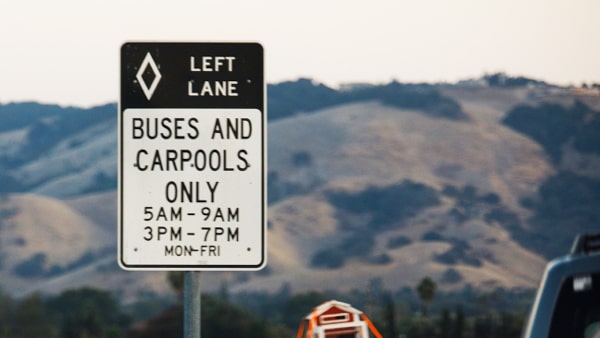
A lane is marked by an HOV sign showing a minimum occupancy. When may you use that lane?

You can drive in a carpool lane if:
  1. A When your vehicle meets the posted occupancy requirement
  2. B Whenever the regular lanes are congested
  3. C Only while passing another vehicle
  4. D Whenever you are driving to work

Correct answer: A – When your vehicle meets the posted occupancy requirement

An HOV lane is designated for high-occupancy vehicles and carpooling. A driver must follow the occupancy requirement displayed on the lane’s sign. Congestion, the desire to pass, or the purpose of a trip does not by itself qualify a vehicle to use the lane.

Source: Rhode Island Driver’s Manual — Ch. IV.B, “Roadway Markings”

Question 4

A prescribed medication has made a driver incapable of operating safely. Is driving permitted because the medication was legally prescribed?

  1. A Yes, if the prescribing professional approved it
  2. B Yes, if the prescription container is in the vehicle
  3. C No, legal entitlement to use the drug is not a defense
  4. D Yes, if the driver remains below the speed limit

Correct answer: C – No, legal entitlement to use the drug is not a defense

Rhode Island prohibits operating a vehicle while under the influence of a drug to a degree that makes the person incapable of driving safely. Legal entitlement to use the drug is not a defense. For a qualifying first drug-related offense under § 31-27-2(d)(1)(i), penalties include a $100–$300 fine, a 30–180-day license suspension, 10–60 hours of community restitution, and up to one year of imprisonment.

Source: R.I. Gen. Laws § 31-27-2(a), (b)(1), (d)(1)(i) — Driving under influence of liquor or drugs

Question 5

A white KEEP RIGHT sign shows an arrow passing to the right of an obstruction. What does it direct you to do?

This white sign means:
  1. A Pass to the right of the divider or obstruction
  2. B Yield before making a right turn
  3. C Move right only if you are driving slowly
  4. D Turn right at the next intersection

Correct answer: A – Pass to the right of the divider or obstruction

A KEEP RIGHT sign directs traffic to travel to the right of the island, divider, or other obstruction marked by the sign. It regulates how you pass that specific feature. It is not an instruction to make a right turn at the next intersection or a general slower-traffic sign.

Source: Rhode Island Driver’s Manual — App. K, “Regulatory and Warning Sign Examples: Regulatory Signs”

Question 6

Which habit is part of an effective defensive-driving visual search?

  1. A Focus only on the vehicle directly ahead
  2. B Remain alert and continually scan different areas
  3. C Depend on other drivers to correct your mistakes
  4. D Wait until a hazard is close before reacting

Correct answer: B – Remain alert and continually scan different areas

The Rhode Island manual’s defensive-driving guidance tells drivers to keep their eyes moving rather than stare at one object. Scan ahead and to the sides, and regularly glance in the rearview and side mirrors. A continuing visual search helps identify changes and possible conflicts early enough to choose an appropriate response.

Source: Rhode Island Driver’s Manual — Ch. VII, “Systems for Safe, Courteous, and Defensive Driving”