Rhode Island Practice Permit Test 6

4.5 out of 5 (61 votes)
80% Passing score
20 Questions
4 Mistakes allowed
Rhode Island permit prep is not something you want to approach with a few road-sign flashcards and a vague memory of who gets the right of way. The knowledge exam is based on the Rhode Island Driver’s Manual, and it reaches into the full range of everyday driving rules: traffic laws, signs, signals, lane markings, pavement markings, safe driving practices, impaired driving, and the small but important business of sharing the road with pedestrians, cyclists, motorcycles, emergency vehicles, and large trucks. This RI permit practice test is meant to make that material easier to work through without flattening it into a dull manual recap. The real passenger-car knowledge test is multiple choice, and the commonly reported format is 50 questions with 40 correct answers required to pass. That is an 80% score, which sounds manageable until you realize how quickly missed questions add up when the wording leans into details. So the point here is not just repetition, although repetition helps. It is getting used to how Rhode Island driving rules are asked, how signs connect to right-of-way decisions, and how ordinary driving situations can turn into test questions. Road signs are included as part of the main Rhode Island knowledge exam, not treated as a separate road-sign-only test for a standard passenger permit. That matters because sign knowledge is rarely just “what does this shape mean?” It is usually tied to what you are allowed to do next, what other drivers may do, and where your attention should already be before you move. The testing process has its own details, too, and they are worth knowing before the day arrives. Computerized knowledge exams are given by reservation at the DMV headquarters in Cranston, and a vision test is handled at that time. Applicants under 18 need the required 33-hour driver education course and must bring the original completion certificate. Adults 18 and older do not need that teen driver education course. The exam is available in English, Spanish, and Portuguese, with other foreign-language exams requested ahead of time. Bring the completed LI-1 application, identity documents, Social Security information or proof of ineligibility, two Rhode Island residency documents, and the correct fee. A little fussy, yes, but knowing it now beats finding it out at the counter.
FREE DMV Practice Test App
Study for your Rhode Island permit test or driver’s license with the NextDoorDriving app. 700+ DMV questions and answers, 100% free!
Download on the App Store

Sample Rhode Island Permit Test Questions

Question 1

When rain, snow, or fog reduces daytime visibility, which headlights should you use?

  1. A High-beam headlights
  2. B Low-beam headlights
  3. C Parking lights only
  4. D Emergency flashers with high beams

Correct answer: B – Low-beam headlights

Rhode Island requires vehicle lights when windshield wipers are being used because of unfavorable weather and whenever visibility is insufficient to see clearly for 500 feet. The driver’s manual directs motorists to use low beams during rain, snow, fog, and other conditions that reduce visibility. High beams may reflect from the precipitation and shorten the driver’s effective viewing distance.

Source: R.I. Gen. Laws § 31-24-1(a) – Times when lights required, Rhode Island Driver’s Manual — Ch. VIII, “Night Driving—Using Your Headlights”

Question 2

A posted minimum speed is intended primarily to:

  1. A Prevent unnecessarily slow driving from impeding normal traffic movement
  2. B Report temporary roadway conditions
  3. C Measure the need for future traffic signals
  4. D Identify areas reserved for pedestrians

Correct answer: A – Prevent unnecessarily slow driving from impeding normal traffic movement

Rhode Island prohibits driving so slowly that normal and reasonable traffic movement is impeded or blocked. A minimum-speed requirement supports an orderly traffic flow by limiting unnecessarily slow travel. A driver may still reduce speed when necessary for safe operation or to comply with another law.

Source: R.I. Gen. Laws § 31-14-9 – Minimum speed

Question 3

A downward green arrow displayed over a reversible lane indicates that:

This green arrow on a lane use control signal means that:
  1. A You may travel in that lane
  2. B The lane is closed to traffic
  3. C Traffic in the lane has priority at every intersection
  4. D You must immediately merge into that lane

Correct answer: A – You may travel in that lane

Reversible lanes may carry traffic in different directions at different times. A green arrow above the lane indicates that motorists may travel in it. The arrow identifies an available lane; it does not require a driver in another lane to merge into it.

Source: Rhode Island Driver’s Manual — Ch. IV, “Roadway Markings”

Question 4

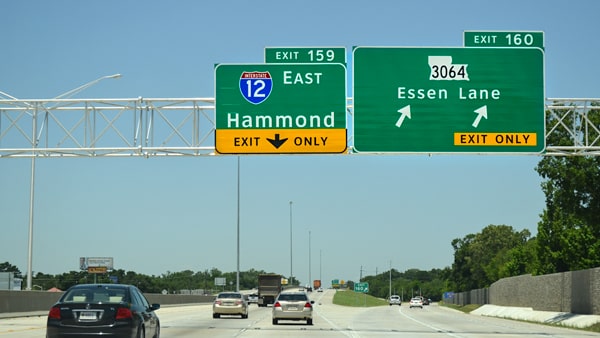
A yellow “EXIT ONLY” panel displayed above your freeway lane means that:

If you see this sign above your lane, you:
  1. A The lane cannot be used to exit
  2. B The lane may either continue through or exit
  3. C The lane continues through the interchange
  4. D The lane leaves the freeway at the upcoming exit

Correct answer: D – The lane leaves the freeway at the upcoming exit

An “EXIT ONLY” panel is used to identify a freeway lane that drops at an interchange. Traffic remaining in that lane is directed onto the exit ramp rather than continuing on the main roadway. A driver who wants to continue through the interchange must move safely into a through lane before the lane separates.

Source: 550-RICR-00-00-1 §§ 1.3–1.4 – Rules and Regulations Rules Governing the State Traffic Commission, Manual on Uniform Traffic Control Devices for Streets and Highways (2009) — § 2E.24, “Signing for Interchange Lane Drops”

Question 5

Which of these is normally displayed as a vertical rectangular regulatory sign?

  1. A School crossing
  2. B Railroad crossing
  3. C Stop
  4. D Speed limit

Correct answer: D – Speed limit

The regulatory-sign chart displays a speed limit sign as a vertical white rectangle with a black legend. Stop signs use an octagonal shape, while school and railroad crossing warnings use their own distinctive shapes. Recognizing a sign’s shape can help identify its general purpose before its message is readable.

Source: Rhode Island Driver’s Manual — “Signs,” “Regulatory Signs” and “Warning Signs”

Question 6

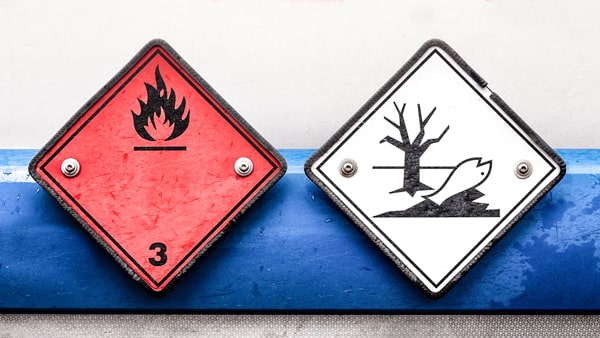
Outside a business or residence district, a vehicle carrying explosives or flammable liquids approaches a railroad crossing with no officer or signal directing it through. The driver must:

Which of the following is true about vehicles displaying a diamond-shaped sign (indicating a hazardous load)?
  1. A Use the crossing only when traveling on a freeway
  2. B Remain below 35 mph while crossing
  3. C Stop 15 to 50 feet from the nearest rail and proceed only when safe
  4. D Continue because the vehicle has priority

Correct answer: C – Stop 15 to 50 feet from the nearest rail and proceed only when safe

Rhode Island requires a vehicle carrying explosives or flammable liquids as cargo to stop between 15 and 50 feet from the nearest rail. While stopped, the driver must look and listen for trains and crossing signals, then proceed only when safe. The vehicle must cross in a gear that does not require shifting on the tracks. The rule has exceptions for crossings in business or residence districts and when an officer or traffic signal directs traffic to proceed.

Source: R.I. Gen. Laws § 31-20-4(a)–(c) – Vehicles required to stop at all railroads — Exceptions