Rhode Island Road Signs Test 2

4.9 out of 5 (45 votes)
80% Passing score
20 Questions
4 Mistakes allowed
Rhode Island’s permit test covers more ground than most people expect, and road signs are only one piece of it — though an important piece. The knowledge exam is based on the Rhode Island Driver’s Manual, which means you can be asked about traffic laws, right-of-way, pavement markings, signals, safe driving habits, impaired driving, and how to share the road with pedestrians, bicycles, motorcycles, emergency vehicles, and larger vehicles. Basically, the DMV wants to know whether you can read the road, not just recognize a red octagon and call it a day. This RI DMV practice test gives you a focused way to work through that material before you take the real exam. The questions are multiple choice, with the kind of wording and decision-making you should expect from a Rhode Island permit test practice session: road signs, traffic signals, lane markings, warning signs, regulatory signs, and the little rule details that tend to blur together when you only read the manual once. And, yes, reading the manual matters. But practicing with questions forces you to catch the gaps — the ones you do not notice until an answer choice sounds almost right, which is deeply unhelpful in the moment. For the actual Rhode Island permit knowledge test, the commonly reported format is 50 multiple-choice questions, with 40 correct answers needed to pass. That works out to 80%, so you can miss up to 10. Road sign questions are included as part of the main knowledge exam; Rhode Island does not appear to use a separate road-sign-only test for a standard passenger-car learner permit. The computerized exam is given by reservation at the DMV headquarters in Cranston, and a vision screening is handled at the same time. The computer test is available in English, Spanish, and Portuguese, while other foreign-language exams may need to be requested ahead of time. The process also changes a bit depending on your age. If you are under 18, Rhode Island requires the 33-hour driver education course before you apply for a Limited Instruction Permit, and the DMV wants the original completion certificate, not a photocopy. Adults 18 and older skip that teen course, but they still need the permit application, required identity and residency documents, the knowledge exam, and the vision test. So this practice test is not just about getting comfortable with signs. It is a practical rehearsal for the rules, wording, and Rhode Island-specific details you are likely to face before you move on to the next step.
FREE DMV Practice Test App
Study for your Rhode Island permit test or driver’s license with the NextDoorDriving app. 700+ DMV questions and answers, 100% free!
Download on the App Store

Sample Rhode Island Permit Test Questions

Question 1

What may a driver do when facing a steady circular green light?

  1. A Proceed through or turn as permitted, after yielding where required
  2. B Stop before entering every intersection
  3. C Proceed without checking for pedestrians or vehicles
  4. D Turn right only

Correct answer: A – Proceed through or turn as permitted, after yielding where required

A circular green signal permits a driver to proceed straight or make a permitted turn or U-turn. The driver must still obey signs, markings, and separate turn signals. Traffic proceeding on green must yield to pedestrians lawfully in an associated crosswalk and vehicles lawfully within the intersection; left-turning traffic must also yield to hazardous oncoming traffic.

Source: R.I. Gen. Laws § 31-13-6(1)(i), (1)(i)(A)–(B) – Meaning of Traffic Control Signals
Question 2

A standard diamond-shaped traffic sign generally provides what type of message?

  1. A A warning about a roadway condition or hazard
  2. B An interstate route number
  3. C A posted speed limit
  4. D A parking regulation

Correct answer: A – A warning about a roadway condition or hazard

Standard warning signs are generally diamond-shaped and alert road users to roadway conditions or hazards. They normally have black symbols, words, and borders on a yellow background, although specified warning signs may use other colors or shapes. Regulatory and route signs use different standard designs.

Source: 550-RICR-00-00-1.3 – Incorporated Materials, 2009 MUTCD — § 2C.03, “Design of Warning Signs”

Question 3

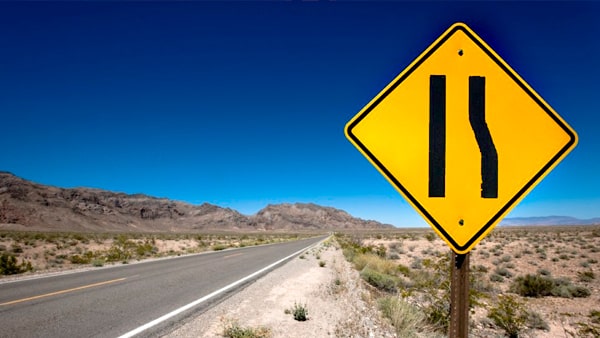
A yellow diamond sign shows the right lane tapering into the lane beside it. What does it warn you about?

This sign means:
  1. A The right lane ends ahead
  2. B A divided highway begins
  3. C A steep hill begins
  4. D Trucks may enter the roadway

Correct answer: A – The right lane ends ahead

The Lane Ends sign warns of a reduction in the number of traffic lanes traveling in your direction. When the symbol shows the right lane tapering out, traffic in that lane will need to merge left. Observe surrounding traffic and complete any necessary lane movement safely.

Source: 550-RICR-00-00-1.3 – Incorporated Materials, 2009 MUTCD — § 2C.42, “Lane Ends Signs (W4-2, W9-1, W9-2)”

Question 4

Which color is used for lane lines separating traffic moving in the same direction?

  1. A Yellow
  2. B White
  3. C Red
  4. D Black

Correct answer: B – White

White lines separate lanes in which traffic travels in the same direction. Broken white lines generally allow drivers to change lanes, while solid white lines indicate that lane changing is restricted. Drivers must check that a lane movement can be completed safely before crossing any lane line.

Source: Rhode Island Driver’s Manual — § IV.B, “Roadway Markings”

Question 5

On a Rhode Island freeway, what colors are normally used for a guide sign showing the distance to an exit?

  1. A Black on yellow
  2. B White on black
  3. C White on red
  4. D White on green

Correct answer: D – White on green

Freeway and expressway guide signs normally display white letters, numerals, arrows, symbols, and borders on a green background. These signs provide information such as destinations, routes, exits, lanes, and distances. Yellow-and-black signs instead usually provide warnings about conditions ahead.

Source: 550-RICR-00-00-1.3 – Incorporated Materials, 2009 MUTCD — § 2E.05, “Color of Guide Signs”

Question 6

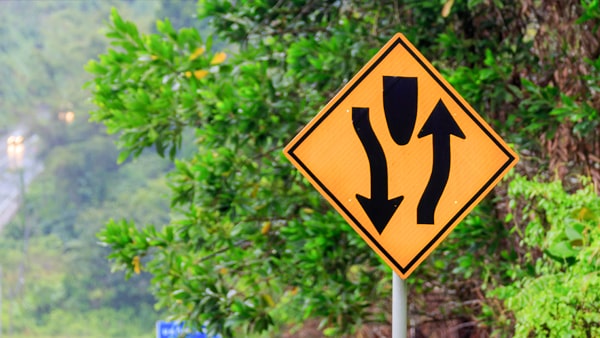
A yellow warning sign indicates that opposing traffic will soon be separated by a median or physical barrier. What begins ahead?

This sign means:
  1. A The end of a divided highway
  2. B A one-way street
  3. C An undivided two-way road
  4. D A divided highway

Correct answer: D – A divided highway

The Divided Highway sign warns that the road ahead becomes physically divided. A median or other barrier will separate traffic traveling in opposite directions. This sign applies to the beginning of a divided roadway section, not to an intersection with another divided highway.

Source: 550-RICR-00-00-1.3 – Incorporated Materials, 2009 MUTCD — § 2C.22, “Divided Highway Sign (W6-1)”