


Rhode Island Permit Test Simulator

4.6 out of 5 (121 votes)
80% Passing score
50 Questions
10 Mistakes allowed
Rhode Island’s DMV permit test rewards people who actually study the manual, not people who sort of remember how Stop signs work and figure the rest will come to them. The exam is based on the Rhode Island Driver’s Manual, and it can reach into traffic laws, road signs, signals, pavement markings, right-of-way rules, safe driving practices, impaired driving, and the everyday business of sharing the road with pedestrians, cyclists, motorcycles, emergency vehicles, and large trucks. That is a lot of ground for one permit test, and some of it feels obvious until, well, it doesn’t. This RI permit test practice simulator is built around the real shape of the DMV knowledge test. You get 50 randomly selected multiple-choice questions, with 40 correct answers needed to pass — an 80% score. Missing up to 10 questions gives you a little room, but not much, and that is the part worth paying attention to. The random question set also matters. It keeps you from memorizing one neat little answer pattern and thinking you are ready when you have only gotten familiar with a single version of the test. The practice test covers the material Rhode Island actually expects you to know: signs and signals, lane markings, right-of-way situations, traffic laws, driver responsibility, and the kinds of safety rules that show up both on the screen and later on the road. It is also a useful way to find the weak spots that do not announce themselves politely. Maybe road signs are fine, but pavement markings are shaky. Maybe you know basic traffic signals and then get tripped up by sharing-the-road questions. Fine. Better here than at the DMV. A few licensing details are worth keeping in the same mental folder. Teen applicants need the required 33-hour driver education course before applying for a Limited Instruction Permit, while adults 18 and older generally take the computerized knowledge exam, pass the vision screening, and then hold an instruction permit before moving on to the road test. The computerized knowledge exam is offered by reservation at the DMV headquarters in Cranston, with English, Spanish, and Portuguese available on the computerized test. Road sign questions are part of the main knowledge exam, not a separate little test hiding somewhere else. Use this Rhode Island DMV practice test to get comfortable with the format, build accuracy, and walk into the real permit test with fewer surprises than the person who “just skimmed it.”
FREE DMV Practice Test App
Study for your Rhode Island permit test or driver’s license with the NextDoorDriving app. 700+ DMV questions and answers, 100% free!
Download on the App Store

Sample Rhode Island Permit Test Questions

Question 1

Fog has reduced visibility so severely that you cannot continue safely. What should you do?

  1. A Use high beams and maintain your speed
  2. B Use low beams and move completely off the travel lane before stopping
  3. C Stop immediately in the travel lane
  4. D Continue at the same speed with hazard flashers on

Correct answer: B – Use low beams and move completely off the travel lane before stopping

Use low-beam headlights in fog because high beams may reflect from moisture in the air and shorten the distance you can see. If conditions make it necessary to stop, move as far off the traffic lane as possible before doing so. Do not leave the vehicle stopped in a lane used by moving traffic.

Source: Rhode Island Driver’s Manual — Ch. VIII.B, “Night Driving”, Rhode Island Driver’s Manual — Ch. III.M, “Safe Driving on the Highway”

Question 2

Which centerline prohibits passing by traffic traveling in either direction?

  1. A One solid yellow line beside one broken yellow line
  2. B A single broken yellow line
  3. C Two solid yellow lines
  4. D A single broken white line

Correct answer: C – Two solid yellow lines

Double solid yellow lines separate traffic moving in opposite directions and prohibit passing from either side. A broken yellow centerline permits passing with care when the maneuver is otherwise lawful and safe. Limited exceptions may allow crossing solid lines for matters such as a legal turn or an obstruction, but those exceptions do not authorize passing another vehicle.

Source: Rhode Island Driver’s Manual — Ch. IV.B, “Roadway Markings”

Question 3

Outside a business or residence district, which vehicle generally must stop before crossing railroad tracks at grade?

What vehicles must stop at all railroad crossings?
  1. A Any pickup truck
  2. B A school bus carrying a schoolchild or a vehicle carrying passengers for hire
  3. C Any motorcycle
  4. D Any passenger vehicle towing a small trailer

Correct answer: B – A school bus carrying a schoolchild or a vehicle carrying passengers for hire

Rhode Island requires a vehicle carrying passengers for hire, a school bus carrying a schoolchild, and a vehicle carrying specified explosive or flammable cargo to stop 15–50 feet from the nearest rail. The driver must look and listen and may proceed only when safe. The section does not apply in business or residence districts, and no stop is required when an officer or traffic signal directs traffic to proceed.

Source: R.I. Gen. Laws § 31-20-4(a)–(c) — Vehicles required to stop at all railroads — Exceptions

Question 4

When traveling on a narrow or winding roadway, what does Rhode Island law require?

  1. A Maintain the posted maximum speed
  2. B Drive at an appropriately reduced speed
  3. C Drive along the centerline for extra clearance
  4. D Accelerate before meeting approaching traffic

Correct answer: B – Drive at an appropriately reduced speed

Rhode Island’s speed law requires an appropriately reduced speed when a driver is traveling on a narrow or winding roadway. The same duty applies when approaching curves, hill crests, intersections, railroad crossings, and other special hazards. A posted limit is not permission to travel at that speed when the roadway conditions call for a lower speed.

Source: R.I. Gen. Laws § 31-14-3(a) — Conditions requiring reduced speed, R.I. Gen. Laws § 31-14-1 — Reasonable and prudent speeds

Question 5

On a three-lane expressway carrying traffic in one direction, when may a driver pass another vehicle on the right?

  1. A Whenever the left lane is occupied
  2. B Only after sounding the horn continuously
  3. C By using the shoulder if the lanes are congested
  4. D When the roadway is wide and unobstructed, the movement is safe, and the driver stays on the pavement

Correct answer: D – When the roadway is wide and unobstructed, the movement is safe, and the driver stays on the pavement

Passing on the right is permitted on a one-way roadway when it is free from obstructions and wide enough for two or more lines of moving vehicles. The maneuver must be possible to complete safely. A driver may not leave the pavement or main-traveled part of the roadway to make the pass.

Source: R.I. Gen. Laws § 31-15-5(a)(2), (b) — Overtaking on the right

Question 6

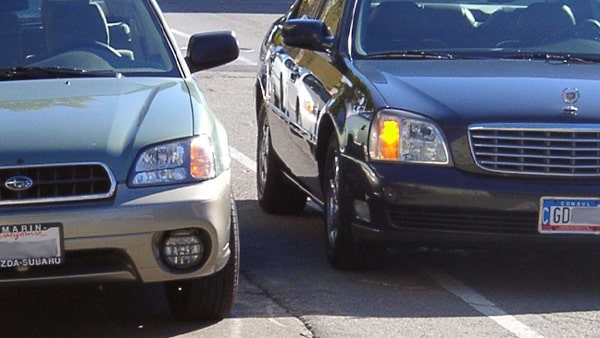
For an ordinary parking maneuver, which location is prohibited?

Which of the following is true about double parking?
  1. A On the roadway side of a vehicle parked at the curb
  2. B In a lawful marked space
  3. C Beside a curb where parking is permitted
  4. D In a private driveway with the owner’s permission

Correct answer: A – On the roadway side of a vehicle parked at the curb

Rhode Island generally prohibits stopping, standing, or parking on the roadway side of a vehicle already stopped or parked at the edge or curb. The statute contains limited exceptions, including certain momentary stops to load or unload passengers or property and unavoidable stops by disabled vehicles. Those exceptions do not make ordinary double parking lawful.

Source: R.I. Gen. Laws § 31-21-4(a)(12), (b) — Places where parking or stopping prohibited