


South Dakota DMV Sign Test 3

4.9 out of 5 (91 votes)
80% Passing score
20 Questions
4 Mistakes allowed
Road signs do a lot of quiet work on the South Dakota knowledge test. They are easy to recognize when you are scrolling past them in a study guide, sure, but the exam is not really asking whether you have seen a Stop sign before. It is checking whether you understand traffic signs as part of the larger rules-of-the-road system: shapes, colors, symbols, warnings, pavement markings, signals, and those plain regulatory signs that look harmless until they are the reason you miss a question. This South Dakota road signs test focuses on that exact piece of the official permit exam. The real South Dakota permit knowledge test is the standard noncommercial driver knowledge exam used by the Driver Licensing Program, and it is based on the South Dakota Driver License Manual. The manual covers safe driving, traffic control devices, right-of-way rules, school buses, sharing the road, impaired driving, pavement markings, traffic signals, and traffic signs. So, no, road signs are not floating off by themselves somewhere. They are part of the main test, mixed in with everything else a new driver is expected to know. The official knowledge test has 25 multiple-choice questions, and you need 20 correct answers to pass. That is an 80% score, with a maximum of 5 missed questions total. South Dakota does not publish a separate road-sign-only test for a standard operator license, and there is no separate missed-question limit just for signs. Miss a sign question, and it counts the same as missing one about speed, right-of-way, or when to stop for a school bus. Which is fine, technically. It just means the “small stuff” is not really small. This SD DMV signs practice test helps you slow down long enough to notice what the signs are actually telling you. Stop and yield signs are only the beginning. You will also want to be comfortable with warning signs on rural roads, railroad crossings, guide signs, regulatory signs, and markings that tell you what is allowed before you have time to negotiate with yourself about it. South Dakota driving can shift from town streets to open highway to ugly weather pretty quickly, and the signs tend to know what is coming before you do. Take the South Dakota road sign recognition test as many times as you need, then move into a full South Dakota permit practice test. If you fail the official knowledge test, you cannot retest until the next working day, and each fee gives you 3 testing opportunities within 6 months. A little repetition here is not overkill. It is just the cheaper, calmer way to find out what you still need to learn.
FREE DMV Practice Test App
Study for your South Dakota permit test or driver’s license with the NextDoorDriving app. 700+ DMV questions and answers, 100% free!
Download on the App Store

Sample South Dakota Permit Test Questions

Question 1

In an ordinary no-passing zone, a solid yellow line on your side tells you not to:

  1. A Use the roadway after dark
  2. B Turn on your headlights
  3. C Follow another vehicle
  4. D Move left of the line to pass another motor vehicle

Correct answer: D – Move left of the line to pass another motor vehicle

South Dakota prohibits overtaking another vehicle in a no-passing zone marked by signs or pavement lines. A driver may not travel to the left of striping designated to mark that zone. A shared center turn lane is marked differently, with solid and dashed yellow boundaries and alternating left-turn arrows.

Source: SDCL § 32-26-37 – Passing in no-passing zone--Violation as misdemeanor., SDCL § 32-26-39 – Designation of no-passing zones--Pavement striping marking no-passing zone--Violation as misdemeanor., South Dakota Driver License Manual — Traffic Control Devices, “Shared Center Lane”
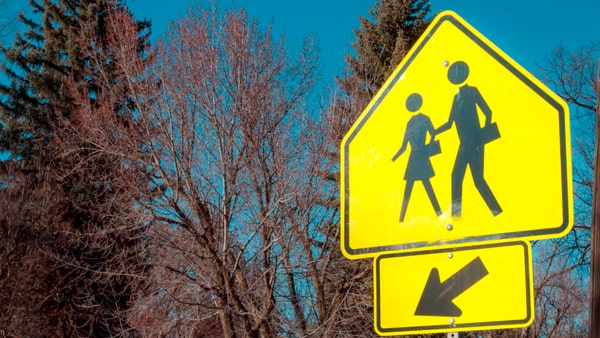

Question 2

What does the pictured five-sided warning sign indicate?

This road sign means:
  1. A A school crossing
  2. B A business district
  3. C Pedestrians must use the sidewalk
  4. D Pedestrian crossing is prohibited

Correct answer: A – A school crossing

The five-sided sign showing children identifies a school crossing. School-related warning signs may have a fluorescent yellow background to improve visibility. Reduce speed, watch carefully for children entering the roadway, and be prepared to stop when necessary.

Source: South Dakota Driver License Manual — Traffic Signs, “Warning Signs”

Question 3

What colors are normally used on a highway sign giving the distance to an upcoming exit?

  1. A Yellow with black lettering
  2. B Black with white lettering
  3. C Red with white lettering
  4. D Green with white lettering

Correct answer: D – Green with white lettering

Destination signs showing highway exits, directions, or distances normally use white lettering on a green background. These rectangular guide signs help drivers identify routes and reach cities, airports, and other destinations. Brown guide signs may instead be used for certain parks, historical areas, or similar special destinations.

Source: South Dakota Driver License Manual — Traffic Signs, “Destination Signs”

Question 4

In South Dakota, what should you do when an intersection’s traffic signal is completely dark?

  1. A Wait at the intersection until power is restored
  2. B Continue without stopping if no traffic is visible
  3. C Stop and follow the rules that apply at a stop sign
  4. D Drive through as you would under a green light

Correct answer: C – Stop and follow the rules that apply at a stop sign

A driver facing a completely unlighted traffic signal must stop in the same manner as at a stop sign. After stopping, proceed only under the applicable stop-sign right-of-way rules and when the movement is safe. The statute treats malfunctioning green or yellow displays differently, allowing cautious movement under their respective rules.

Source: SDCL § 32-28-8.2 – Procedure when traffic lights malfunctioning., South Dakota Driver License Manual — Traffic Control Devices, “Traffic Signals”

Question 5

A two-way road has one solid yellow centerline and one broken yellow centerline. If the broken line is beside your lane, you may pass:

When the road is marked with a solid yellow line and a broken yellow line on your side you may pass:
  1. A Only to avoid an emergency
  2. B Only when traveling on an expressway
  3. C When the road ahead is clear and passing can be completed safely
  4. D Only while crossing an intersection

Correct answer: C – When the road ahead is clear and passing can be completed safely

The broken yellow line beside your lane indicates that passing is permitted from your direction. Permission from the marking does not make every pass lawful or safe. The left side must be clearly visible and free of oncoming traffic for enough distance to complete the maneuver safely.

Source: SDCL § 32-26-34 – Passing by crossing highway center line when vision is obscured--Violation as misdemeanor., South Dakota Driver License Manual — Traffic Control Devices, “Pavement Markings”

Question 6

When red warning lights are flashing at a railroad grade crossing, you must:

  1. A Stop only when a train is visible
  2. B Stop exactly 10 feet from the signal
  3. C Stop and proceed only when the crossing can be made safely
  4. D Reduce speed without stopping

Correct answer: C – Stop and proceed only when the crossing can be made safely

Flashing railroad lights warn that a train or other on-track equipment may be approaching, and the driver must stop. South Dakota requires the stop to be made within 50 feet but not less than 15 feet from the nearest rail when a visible or audible signal gives warning. Proceed only when safe; violating this requirement is a Class 2 misdemeanor.

Source: SDCL § 32-29-4 – Stop required at railroad grade crossing when warning given--Violation as misdemeanor., South Dakota Driver License Manual — Traffic Signs, “Railroad Crossing Warning Signs”