South Dakota Road Signs Test

4.9 out of 5 (118 votes)
80% Passing score
10 Questions
2 Mistakes allowed
South Dakota road signs deserve more attention than most people give them during permit test prep. Not because there is a separate road-sign-only exam for a standard noncommercial license — there is not, at least not one published for the regular operator knowledge test — but because sign questions are folded directly into the main South Dakota permit knowledge test. So when a sign question shows up, it counts the same as a question about right-of-way, school buses, pavement markings, traffic signals, speed control, sharing the road, or impaired driving. Same test. Same score. Same five-question cushion, which is not as roomy as it sounds once you start missing things. The official South Dakota knowledge test has 25 questions, and you need 20 correct answers to pass. That is an 80% score, with up to 5 misses allowed. There is no separate published road sign missed-question limit for the standard test, which means this South Dakota road signs practice test is best used as focused practice inside your bigger permit test prep, not as a replacement for the full South Dakota Driver License Manual. A little boring to say, maybe, but that manual is still the source the state expects you to know. This South Dakota DMV signs practice test concentrates on the traffic signs and traffic control devices that tend to matter on real roads, not just on a screen. South Dakota driving can move from Sioux Falls traffic to open prairie, farm roads, work zones, Black Hills tourist routes, and rural highways where weather and wildlife are not background details. Deer crossing signs, speed limit changes, warning signs, regulatory signs, guide signs, pavement markings — they all ask you to notice something early enough to react like a competent driver instead of a surprised one. The questions are written to help you recognize signs, understand what they require, and connect them to the rules of the road covered in the driver manual. If you miss an answer, the explanation is where the useful part usually lives. Read it even if you are mildly irritated. Especially then, honestly, because that is often the moment when the difference between guessing and knowing finally shows up. South Dakota also requires applicants who fail a test to wait until at least the next working day before retesting, and each paid fee covers 3 testing opportunities within 6 months. So, yes, practice matters. Use this South Dakota permit practice test to tighten up your sign knowledge before the real DMV knowledge exam starts counting every answer.
FREE DMV Practice Test App
Study for your South Dakota permit test or driver’s license with the NextDoorDriving app. 700+ DMV questions and answers, 100% free!
Download on the App Store

Sample South Dakota Permit Test Questions

Question 1

The pictured white X-shaped crossbuck sign marks a:
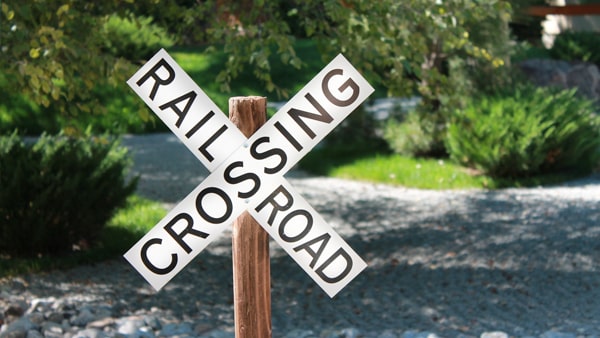
This road sign means:
  1. A Stop-controlled intersection
  2. B Three-way intersection
  3. C Crossroad ahead
  4. D Railroad grade crossing

Correct answer: D – Railroad grade crossing

A crossbuck is located at a highway-railroad grade crossing. Watch and listen for trains or other on-track equipment as you approach. If a visible or audible signal warns of an immediate approach, South Dakota law requires a complete stop between 15 and 50 feet from the nearest rail and permits proceeding only when safe.

Source: SDCL § 32-29-4 – Stop required at railroad grade crossing when warning given--Violation as misdemeanor., South Dakota Driver License Manual — Traffic Signs, “Railroad Crossing Warning Signs”
Question 2

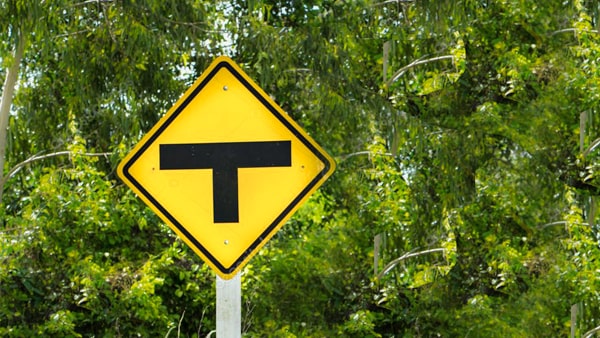
The pictured T-shaped warning sign identifies what type of roadway feature?

This sign shows one type of:
  1. A A required right turn
  2. B An intersection where the approaching road ends
  3. C A lane shift
  4. D A series of curves

Correct answer: B – An intersection where the approaching road ends

A T-intersection sign warns that the roadway you are following ends at another road. Because continuing straight will not be possible, reduce speed and prepare to turn after observing any traffic controls. Also check for cross traffic, pedestrians, and bicyclists before entering the intersecting roadway.

Source: South Dakota Driver License Manual — Traffic Signs, “Warning Signs”, South Dakota Driver License Manual — General Driving, “Intersections”

Question 3

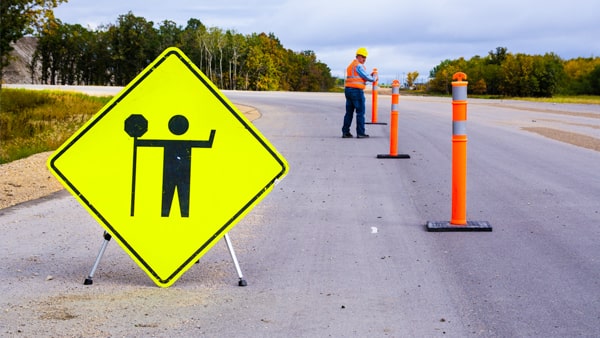
What does the pictured orange work-zone sign warn is ahead?

This sign means:
  1. A A pedestrian crossing
  2. B The end of road work
  3. C A school crossing
  4. D A flagger controlling traffic

Correct answer: D – A flagger controlling traffic

The Flagger Ahead sign warns that a person may be directing traffic in a work zone. A flagger can instruct drivers to proceed, slow down, or stop, and those instructions must be followed. South Dakota’s manual also advises reducing speed in work zones and being prepared for a sudden stop.

Source: South Dakota Driver License Manual — Traffic Signs, “Work Zone Signs”

Question 4

Which pavement marking normally identifies the right edge of a roadway?

  1. A A broken white line
  2. B A solid yellow line
  3. C A solid white line
  4. D A broken yellow line

Correct answer: C – A solid white line

A solid white line normally marks the right edge of the roadway. Broken white lines generally separate lanes traveling in the same direction, while yellow markings are used for opposing traffic or certain left roadway edges.

Source: South Dakota Driver License Manual — Traffic Control Devices, “Pavement Markings”

Question 5

Which listed traffic sign is normally displayed on a vertical rectangle?

  1. A School crossing sign
  2. B Railroad advance-warning sign
  3. C Stop sign
  4. D Speed limit sign

Correct answer: D – Speed limit sign

Speed limit signs are rectangular regulatory signs with black lettering and numbers on a white background. A school crossing sign has a five-sided shape, the railroad advance-warning sign is round, and a stop sign has eight sides. Sign shape helps drivers recognize the type of message before they can read it.

Source: South Dakota Driver License Manual — Traffic Signs, “Regulatory Signs” and “Speed Limit Signs”, South Dakota Driver License Manual — Traffic Signs, “Warning Signs” and “Railroad Crossing Warning Signs”

Question 6

What does a broken yellow centerline beside your lane indicate?

A broken yellow center line on the roadway means:
  1. A You are entering a no-passing zone
  2. B You may pass on the left when the roadway is clear and the maneuver is safe
  3. C You must reduce speed immediately
  4. D Turning is prohibited

Correct answer: B – You may pass on the left when the roadway is clear and the maneuver is safe

A dashed yellow centerline separates opposing directions of traffic and permits passing from the side next to the dashed line. Before crossing it, the driver must have a clear view and enough distance free of oncoming traffic to complete the pass safely. South Dakota also prohibits passing in locations marked as no-passing zones.

Source: SDCL § 32-26-34 – Passing by crossing highway center line when vision is obscured--Violation as misdemeanor., South Dakota Driver License Manual — Traffic Control Devices, “Pavement Markings”