Tennessee Permit Practice Test 4

4.8 out of 5 (637 votes)
80% Passing score
20 Questions
4 Mistakes allowed
The Tennessee permit test rewards people who know the details, not people who vaguely remember “stop at red lights” and hope the rest sorts itself out. This Tennessee DMV practice test is built around that reality. It gives you 20 multiple-choice questions, with 16 correct answers needed to pass, and it keeps the focus where it belongs: Tennessee road rules, traffic signs, licensing requirements, safe-driving judgment, and child passenger safety. That child safety piece deserves attention. This version includes questions about child safety seat use and installation, which can feel like a narrow topic until it shows up in a question and suddenly every age, seat type, and safety rule starts blending together. So, yes, it is worth studying carefully. Not obsessively. Carefully. For teen drivers, Tennessee’s Graduated Driver License program is a whole sequence, and the practice test is a good place to get familiar with the rules before the official exam is staring back at you. A standard learner permit starts at age 15. The applicant must pass the written exams and vision screening, bring the required documents, and, if under 18, provide proof of school attendance. Once licensed at the permit level, the teen may drive only with a licensed driver age 21 or older in the front seat, may not drive from 10 p.m. to 6 a.m., and must hold the permit for 180 days before moving to the next stage. At age 16, a teen can apply for the Intermediate Restricted License after completing 50 hours of supervised driving, including 10 hours at night, and passing the road skills test. That license still has limits: no driving between 11 p.m. and 6 a.m., only one passenger, and seat belts required for everyone. At 17, eligible drivers can move to the Intermediate Unrestricted License. A regular Class D license comes at 18, or earlier with high school graduation or a GED. Adults get a more direct path. First-time applicants 18 or older still need the vision screening, Class D knowledge test, and road skills test when required, but they are not tied to the teen GDL timeline or the 50-hour certification. Use this TN permit practice test more than once. That is not overpreparing; that is how you notice the small Tennessee-specific rules before they cost you points.
FREE DMV Practice Test App
Study for your Tennessee permit test or driver’s license with the NextDoorDriving app. 700+ DMV questions and answers, 100% free!
Download on the App Store

Sample Tennessee Permit Test Questions

Question 1

When a vehicle is following you too closely, why should you increase the space ahead of your vehicle?

  1. A. To encourage the tailgater to pass on the shoulder
  2. B. To give yourself room to slow gradually instead of braking suddenly
  3. C. To prevent other vehicles from entering your lane
  4. D. To allow you to drive above the speed limit

Correct answer: B. – To give yourself room to slow gradually instead of braking suddenly

A larger following distance gives you more time and room to respond without sudden braking. This reduces the chance that the tailgating driver will strike your vehicle from behind if traffic slows. When conditions permit, allow the other driver to pass rather than accelerating or making abrupt maneuvers.

Source: Tennessee Comprehensive Driver License Manual — “Tailgaters”
Question 2

Where may a U-turn be made on a divided highway?

  1. A. Across any unpaved portion of the median
  2. B. At an authorized paved crossover where U-turns are permitted
  3. C. Through an emergency opening on an interstate
  4. D. Across a median barrier when traffic is light

Correct answer: B. – At an authorized paved crossover where U-turns are permitted

Tennessee guidance prohibits driving across a median or dividing barrier except at an authorized crossover or intersection. A U-turn may be made from a designated paved crossover on a divided highway when the maneuver is permitted and safe. Interstate median openings are not provided for ordinary traffic use.

Source: Tennessee Comprehensive Driver License Manual — Rules of the Road, “Divided Highways”

Question 3

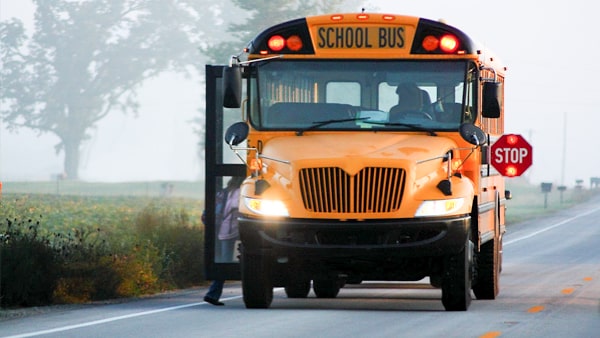
A school bus stops on a two-lane road with its red lights flashing and stop arm extended. What must opposing traffic do?

If a school bus stops to unload children on a two-lane highway, vehicles traveling in the opposite direction are:
  1. A. Continue without stopping
  2. B. Signal and pass at reduced speed
  3. C. Stop, then proceed while the stop arm remains extended
  4. D. Stop and remain stopped until the bus signals are deactivated

Correct answer: D. – Stop and remain stopped until the bus signals are deactivated

On a two-lane road in Tennessee, drivers approaching a stopped school bus from either direction must stop when its red warning lights and stop arm are activated. They must remain stopped until the visual signals are no longer operating, the stop arm is withdrawn, and the bus begins moving. Painted centerlines do not create a divided-highway exception.

Source: Tennessee Comprehensive Driver License Manual — “The School Bus Stop Law” and “Meeting a School Bus”

Question 4

Driving faster than surrounding traffic and repeatedly passing other vehicles generally:

  1. A. Makes the trip substantially safer
  2. B. Increases the risk of a crash
  3. C. Prevents traffic congestion
  4. D. Is permitted only on interstate highways

Correct answer: B. – Increases the risk of a crash

Higher speeds reduce the time available to identify and react to roadway hazards. Repeated passing also creates additional conflicts through lane changes and, on two-lane roads, exposure to opposing traffic. Match the lawful, safe flow of traffic rather than creating unnecessary passing situations.

Source: Tennessee Comprehensive Driver License Manual — Rules of the Road, “The Basic Speed Rule” and “Passing Other Vehicles”

Question 5

When approaching a steep downhill grade on snow or ice, you should:

  1. A. Follow another vehicle closely for traction
  2. B. Pump the brakes continuously
  3. C. Select a lower gear before starting down the hill
  4. D. Accelerate quickly onto the grade

Correct answer: C. – Select a lower gear before starting down the hill

Snow and ice greatly reduce tire traction and increase stopping distance. Slow before reaching the downgrade and select a lower gear before starting down the hill. The lower gear helps control speed through engine braking and reduces the need for heavy braking, which could cause the wheels to lose traction.

Source: Tennessee Comprehensive Driver License Manual — “Winter Driving: Snow and Ice”

Question 6

What is a direct consequence if a court finds that a driver violated Tennessee's implied-consent law by refusing a lawfully requested test?

A police officer stops you because he suspects you are DUI. You refuse to take a chemical test. What happens now?
  1. A. The driver's license is revoked
  2. B. Bail is automatically denied
  3. C. The vehicle is automatically forfeited
  4. D. The driver receives only a warning

Correct answer: A. – The driver's license is revoked

Tennessee's implied-consent law allows license consequences when a driver refuses a lawfully requested test after being advised of the consequences. If the court finds an implied-consent violation, it must revoke the driver's license. For a standard first violation without a qualifying prior offense, the current revocation period is 18 months; longer periods can apply in specified circumstances.

Source: Tenn. Code Ann. § 55-10-406 – Implied Consent to Tests for Alcohol or Drug Content, Tenn. Code Ann. § 55-10-407(a) – Penalty for Violations of § 55-10-406