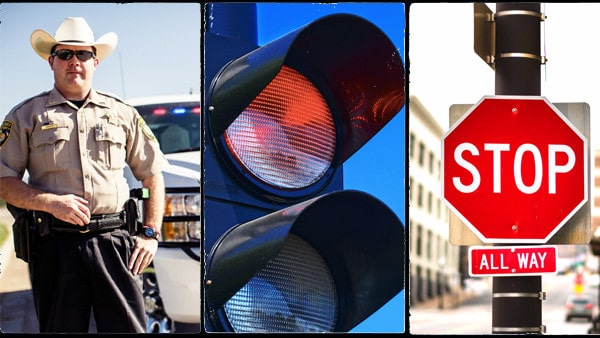
Tennessee DMV Sign Test 4

4.8 out of 5 (190 votes)
80% Passing score
20 Questions
4 Mistakes allowed
This Tennessee road sign practice test gives drivers a focused way to review the sign questions that can appear on the Regular Class D knowledge test. It is not only for teenagers trying to get a learner permit, and it is not only for adults who have somehow avoided the written test until now. It is for anyone who needs the signs, signals, markings, colors, and shapes to feel familiar before test day — and, yes, before real traffic starts asking questions a lot faster than a computer screen does. The official Tennessee Class D knowledge test is based on the Tennessee Comprehensive Driver License Manual and is administered by the Tennessee Department of Safety and Homeland Security, Driver Services Division. The online version has 30 multiple-choice questions, a 60-minute time limit, and an 80% passing score. That means you need 24 correct answers and can miss no more than 6. So, while this TN permit practice test focuses specifically on road signs, it fits inside the bigger picture: Tennessee also tests traffic laws, safe driving habits, road rules, alcohol and drug rules, and general driver responsibility. The road sign material deserves its own attention, honestly. Not because it is glamorous, but because it is easy to rush through. Red signs usually demand immediate action or restriction, yellow warns you about hazards, green points you toward permitted movement, and the shape of a sign can tell you something before the words even register. Add in traffic signals, pavement markings, lane markings, guide signs, warning signs, and regulatory signs, and suddenly “I know signs” becomes a little too casual as a study plan. After you complete the Tennessee driving signs test, you will get a summary of your answers with feedback on what you missed. That matters, because guessing correctly once does not mean the idea stuck. The better move is to notice the pattern behind the mistake, then go back to the Tennessee Driver’s Handbook and clean it up there. For teen drivers, Tennessee’s Level I Learner Permit starts at age 15, after the required written exams and vision screening. Before moving to the Intermediate Restricted License, teens need 50 supervised driving hours, including 10 at night. Adults 18 and older follow a different licensing path, but they still need the Class D knowledge test, vision screening, learner permit when required, and road skills test. Different route, same basic truth: sign knowledge is part of driving here, not decoration.

FREE DMV Practice Test App
Study for your Tennessee permit test or driver’s license with the NextDoorDriving app. 700+ DMV questions and answers, 100% free!
Download on the App Store

Sample Tennessee Permit Test Questions

Question 1

What must you do while red warning lights are flashing at a railroad crossing?

  1. A. Stop only when a train is visible
  2. B. Stop exactly 10 feet from the signal
  3. C. Stop and wait until the lights stop and the crossing is safe
  4. D. Reduce speed and continue across the tracks

Correct answer: C. – Stop and wait until the lights stop and the crossing is safe

In Tennessee, flashing red lights at a railroad crossing indicate that you must stop and wait. Do not drive onto the tracks until the warning lights have stopped and you have verified that the tracks are clear. Never stop your vehicle on the tracks.

Source: Tennessee Comprehensive Driver License Manual — Section B, “Stopping for Railroad Crossings”

Question 2

Which color generally separates traffic lanes moving in the same direction?

  1. A. Yellow
  2. B. White
  3. C. Red
  4. D. Black

Correct answer: B. – White

White lane lines separate lanes carrying traffic in the same direction. Broken white lines normally permit lane changes when the movement is safe, while solid white lines discourage or restrict crossing depending on the location. White lines also mark the roadway’s right edge.

Source: Tennessee Comprehensive Driver License Manual — Section B, “General Principles of Pavement Lane Markings”

Question 3

A yellow arrow appears for your dedicated right-turn lane. What does it indicate?

  1. A. The protected turn is ending, and you must watch for the next signal
  2. B. You may turn after yielding, regardless of the next signal
  3. C. Right turns are prohibited for the rest of the signal cycle
  4. D. You should accelerate before the arrow changes

Correct answer: A. – The protected turn is ending, and you must watch for the next signal

A yellow arrow announces the end of the movement allowed by the preceding green arrow. Another signal indication will follow and will determine whether you may continue, must yield, or must stop. Do not treat the yellow arrow as an instruction to accelerate.

Source: Tenn. Code Ann. § 55-8-110(a)(5) — Traffic-Control Signals — Inoperative Signals, Tennessee Comprehensive Driver License Manual — Section B, “Traffic-Control Signals”

Question 4

After stopping at a stop line, your view of cross traffic is blocked. What should you do next?

  1. A. Wait five seconds and enter the intersection
  2. B. Sound the horn and continue
  3. C. Listen for traffic and proceed without moving forward
  4. D. Creep forward cautiously, check for traffic and pedestrians, and proceed when clear

Correct answer: D. – Creep forward cautiously, check for traffic and pedestrians, and proceed when clear

In Tennessee, first make a complete stop at the marked stop line or before the crosswalk. If the location does not provide a clear view, edge forward slowly while continuing to watch for cross traffic and pedestrians. Yield as required and enter only when the way is clear.

Source: Tennessee Comprehensive Driver License Manual — Section B, “Stopping at Intersections”

Question 5

If these instructions conflict, which one takes priority?

Which of the following must you obey over the other three?
  1. A. A steady red traffic signal
  2. B. A police officer directing traffic
  3. C. A stop sign
  4. D. A flashing red traffic signal

Correct answer: B. – A police officer directing traffic

Tennessee law requires drivers to comply with a police officer’s lawful traffic directions. Those directions control even when they conflict with a traffic signal or sign. Watch the officer carefully and follow the movement indicated.

Source: Tenn. Code Ann. § 55-8-104 — Obedience to Police Officers, Tennessee Comprehensive Driver License Manual — Section B, “Traffic-Control Signals”

Question 6

A center line is solid yellow on the opposing side and broken yellow next to your lane. When may you pass?

When the road is marked with a solid yellow line and a broken yellow line on your side you may pass:
  1. A. Only when responding to an emergency
  2. B. Only when the road is an expressway
  3. C. When the opposing lane is clear and the pass can be completed safely
  4. D. Only while traveling through an intersection

Correct answer: C. – When the opposing lane is clear and the pass can be completed safely

A broken yellow line next to your lane indicates that you may cross the center line to pass. You must have a clear view, sufficient space, and no conflicting oncoming traffic. Drivers next to the solid line may not cross it to pass.

Source: Tennessee Comprehensive Driver License Manual — Section B, “General Principles of Pavement Lane Markings”