


Tennessee DMV Practice Test 6

4.9 out of 5 (328 votes)
80% Passing score
20 Questions
4 Mistakes allowed
This Tennessee practice permit test gives you a focused way to study before you walk into a Driver Services Center or take the online knowledge test. It is test six in our TN DMV practice test series, and this one leans into signal usage more than most people expect—turn signals, lane changes, when to communicate early, when not to confuse other drivers, all of that practical road stuff that sounds simple until you start seeing it in test-question form. The questions are based on the official Tennessee drivers manual, which is the source you should be using anyway because the real exam is built from that material. Tennessee’s knowledge test has 30 questions, and you need 24 correct answers to pass. That is an 80% score, with room to miss only 6. This DMV permit practice test uses 20 questions and sets the passing mark at 16 correct, so the math lines up the same way and gives you a fair read on whether you are actually ready. It is not only for adults, either. Teen drivers can apply for a learner permit at 15, and once they have it, the clock starts on Tennessee’s graduated licensing process. Before moving to an Intermediate Restricted License at 16, a teen driver has to hold the permit for 180 days and complete 50 hours of supervised driving, including 10 hours at night. The supervising driver must be licensed, at least 21 years old, and seated in the front seat. There are nighttime limits too—10 p.m. to 6 a.m. on a learner permit, then 11 p.m. to 6 a.m. at the Intermediate Restricted stage. And yes, the one-passenger limit during that restricted phase is one of those details worth knowing before it becomes a real-life issue. When you finish the Tennessee DMV driving test practice, you get a review of your answers, including missed questions and the correct answers. That part matters. A practice test should not just tell you that you passed or failed and send you away. It should show you where your understanding got thin. Whether you are preparing for Nashville traffic, Memphis event weekends, Knoxville game-day roads, or quieter drives closer to home, clean signaling is one of the habits Tennessee expects you to know before it lets you drive on your own.
FREE DMV Practice Test App
Study for your Tennessee permit test or driver’s license with the NextDoorDriving app. 700+ DMV questions and answers, 100% free!
Download on the App Store

Sample Tennessee Permit Test Questions

Question 1

Which yellow warning-sign symbol indicates that two-way traffic begins ahead?

  1. A. One straight arrow beside a merging arrow
  2. B. Two lanes separated by a median symbol
  3. C. One arrow pointing up and another pointing down
  4. D. Two arrows curving left and right

Correct answer: C. – One arrow pointing up and another pointing down

The TWO-WAY TRAFFIC sign shows one upward arrow and one downward arrow. It warns that traffic ahead travels in both directions, such as where a divided or one-way roadway changes to an undivided two-way roadway. Be prepared for oncoming vehicles.

Source: Tennessee Comprehensive Driver License Manual — Ch. 3, “Warning Signs—Diamond Shape (Yellow)”

Question 2

A white rectangular sign shows an arrow bending to the right of an obstruction. What must you do?

This white sign means:
  1. A. Keep to the right of the obstruction
  2. B. Yield before making a right turn
  3. C. Move right only if driving slower than other traffic
  4. D. Turn right at the next intersection

Correct answer: A. – Keep to the right of the obstruction

The KEEP RIGHT sign directs traffic to pass on the right side of an island, divider, or other obstruction. It regulates the path vehicles must follow at that location. It does not require a turn at the next intersection.

Source: Tennessee Comprehensive Driver License Manual — Ch. 3, “Regulatory Signs”

Question 3

At an ordinary intersection with no special lane-use signs, which lane should you use to begin a right turn from a multilane roadway?

  1. A. The lane nearest the centerline
  2. B. The lane nearest the right curb or roadway edge
  3. C. Either lane, depending on oncoming traffic
  4. D. Either lane, depending on your speed

Correct answer: B. – The lane nearest the right curb or roadway edge

Tennessee generally requires the approach for a right turn and the turn itself to be made as close as practicable to the right curb or roadway edge. Use the rightmost appropriate lane unless signs or pavement markings direct otherwise. Avoid swinging into another lane while turning.

Source: TCA § 55-8-140(a)(1) — Required Position and Method of Turning, Tennessee Comprehensive Driver License Manual — Ch. 4, “Turning”

Question 4

An authorized emergency vehicle approaches using the required lights and siren. How should you yield?

  1. A. Pull as close as possible to the right edge, clear the intersection, and stop
  2. B. Move right but continue driving slowly until it passes
  3. C. Stop immediately, even if you are blocking an intersection
  4. D. Accelerate until you reach a place where it can pass

Correct answer: A. – Pull as close as possible to the right edge, clear the intersection, and stop

Tennessee law requires you to yield, move as close as possible to the right-hand edge or curb, remain clear of an intersection, and stop. Stay stopped until the emergency vehicle has passed unless a police officer directs otherwise. Do not continue slowly beside or ahead of it.

Source: TCA § 55-8-132(a) — Operation of Vehicles and Streetcars on Approach of Authorized Emergency Vehicles, Tennessee Comprehensive Driver License Manual — Ch. 4, “Emergency Vehicles”

Question 5

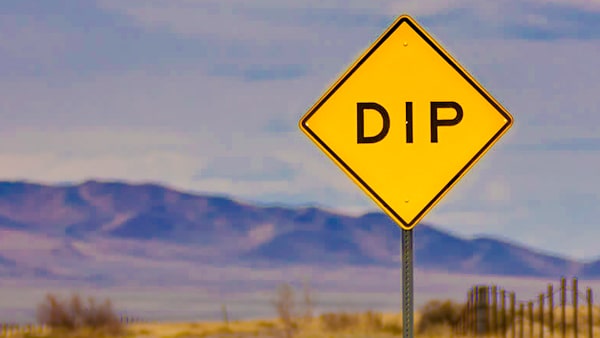
A yellow diamond sign displaying the word DIP warns of:

This sign means:
  1. A. A low section in the roadway ahead
  2. B. A soft roadway shoulder
  3. C. A pedestrian crossing
  4. D. A required stop

Correct answer: A. – A low section in the roadway ahead

A DIP sign warns that the roadway has a low section ahead. It is a warning sign rather than a stop or regulatory sign. Be prepared for the change in road elevation and any conditions present in the depressed area.

Source: Tennessee Comprehensive Driver License Manual — Ch. 3, “Warning Signs—Diamond Shape (Yellow)”

Question 6

A pedestrian using a guide dog or carrying an identifying white cane is crossing the roadway. What must a driver do?

  1. A. Yield only when the person is at a signalized corner
  2. B. Yield the right-of-way and use necessary caution
  3. C. Proceed unless another pedestrian is assisting the person
  4. D. Sound the horn and pass before the person reaches your lane

Correct answer: B. – Yield the right-of-way and use necessary caution

Tennessee gives special right-of-way protection to a pedestrian led by a guide dog or carrying an identifying white cane. Drivers must yield and take the precautions needed to avoid injuring or endangering that pedestrian. Use particular care before turning or backing near the crossing area.

Source: TCA § 55-8-180 — Pedestrians Led by Guide Dog or Carrying Identifying Cane Given Right-of-Way, Tennessee Comprehensive Driver License Manual — Ch. 4, “Pedestrians”