Delaware DMV Practice Test

4.7 out of 5 (129 votes)
80% Passing score
20 Questions
4 Mistakes allowed
Delaware’s Class D knowledge test is not a mystery, exactly, but it is also not the kind of thing you want to wander into half-prepared and hoping your common sense does all the heavy lifting. The official test is based on the Delaware Driver Manual, and it covers the material the DMV actually expects you to know: traffic laws, rules of the road, road signs, signals, pavement markings, safe driving habits, and the motor vehicle rules that tend to blur together when you are reading too fast. This Delaware DMV practice test gives you a cleaner way to study before the real thing. It includes 20 multiple-choice questions covering the same general ground as the official Delaware DMV knowledge test, from right-of-way situations and sign recognition to safety rules and those small legal requirements that feel minor until, of course, they become the question you miss. The real Class D knowledge test has 32 questions, and you need 26 correct answers to pass. That is 81.25%, which is a weirdly specific number, but the practical translation is simple enough: you can miss up to 6. But why settle for the minimum score when you can go for a gold star? You can take this Delaware DMV permit practice test online, retake it as often as needed, and use each attempt to spot the areas that are still shaky. It is free, Delaware-specific, and built to help you get familiar with the test format before sitting down for the actual DMV permit test.   How the rest of the licensing process moves depends on how old you are. For younger drivers, Delaware’s Graduated Driver License process adds a few extra steps. A Level One Learner’s Permit applicant generally needs to be at least 16 and under 18, complete an approved Delaware driver education course, and bring the Blue/White Certificate. There also has to be a sponsor on the application, which sounds like paperwork because it is paperwork, but it matters. Adults 18 and older go through the Class D learner’s permit process a little differently. They must pass the vision screening and knowledge exam, then hold the permit before taking the road skills test. Delaware also requires a wait of at least 10 days after passing the knowledge test before the road test can happen.  But before you get behind the wheel, you need to get the permit, so let's start there.
FREE DMV Practice Test App
Study for your Delaware permit test or driver’s license with the NextDoorDriving app. 700+ DMV questions and answers, 100% free!
Download on the App Store

Sample Delaware Permit Test Questions

Question 1

A truck swings left before making a right turn. Which action is especially dangerous?

  1. A Driving between the truck and the right curb or shoulder
  2. B Waiting behind the truck until it completes the turn
  3. C Increasing your following distance
  4. D Remaining outside the truck’s side blind area

Correct answer: A – Driving between the truck and the right curb or shoulder

Large trucks sometimes swing left to obtain enough room for a right turn. Entering the space between the truck and the curb or shoulder places your vehicle in the truck’s turning path and a blind area. Remain behind the truck and allow it room to complete the maneuver.

Source: Delaware Driver Manual — § 5, “The Key to Safer Highways: Know the No-Zone”

Question 2

What does a broken yellow center line on a two-way road indicate?

A broken yellow center line on the roadway means:
  1. A Passing is prohibited in both directions
  2. B The line may be crossed to pass with care when conditions permit
  3. C A mandatory speed reduction is ahead
  4. D Turning is prohibited

Correct answer: B – The line may be crossed to pass with care when conditions permit

A broken yellow center line separates traffic traveling in opposite directions and permits crossing for passing with care. In Delaware, the driver must still verify that the left side is clearly visible and free of oncoming traffic for enough distance to complete the pass. Other passing restrictions continue to apply.

Source: 21 Del. C. § 4118 – Limitations on overtaking on the left, 2 DE Admin. Code 2402 – Manual on Uniform Traffic Control Devices (MUTCD), Part 3, § 3B.01, “Yellow Center Line Pavement Markings and Warrants”

Question 3

Before moving left to pass another vehicle, which signal should you use?

Before passing another vehicle you should:
  1. A Repeated high-beam flashes
  2. B Four-way hazard flashers
  3. C The proper left-turn signal for the lane change
  4. D A continuous horn signal

Correct answer: C – The proper left-turn signal for the lane change

Before moving left to pass, use the appropriate turn signal to indicate the lane change. Delaware law requires a proper signal before moving right or left from a direct course, and the movement must be made safely without interfering with traffic. Signal again before returning to the original lane.

Source: 21 Del. C. § 4155(a), (d) – Turning movements and required signals, Delaware Driver Manual — § 5, “Passing”

Question 4

At an intersection without painted crosswalk lines or operating signals, when must a driver yield to a pedestrian?

  1. A Only when the pedestrian waves to the driver
  2. B Never, because an unmarked crossing gives vehicles priority
  3. C When the pedestrian is crossing within the unmarked crosswalk and is on the driver’s half or close enough to be in danger
  4. D Only when a school crossing guard is present

Correct answer: C – When the pedestrian is crossing within the unmarked crosswalk and is on the driver’s half or close enough to be in danger

Delaware law requires a driver to yield, slowing or stopping if necessary, to a pedestrian crossing within a crosswalk under the stated conditions. This rule includes an unmarked crosswalk at an intersection. A pedestrian crossing somewhere other than a marked crosswalk or an unmarked intersection crosswalk generally must yield to vehicles.

Source: 21 Del. C. § 4142(a) – Pedestrians’ right-of-way in crosswalks, 21 Del. C. § 4143(a) – Crossing at other than crosswalks

Question 5

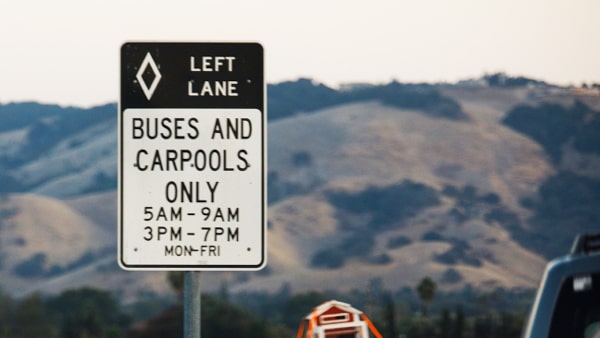
When a reserved lane is marked “HOV 3,” when may you use it?

You can drive in a carpool lane if:
  1. A When your vehicle carries at least three people during the posted hours
  2. B Whenever you are driving a large passenger van
  3. C Whenever you need to pass slower traffic
  4. D Whenever the regular lanes are congested

Correct answer: A – When your vehicle carries at least three people during the posted hours

An HOV sign identifies a lane reserved for high-occupancy vehicles. “HOV 3” requires at least three people in the vehicle during the days and hours shown. A driver must follow posted lane-use controls; congestion or a desire to pass does not cancel the restriction.

Source: 21 Del. C. § 4122 – Driving on roadways laned for traffic, Delaware Driver Manual — § 4, “Reserved Lanes”

Question 6

Which statement about icy road surfaces is correct?

  1. A Shaded areas can freeze first and remain icy longer
  2. B Bridges can be icy even when nearby pavement is not
  3. C Ice becomes especially slippery when it begins to get wet
  4. D All of the above

Correct answer: D – All of the above

Shaded pavement may freeze before exposed areas and take longer to dry. Bridges and overpasses can be colder than surrounding roads, allowing ice to form there first. Ice near the freezing point may become wet and even more slippery. Reduce speed whenever rain, snow, sleet, or ice reduces traction.

Source: Delaware Driver Manual — § 5, “Adjusting To Road Conditions”