


Delaware DMV Practice Test 2

4.8 out of 5 (94 votes)
80% Passing score
20 Questions
4 Mistakes allowed
Delaware does not hand out driver’s licenses just because someone feels ready, which is fair, even if the whole process can feel a little more complicated than expected. This Delaware DMV practice test is built for that exact stage: the part where you want to know whether the rules are actually in your head, not just vaguely familiar from a quick skim of the manual. The practice test includes 20 questions covering the material Delaware drivers are expected to understand before they get behind the wheel. Seat belt rules, signs, right-of-way, safe following distance, traffic signals, and those little details that seem easy until the answer choices start looking suspiciously similar. It is the kind of Delaware driving test practice that helps you slow down and notice what you almost know, which, honestly, is where a lot of test-day mistakes come from. There is some practical DMV reality folded into this too. You will need to apply for a permit in person at a Delaware DMV office, whether that is Wilmington, Delaware City/New Castle, Dover, or Georgetown. Every Delaware license applicant must take a vision test by reading a chart and meet the state’s vision standard, which is 20/40 with or without glasses or contacts. If you need corrective lenses to meet that standard, the restriction goes on your license. Depending on the results, some drivers may be limited to daylight driving, and applicants who do not meet the required vision level may need additional medical or eye-doctor review.  After passing the knowledge and eye exams and receiving your learner’s permit, adult Class D applicants must wait at least 10 days before taking the road skills test. That next step has its own checklist: valid permit, a licensed driver at least 21 years old, proper registration and insurance, and a test vehicle with working safety equipment. Also, missed road test appointments may come with a $25 no-show fee, which is one of those small facts worth knowing before it becomes your small fact. But first, use this Delaware DMV permit practice test as a steady, low-pressure way to prepare. The hints and explanations help you catch weak spots without making the whole thing feel dramatic. It is not a replacement for the official manual or driver education, but as DMV permit test practice goes, it gives you a much clearer read on whether you are ready.
FREE DMV Practice Test App
Study for your Delaware permit test or driver’s license with the NextDoorDriving app. 700+ DMV questions and answers, 100% free!
Download on the App Store

Sample Delaware Permit Test Questions

Question 1

You are turning right as a pedestrian using a guide dog begins crossing in front of you. What should you do?
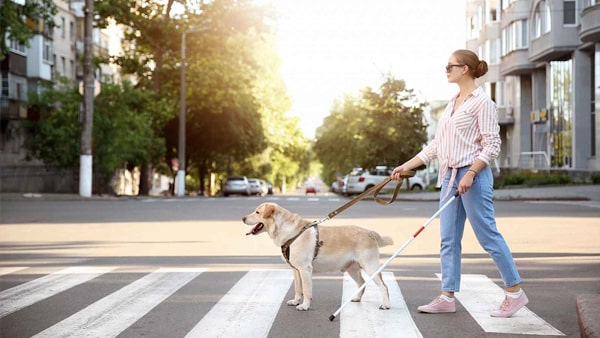
You want to make a right turn at the corner. A pedestrian with a guide dog is at the corner ready to cross the street in front of you. Before making your right turn, you should:
  1. A Turn off the engine until the pedestrian finishes crossing
  2. B Tell the pedestrian when it is safe to cross
  3. C Wait until the pedestrian has cleared your turning path
  4. D Sound the horn before turning

Correct answer: C – Wait until the pedestrian has cleared your turning path

A turning driver must yield to a pedestrian crossing within the crosswalk, and Delaware requires necessary precautions to avoid injuring a blind pedestrian using a guide dog. Wait until the pedestrian has cleared the path of your turn. The driver manual also advises against sounding the horn around blind pedestrians because it may confuse or frighten them.

Source: 16 Del. C. § 9503 — Rules of the road, 21 Del. C. § 4142(a) — Pedestrians’ right-of-way in crosswalks, Delaware Driver Manual — Section Four, “Right-Of-Way”

Question 2

After a train passes at a railroad crossing without gates, what must you verify before crossing?

  1. A The rear of the train has cleared your side of the road
  2. B The first train is completely out of sight
  3. C Every track is clear and no train is approaching from either direction
  4. D The pavement and rails are dry

Correct answer: C – Every track is clear and no train is approaching from either direction

Do not begin crossing merely because one train has passed. Railroad crossings may have multiple tracks, and another train could approach from either direction. Check every track, obey any continuing warning signal, and proceed only when you can cross the entire grade crossing safely.

Source: 21 Del. C. § 4161(a) — Obedience to signal indicating approach of train or other on-track equipment, drawbridge, or automatic signal system controlling the flow of traffic, Delaware Driver Manual — Section Four, “Railroad Crossings”

Question 3

When two vehicles meet on a narrow two-way road, what are the drivers required to do?

  1. A Give the entire roadway to the larger vehicle
  2. B Pass to the right and give each other at least half of the traveled roadway, as nearly as possible
  3. C Stop and remain in place until directed by police
  4. D Give priority to whichever vehicle is traveling faster

Correct answer: B – Pass to the right and give each other at least half of the traveled roadway, as nearly as possible

On a narrow two-way road, Delaware law directs approaching drivers to pass each other on the right. Each driver must give the other at least half of the main-traveled portion as nearly as possible. Drivers must also use an appropriate speed when traveling on a narrow or winding roadway.

Source: 21 Del. C. § 4115 — Passing vehicles proceeding in opposite directions, 21 Del. C. § 4168(b) — General speed restrictions

Question 4

Why should you check your blind spots carefully when bicycles are nearby?

  1. A Bicyclists always have priority over motor vehicles
  2. B A bicyclist may be outside the area visible in your mirrors
  3. C Bicyclists are required to ride facing traffic
  4. D Bicyclists are exempt from traffic laws

Correct answer: B – A bicyclist may be outside the area visible in your mirrors

A bicycle’s narrow profile can make it difficult to see in a vehicle’s mirrors, particularly before a turn or lane change. Check the appropriate mirror and look into the blind spot before moving. Delaware law requires a turn or lateral movement to be made safely and without interfering with other traffic.

Source: 21 Del. C. § 4155(a) — Turning movements and required signals, Delaware Driver Manual — Section Five, “Blind Spots”

Question 5

If you become so drowsy that you cannot remain alert while driving, you should:

  1. A Use air conditioning and caffeine to continue
  2. B Open the windows and increase the radio volume
  3. C Leave the roadway, park safely, and rest or change drivers
  4. D Increase speed to reach your destination sooner

Correct answer: C – Leave the roadway, park safely, and rest or change drivers

Drowsiness dulls judgment and slows reaction time, making continued driving hazardous. If you are tired, the Delaware Driver Manual recommends resting or changing drivers. Pull off at a safe location and do not resume driving until you are alert enough to operate the vehicle safely.

Source: Delaware Driver Manual — Section Two, “Drowsy Driving”

Question 6

A steady circular yellow signal warns that which signal will appear immediately afterward?

  1. A A flashing yellow signal
  2. B A steady green signal
  3. C A steady red signal
  4. D A flashing red signal

Correct answer: C – A steady red signal

A steady circular yellow signal warns that a red signal for the movement will be displayed immediately afterward. Prepare to stop before entering the intersection. If you are already too close to stop safely when yellow appears, continue through the intersection carefully rather than making an unsafe sudden stop.

Source: 21 Del. C. § 4108(a)(2)a. — Traffic-control signal legend, Delaware Driver Manual — Section Four, “Steady Yellow Light”