Delaware DMV Sign Test 3

5 out of 5 (46 votes)
80% Passing score
20 Questions
4 Mistakes allowed
Road signs are one of those Delaware DMV topics people assume they already know, right up until the test asks about a sign by shape, color, or symbol and suddenly the answer starts looking a little less obvious. That is why this Delaware road signs test is worth taking seriously. Not dramatically seriously, no need to clear your weekend for it, but seriously enough to practice before you sit down for the real Class D knowledge exam. This Delaware DMV road sign test gives you 20 practice questions focused on the signs and signals Delaware drivers are expected to recognize quickly. Stop signs, yield signs, warning signs, direction signs, lane-use signs, pavement markings, traffic signals, the whole familiar-but-somehow-still-testable group. The official Delaware Class D knowledge test includes 32 questions, and you need 26 correct answers to pass, so road sign questions are not just decorative filler. Miss too many of the “easy” ones and, well, now they were not so easy. The point here is not to memorize a bunch of shapes in a panic. It is to get comfortable seeing a sign and knowing what it means without overthinking it. A triangle means yield. An octagon means stop. Rectangular signs often give rules, directions, or useful information, depending on the sign itself. And then, of course, Delaware can throw in highway signs, traffic signals, and pavement markings too, because the DMV does enjoy covering the full menu. You can take this Delaware road signs permit test online whenever it fits, which is helpful if your schedule is already doing that thing where every simple errand becomes three errands. After the test, the feedback shows what you got right, what you missed, and why the correct answers make sense. That last part matters more than people admit, because guessing correctly once does not help much when a similar sign shows up later with slightly different wording. For the real licensing process, Delaware applicants take the DMV-administered Class D knowledge exam in person at a DMV office, including locations in Wilmington, Delaware City/New Castle, Dover, and Georgetown. Applicants also need to pass a vision screening before a license is issued, with 20/40 vision required for full driving privileges, with or without corrective lenses. Audio testing is available on request, and Delaware offers driver manuals in multiple languages, though drivers still need to understand road signs in English. Use this Delaware DMV practice test as a focused, no-nonsense way to tighten up sign recognition before test day and before those signs matter on an actual road.
FREE DMV Practice Test App
Study for your Delaware permit test or driver’s license with the NextDoorDriving app. 700+ DMV questions and answers, 100% free!
Download on the App Store

Sample Delaware Permit Test Questions

Question 1

A two-way road has a solid yellow line beside a broken yellow line, and the broken line is next to your lane. When may you pass?

When the road is marked with a solid yellow line and a broken yellow line on your side you may pass:
  1. A Only during an emergency
  2. B Only while approaching an intersection
  3. C When the way is clear and passing is otherwise lawful
  4. D Only when another driver signals you to pass

Correct answer: C – When the way is clear and passing is otherwise lawful

The Delaware Driver Manual states that you may pass when the broken yellow line is on your side, provided the maneuver is safe. You must have enough clear roadway to complete the pass without interfering with oncoming traffic. Restrictions near curves, intersections, railroad crossings, bridges, and other specified locations still apply.

Source: 21 Del. C. § 4118 – Limitations on overtaking on the left, 21 Del. C. § 4119 – Further limitations on driving to left of center of roadway, Delaware Driver Manual — Section Four, “Pavement Markings”

Question 2

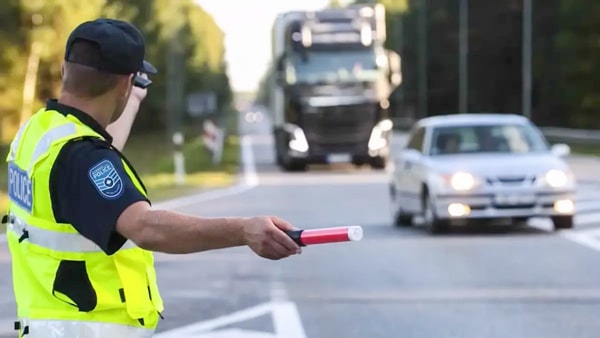
The traffic signal is red, but a uniformed police officer lawfully directs you to proceed. What should you do?

A traffic light is red, but a police officer is telling you to go ahead anyway. What should you do?
  1. A Remain stopped until the signal turns green
  2. B Change lanes and wait for another signal
  3. C Follow the officer's direction while proceeding carefully
  4. D Wait for the officer to approach your vehicle

Correct answer: C – Follow the officer's direction while proceeding carefully

Delaware law requires drivers to comply with a lawful order or direction from a police officer authorized to control traffic. The requirement to obey a traffic-control device contains an exception when an authorized person directs otherwise. Following the officer's direction does not remove the driver's duty to operate with due regard for everyone's safety.

Source: 21 Del. C. § 4103(a)(1)a., (a)(2) – Obedience to authorized persons directing traffic, 21 Del. C. § 4107(a) – Obedience to and required traffic-control devices

Question 3

A yellow diamond warning sign displays a black bicycle symbol. What should a driver understand?

This sign means:
  1. A A playground is ahead
  2. B Bicycle rentals are available nearby
  3. C Motor vehicles must enter a bicycle-only lane
  4. D Bicyclists may be on or entering the roadway

Correct answer: D – Bicyclists may be on or entering the roadway

The bicycle warning sign alerts drivers that bicyclists may be using or entering the roadway. Check both sides of the road and watch carefully for cyclists. The sign is a warning, not an indication that bicycle rentals or parking are available.

Source: Delaware Driver Manual — Section Four, “Warning Signs”

Question 4

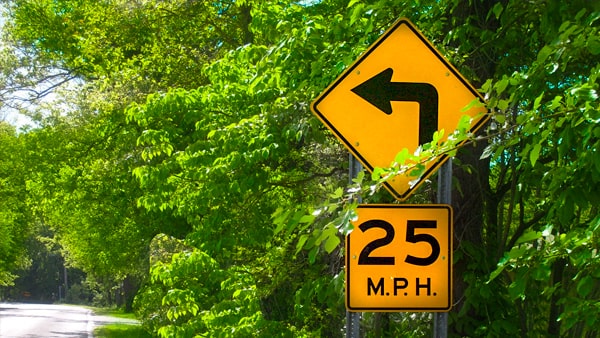
A left-curve warning sign has a yellow “25 MPH” plaque beneath it. What does the combination indicate?

This sign means:
  1. A A left curve with a minimum speed of 25 mph
  2. B A right curve with a minimum speed of 25 mph
  3. C A right curve with an advisory speed of 25 mph
  4. D A left curve with an advisory speed of 25 mph

Correct answer: D – A left curve with an advisory speed of 25 mph

The upper sign warns that the road curves left. The yellow plaque gives an advisory speed of 25 mph for that roadway feature. It is a recommended speed for the curve, not an instruction to travel at least 25 mph.

Source: Delaware Driver Manual — Section Four, “Warning Signs”

Question 5

Which signal requires a complete stop before you proceed through an intersection?

  1. A A flashing red light
  2. B A steady yellow light
  3. C A steady yellow arrow
  4. D A flashing yellow light

Correct answer: A – A flashing red light

Delaware treats a flashing red traffic signal like a stop sign. Stop before the marked stop line or, if there is none, before the crosswalk or intersection. After stopping, proceed only under the rules that apply at a stop sign and when the movement can be made safely.

Source: 21 Del. C. § 4110(a)(1) – Traffic signals, 21 Del. C. § 4164(a), (b) – Stop signs and yield signs

Question 6

Which instruction takes priority over the other three?

Which of the following must you obey over the other three?
  1. A A steady red traffic signal
  2. B A lawful direction from a police officer controlling traffic
  3. C A stop sign
  4. D A flashing red traffic signal

Correct answer: B – A lawful direction from a police officer controlling traffic

In Delaware, drivers must obey a lawful order from a police officer authorized to direct traffic. The law requiring obedience to traffic-control devices expressly recognizes directions given under that authority. Drivers must still operate with due regard for the safety of all highway users.

Source: 21 Del. C. § 4103(a) – Obedience to authorized persons directing traffic, 21 Del. C. § 4107(a) – Obedience to and required traffic-control devices