


Delaware DMV Permit Practice Test 9

4.9 out of 5 (55 votes)
80% Passing score
20 Questions
4 Mistakes allowed
School bus rules are not the flashiest part of the Delaware DMV written test, which is probably why people underestimate them. Bad idea. Delaware takes school bus safety seriously, and the questions can be oddly specific in that DMV way where one tiny detail changes everything. This Delaware DMV practice test gives you 20 multiple-choice questions focused on school buses, including when you have to stop, when passing is allowed, and what drivers are expected to do when children are getting on or off the bus. And yes, this stuff matters outside the test room too. Whether you are driving through Pike Creek, easing around a neighborhood in Dover, or dealing with school traffic near Newark, the rule is not “slow down and see what everyone else does.” Delaware law expects you to know when to stop for a school bus, and guessing is a rough strategy, both for the test and, you know, actual children standing near the road. The official Class D knowledge exam is handled in person by the Delaware Division of Motor Vehicles at DMV offices in Wilmington, Delaware City/New Castle, Dover, or Georgetown. Delaware’s appointment system even lists “Class D knowledge exam only,” which is a subtle little reminder that this is its own licensing hurdle, not just a warm-up activity. Using a Delaware DMV practice permit test before you go in helps you get used to the wording, the scenarios, and the kind of careful reading that the real exam tends to reward. This DMV practice permit test is untimed, which is helpful because school bus questions are not always as obvious as they look at first glance. You can work through each question slowly, get immediate feedback, and read the explanation before moving on. That feedback is where a lot of the learning actually happens, because it turns a missed answer into something useful instead of just a small personal betrayal from a multiple-choice screen. Once you pass the Delaware Class D knowledge exam, you must wait at least 10 days before taking the road skills exam. That test can be scheduled through DMV’s online My Road Test scheduler or by calling a local DMV office. Bring your valid learner’s permit, your accompanying driver’s valid license, vehicle registration, proof of insurance, and a properly equipped vehicle. Miss the appointment, and Delaware may charge a $25 no-show fee. A DMV permit test practice session cannot handle the paperwork for you, sadly, but it can help make sure the written-test part feels a lot less mysterious.
FREE DMV Practice Test App
Study for your Delaware permit test or driver’s license with the NextDoorDriving app. 700+ DMV questions and answers, 100% free!
Download on the App Store

Sample Delaware Permit Test Questions

Question 1

In Delaware, what must you do when facing a steady red arrow pointing right?
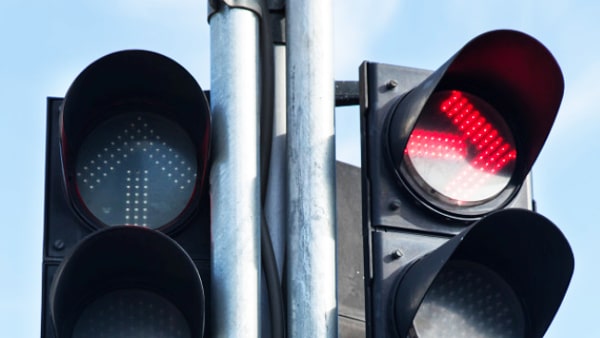
A red arrow pointing to the right on a traffic light means you may:
  1. A Stop, then turn if the roadway appears clear
  2. B Remain stopped until a signal permits the right turn
  3. C Slow down and turn after checking traffic
  4. D Turn if vehicles behind you are waiting

Correct answer: B – Remain stopped until a signal permits the right turn

A steady red arrow requires a complete stop and prohibits movement in the arrow’s direction until an indication permitting that movement appears. The right-turn-on-red exception applies to a circular red signal, not a steady red arrow. A flashing red arrow, by contrast, permits a turn after stopping and selecting a safe gap.

Source: 21 Del. C. § 4108(a)(3) – Traffic-control signal legend, Delaware Driver Manual — Section Four, “Arrows”

Question 2

When parking downhill where there is no curb, how should you position the front wheels?

  1. A Toward the traveled portion of the road
  2. B Straight and parallel with the road
  3. C Toward the edge of the road
  4. D In either direction

Correct answer: C – Toward the edge of the road

When a vehicle is parked downhill, the front wheels should be turned toward the curb or the edge of the road. With no curb present, point them toward the roadside. This positioning directs the vehicle away from the traveled roadway if it moves downhill.

Source: Delaware Driver Manual — Section Four, “Parking on Hill”

Question 3

When turning right on a steady green signal, to whom must you yield?

  1. A Only vehicles behind you
  2. B No one, because the signal is green
  3. C Pedestrians lawfully within the intersection or adjacent crosswalk
  4. D Only vehicles waiting at a red signal

Correct answer: C – Pedestrians lawfully within the intersection or adjacent crosswalk

Under Delaware law, a steady green signal permits a right turn unless another traffic-control device prohibits it. A turning driver must still yield to pedestrians lawfully within the intersection or an adjacent crosswalk. The driver must also yield to other vehicles already lawfully within the intersection.

Source: 21 Del. C. § 4108(a)(1)a. – Traffic-control signal legend

Question 4

At a stop sign, where should you stop if there is no marked stop line but a crosswalk is present?

  1. A At the middle of the crosswalk
  2. B Before entering the near-side crosswalk
  3. C Just beyond the intersection corner
  4. D At least 15 feet from the intersection

Correct answer: B – Before entering the near-side crosswalk

When a stop line is present, stop at that line. If there is no stop line, stop before entering the crosswalk on the near side of the intersection. If neither a stop line nor a crosswalk exists, stop at the nearest point where you can view approaching traffic before entering the intersecting roadway.

Source: 21 Del. C. § 4164(a) – Stop signs and yield signs

Question 5

From which lane should you normally begin a right turn on a road with two lanes traveling in your direction?

  1. A The lane nearest the center line
  2. B The lane nearest the right curb or roadway edge
  3. C Either lane, based on oncoming traffic
  4. D Either lane, based on your speed

Correct answer: B – The lane nearest the right curb or roadway edge

Both the approach to a right turn and the turn itself must be made as close as practicable to the right-hand curb or roadway edge. This prevents an ordinary right turn from unnecessarily crossing another same-direction lane. Traffic-control devices may direct drivers to follow a different turning path at a particular intersection.

Source: 21 Del. C. § 4152(a)(1), (b) – Required position and method of turning at intersections

Question 6

Which sequence correctly prepares you for a lane change?

  1. A Signal, check the mirrors, and move over without a blind-spot check
  2. B Signal, check the mirrors, check over your shoulder, and move when the lane is clear
  3. C Signal and immediately move into the next lane
  4. D Accelerate, check one mirror, and then signal

Correct answer: B – Signal, check the mirrors, check over your shoulder, and move when the lane is clear

The Delaware manual directs drivers to signal, check the rearview and side mirrors, and look over the appropriate shoulder before changing lanes. The shoulder check covers the blind spot near the vehicle’s rear corner. Continue monitoring traffic ahead and enter the new lane only after verifying that enough clear space is available.

Source: 21 Del. C. § 4155(a), (d) – Turning movements and required signals, Delaware Driver Manual — Section Five, “When changing lanes”