Florida Permit Practice Test

4.8 out of 5 (3533 votes)
80% Passing score
20 Questions
4 Mistakes allowed
The Florida permit test is not the kind of exam you want to stroll into with a vague memory of what a yield sign looks like and a hopeful attitude. The official Class E Knowledge Exam is based on the Florida Driver License Handbook, and it asks 50 multiple-choice questions covering traffic laws, safe driving habits, road signs, and traffic controls. To pass, you need 40 correct answers. That is 80%, which sounds manageable until you remember that missing more than 10 means you are coming back. This Florida DMV practice test gives you a sharper way to prepare before you deal with the real thing. It includes 20 multiple-choice questions built around the material Florida actually expects you to know, from license requirements and traffic signals to right-of-way rules that seem simple until four drivers arrive at the same intersection and everyone suddenly develops strong opinions. And, yes, you should still read the handbook. That part is not optional, even if it is not exactly beach reading. But the handbook gives you the rules; a Florida permit practice test makes you use them. It is one thing to recognize a rule when it is printed neatly on a page, and another to apply it inside a test question where the wording is just slippery enough to make you second-guess yourself. This practice permit test is especially useful if you are applying for a Florida learner’s license, preparing for a Class E driver license, renewing after a while, or just trying to find out whether your driving-law knowledge is as solid as you think it is. Florida also charges for retests: $10 for a knowledge retest and $20 for a skills retest. So, no, one free DMV practice permit test will not magically do all the work for you. Still, it is a much better place to make your first round of mistakes. Use this free Florida permit test practice as a practical warm-up before test day. Work through the questions, pay attention to what you miss, and go back to the handbook when something feels fuzzy. By the time you take the real Florida DMV test, the goal is not just to “feel ready.” The goal is to know why the right answer is right.
FREE DMV Practice Test App
Study for your Florida permit test or driver’s license with the NextDoorDriving app. 700+ DMV questions and answers, 100% free!
Download on the App Store

Sample Florida Permit Test Questions

Question 1

Which pavement marking identifies the right edge of a roadway?

  1. A A broken white line
  2. B A solid yellow line
  3. C A solid white line
  4. D A broken yellow line

Correct answer: C – A solid white line

A single solid white line marks the right edge of the roadway. A solid yellow edge line is used on the left side of a divided highway or one-way street. White lane lines may also separate traffic moving in the same direction, so the line's location helps identify its purpose.

Source: The Official Florida Driver License Handbook — Ch. 6, “Pavement Markings”
Question 2

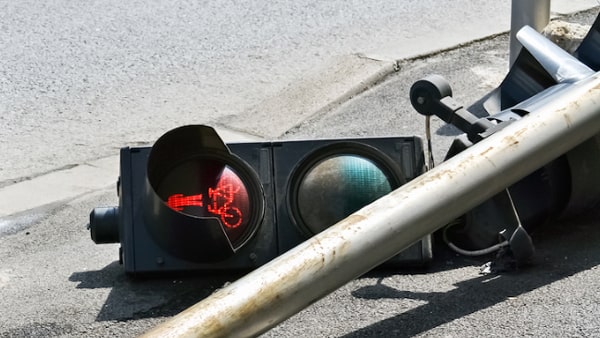
What must you do when you approach an intersection where the traffic lights are not operating?

When a traffic signal light is not working, you should:
  1. A Stop only when cross traffic is present
  2. B Slow down but continue without stopping
  3. C Stop as required at a stop intersection, then proceed when permitted
  4. D Continue as though the signal were green

Correct answer: C – Stop as required at a stop intersection, then proceed when permitted

Florida requires a driver approaching an inoperative traffic light to stop in the same manner required at a stop intersection. After stopping, yield to vehicles and pedestrians as required and proceed only when the movement can be made safely. The rule also applies when only the signal facing your approach is inoperative.

Source: Fla. Stat. § 316.1235 – Vehicle approaching intersection in which traffic lights are inoperative, Fla. Stat. § 316.123(2) – Vehicle entering stop or yield intersection

Question 3

What is the safest response when floodwater covers the roadway ahead?

  1. A Drive through slowly in a low gear
  2. B Follow a larger vehicle across
  3. C Turn around and use another route
  4. D Accelerate to maintain traction

Correct answer: C – Turn around and use another route

Do not attempt to drive across a flooded roadway. Water may conceal a washed-out surface, and a vehicle can lose traction or be carried away. Turn around and find another route rather than trying to judge whether the water is shallow enough to cross.

Source: The Official Florida Driver License Handbook — Ch. 8, “Flooded Roadways”

Question 4

On a narrow, steep road, one vehicle may need to back up to make room. What must the backing driver verify first?

  1. A That the vehicle is facing downhill
  2. B That backing can be done safely without interfering with traffic
  3. C That the other vehicle is smaller
  4. D That the road has no centerline

Correct answer: B – That backing can be done safely without interfering with traffic

Florida law does not permit a driver to back unless the movement can be completed safely and without interfering with other traffic. The driver must check the path behind the vehicle and the surrounding traffic before moving. Backing is also prohibited on the shoulder or roadway of a limited-access facility.

Source: Fla. Stat. § 316.1985 – Limitations on backing

Question 5

How should you direct your vision when an oncoming vehicle's headlights cause glare at night?

When a car with bright headlights comes toward you at night, you should:
  1. A Look directly at the headlights
  2. B Look above the approaching vehicle
  3. C Close one eye until the vehicle passes
  4. D Watch the right edge of your lane

Correct answer: D – Watch the right edge of your lane

Do not stare into an oncoming vehicle's headlights. Watch the right edge of your lane and make brief checks of the approaching vehicle's position until it passes. This keeps your eyes on a useful roadway reference while reducing direct exposure to glare.

Source: The Official Florida Driver License Handbook — Ch. 8, “Night Driving”

Question 6

Which option correctly lists ways drivers can communicate with other road users?

  1. A Turn signals and brake lights, the horn when reasonably necessary, and hazard lights during a breakdown
  2. B High beams for lane changes and the horn at every intersection
  3. C Hand gestures and sudden changes in speed
  4. D Parking lights for turns and hazard lights while passing

Correct answer: A – Turn signals and brake lights, the horn when reasonably necessary, and hazard lights during a breakdown

Turn signals communicate planned turns and lane changes, while brake lights warn traffic that you are slowing or stopping. A horn may warn others when reasonably necessary for safety. If your vehicle becomes disabled, hazard lights help alert approaching drivers to the obstruction.

Source: The Official Florida Driver License Handbook — Ch. 7, “Communicating with Other Drivers”