


Florida Learners Permit Practice Test 7

4.9 out of 5 (1075 votes)
80% Passing score
20 Questions
4 Mistakes allowed
Florida does not exactly let new drivers wander into the permit process with a shrug and a lucky pencil. There are rules, forms, scores, parent signatures, school attendance requirements, and yes, the actual driving laws you’re supposed to know before the state lets you start practicing on real roads with real people in the next lane. This Florida permit practice test, the seventh in our Florida DMV practice test series, gives you 20 questions built around the stuff that tends to show up when you least want to be surprised by it. You’ll see traffic laws, insurance requirements, financial responsibility rules, and the kind of scenario-based questions that make you slow down and think for a second. To pass, you’ll need at least 16 correct answers. That number matters, obviously, but the better goal is knowing why the answer is right before you’re staring at the real Class E Knowledge Exam and trying to talk yourself into option C. Florida also has a few extra rules for minors, because of course it does. If you’re under 18, school attendance is tied to driving privileges. A teen who is not meeting Florida’s attendance requirements may be ineligible to get or keep a license, and driving privileges can be suspended until proof of 30 consecutive days of school attendance is provided. That is one of those details people do not always study, then suddenly it becomes the detail. Parents and guardians are part of the deal, too. When a parent or legal guardian signs a minor’s application, they are accepting responsibility for that minor’s driving. If they later withdraw consent, the license gets canceled. And if a minor takes the Class E Knowledge Exam online through a third-party administrator, the Parent/Guardian Online Test Proctoring Form 71144 is required. Paperwork has entered the chat, unfortunately. One more small wrinkle: passing through an authorized third-party tester may not be the final boss. Applicants who pass the Class E Knowledge Exam or Driving Skills Test that way can be randomly selected for a mandatory no-fee retest before the license is issued. That's why your permit practice test should try to keep it simple. You can take this Florida learner permit test online as many times as you need. Not to game the system, not to chase some magic cheat sheet, but to get familiar with the rules, the wording, and the licensing details that are easy to blur together when you only read them once.
FREE DMV Practice Test App
Study for your Florida permit test or driver’s license with the NextDoorDriving app. 700+ DMV questions and answers, 100% free!
Download on the App Store

Sample Florida Permit Test Questions

Question 1

Under Florida law, what must you do when an emergency vehicle approaches with an activated siren or red or blue lights and you are clear of an intersection?
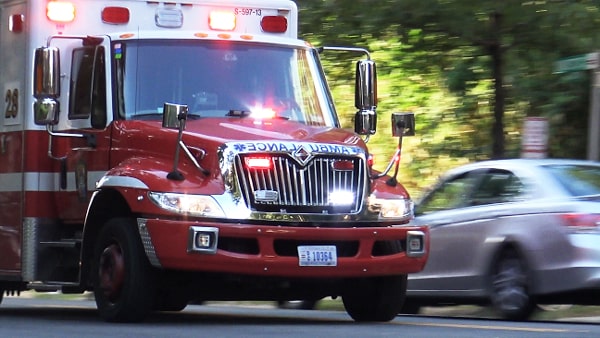
When you hear the siren or see the flashing red light of a closely approaching emergency vehicle, and you are not in the intersection, you should:
  1. A Continue slowly until it passes
  2. B Accelerate to stay ahead
  3. C Move parallel and as close as reasonable to the nearest roadway edge, then stop
  4. D Stop immediately in your current travel lane

Correct answer: C – Move parallel and as close as reasonable to the nearest roadway edge, then stop

You must yield to an approaching authorized emergency vehicle displaying the required audible or visible warning. Move parallel and as close as reasonable to the closest curb or roadway edge, clear of any intersection, and stop. Remain there until the emergency vehicle has passed unless a law enforcement officer directs otherwise.

Source: Fla. Stat. § 316.126(1)(a) – Operation of vehicles and actions of pedestrians; approach of authorized emergency, sanitation, or utility service vehicle, wrecker, or road and bridge maintenance or construction vehicle; presence of disabled motor vehicle

Question 2

A yellow diamond warning sign shows one vertical arrow pointing up and another pointing down. Which sign is this?

  1. A Lane Ends
  2. B Divided Highway Ends
  3. C Two-Way Traffic
  4. D Turn Left or Right

Correct answer: C – Two-Way Traffic

The Two-Way Traffic sign warns that vehicles ahead travel in opposite directions on the same roadway. It may appear where a divided or one-way roadway changes to two-way operation. Remain on the proper side of the roadway and be prepared for oncoming traffic.

Source: The Official Florida Driver License Handbook — Ch. 6, “Traffic Signs”, Manual on Uniform Traffic Control Devices, 2009 ed., Revs. 1–3 — § 2C.44, “Two-Way Traffic Sign (W6-3)”

Question 3

How does alcohol affect the abilities needed for safe driving?

What does alcohol do to your driving skills and judgment?
  1. A It improves vehicle control but weakens judgment
  2. B It weakens both driving skills and judgment
  3. C It affects neither skills nor judgment
  4. D It weakens vehicle control but improves judgment

Correct answer: B – It weakens both driving skills and judgment

Alcohol reduces judgment, reaction time, vision, concentration, and the ability to control a vehicle. It can make judging speed, distance, and the movement of other vehicles more difficult. Because both decision-making and physical driving abilities are weakened, no one can safely offset alcohol’s effects through driving experience.

Source: The Official Florida Driver License Handbook — Ch. 2, “Drinking & Driving”

Question 4

Which centerline marking generally prohibits traffic in both directions from crossing to pass another motor vehicle?

  1. A A broken white line
  2. B Double solid yellow lines
  3. C A broken yellow line
  4. D A single broken white line

Correct answer: B – Double solid yellow lines

Double solid yellow lines indicate that traffic in either direction must not cross to pass another motor vehicle. Florida recognizes limited exceptions for safely and briefly avoiding an obstruction, making certain left turns, or passing a bicycle or other qualifying nonmotorized vehicle. Those exceptions do not permit an ordinary pass of another motor vehicle.

Source: Fla. Stat. § 316.0875(1)–(3) – No-passing zones, The Official Florida Driver License Handbook — Ch. 4, “Pavement Markings”

Question 5

If traction is lost during emergency braking in a vehicle with conventional non-ABS brakes, what should you do?

What should you do if you have to stop your vehicle in an emergency?
  1. A Pump the brake pedal
  2. B Hold the brake pedal down with constant maximum pressure
  3. C Press the accelerator and brake together
  4. D Turn off the engine immediately

Correct answer: A – Pump the brake pedal

For an emergency stop where traction is lost, the handbook directs drivers with conventional brakes to pump the brakes. With four-wheel ABS, press the brake pedal firmly, maintain steady pressure, and steer as needed. Pumping an ABS brake pedal can disengage the anti-lock system.

Source: The Official Florida Driver License Handbook — Ch. 7, “Emergency Braking”

Question 6

An approved chemical breath test following a lawful DUI arrest is used to determine:

  1. A The driver’s reaction time
  2. B The alcoholic content of the driver’s breath or blood
  3. C The driver’s visual sharpness
  4. D The driver’s general driving skill

Correct answer: B – The alcoholic content of the driver’s breath or blood

Florida’s implied-consent law authorizes an approved chemical or physical breath test to determine the alcoholic content of a lawfully arrested driver’s blood or breath. Other authorized tests may examine blood or urine for alcohol, chemical substances, or controlled substances. These tests measure substances or concentration; they do not directly measure vision, reaction time, or driving skill.

Source: Fla. Stat. § 316.1932(1)(a)1.a., (1)(d) – Tests for alcohol, chemical substances, or controlled substances; implied consent; refusal