Kansas DMV Test Evaluation

4.5 out of 5 (815 votes)
80% Passing score
10 Questions
2 Mistakes allowed
The Kansas DMV practice test is a smart place to start if you want to know, fairly quickly, whether your permit test prep is holding together or just sort of floating around in your head. This first practice test gives you 10 randomly selected multiple-choice questions, which is enough to expose the usual weak spots without turning the whole thing into a full afternoon project. You’ll see Kansas driving rules, road signs, right-of-way, safe driving habits, and a few of the state-specific details that people tend to read once and then promptly forget. The official Kansas Class C knowledge test is bigger: 25 questions, with 20 correct answers generally needed to pass. That means you can miss up to 5, which sounds comfortable until you realize how quickly small mistakes stack up. Road sign questions are included in that same test, not separated into their own neat little category, and Kansas expects you to recognize signs by shape, color, or symbol. So the practice matters. Not in a dramatic way, necessarily. Just in the very practical, mildly humbling way that a wrong answer can show you exactly what you thought you knew. This Kansas DMV permit practice test keeps the format familiar. You read the question, compare the answer choices, eliminate the ones that are clearly wrong, and then deal with the ones that are close enough to make you slow down. That last part is where a lot of the learning happens, honestly. The real test is based on the Kansas Driving Handbook, and the better you get at connecting the handbook’s rules to actual test-style wording, the less you have to rely on guessing. You can take this Kansas permit practice test from a phone, desktop, or app, and it is free, which makes repeated practice easier to justify. Kansas applicants may take the official knowledge exam at a driver license office or online through KnowTo Drive, but the core material does not change much: traffic laws, signs, safety, and judgment. Take the first test, review the misses, and then keep working through additional Kansas DMV practice tests until the answers feel steady instead of lucky.
FREE DMV Practice Test App
Study for your Kansas permit test or driver’s license with the NextDoorDriving app. 700+ DMV questions and answers, 100% free!
Download on the App Store

Sample Kansas Permit Test Questions

Question 1

Eating or drinking while operating a vehicle is best described as:
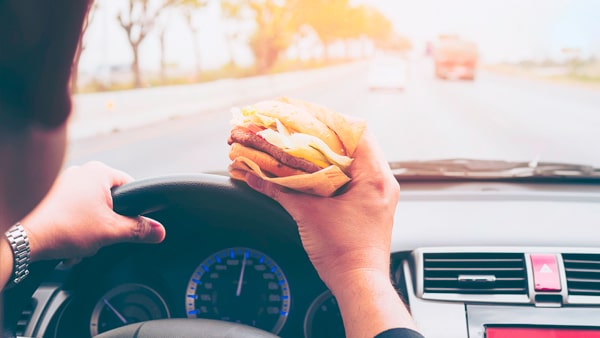
Drivers who eat and drink while driving:
  1. A A way to improve alertness
  2. B Safe whenever traffic is moving slowly
  3. C Harmless if one hand remains on the wheel
  4. D A distraction that takes attention away from driving

Correct answer: D – A distraction that takes attention away from driving

Eating and drinking are listed as driver distractions because they divert attention from the driving task. The driver may need to handle food or a beverage instead of concentrating fully on traffic and vehicle operation. The handbook recommends stopping to eat rather than eating while driving.

Source: Kansas Driving Handbook — § 3, “Driver Distractions”
Question 2

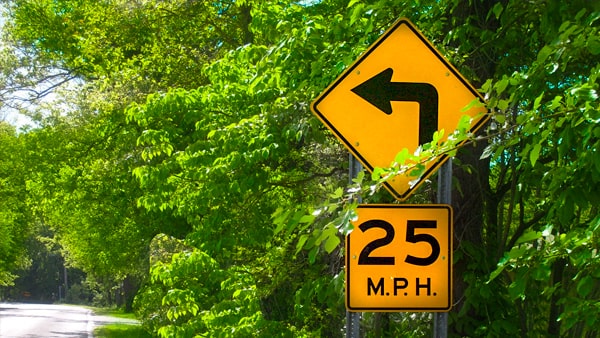
In Kansas, a left-curve warning sign with a 25 mph advisory plaque indicates:

This sign means:
  1. A A left curve with a minimum speed of 25 mph
  2. B A right curve with a minimum speed of 25 mph
  3. C A right curve with an advisory speed of 25 mph
  4. D A left curve with an advisory speed of 25 mph

Correct answer: D – A left curve with an advisory speed of 25 mph

The curve symbol shows the direction of the approaching curve, while the plaque gives its advisory speed. The 25 mph figure is not a minimum speed. Drivers should reduce speed before entering a sharp curve and slow further when poor traction or limited visibility requires it.

Source: Kansas Driving Handbook — § 6, “Warning Signs”, Kansas Driving Handbook — § 7, “Adjusting to Roadway Conditions”

Question 3

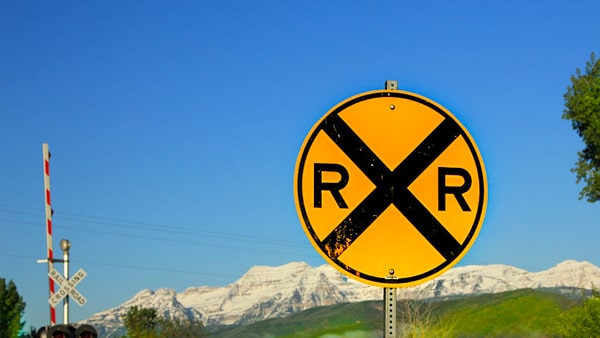
A round yellow sign displaying a black X and the letters “RR” warns of:

This sign is a warning that you are approaching:
  1. A A crossroad intersection
  2. B A pedestrian crossing
  3. C A railroad grade crossing ahead
  4. D A blasting area

Correct answer: C – A railroad grade crossing ahead

The round yellow sign with a black X and “RR” is an advance railroad-crossing warning sign. It is placed before the tracks to alert drivers to slow down, look and listen for rail traffic, and be prepared to stop. The white crossbuck is normally located at the crossing itself.

Source: Kansas Driving Handbook — § 6, “Railroad Crossing Warning Signs”

Question 4

Before moving into another lane, how should you check that the lane is clear?

  1. A Look only over your right shoulder
  2. B Use only the inside rearview mirror
  3. C Check your mirrors and look over your shoulder toward the lane
  4. D Look only over your left shoulder

Correct answer: C – Check your mirrors and look over your shoulder toward the lane

A driver must first determine that a lane change can be made safely. Check the rearview and side mirrors for nearby traffic, then look over your shoulder toward the lane you plan to enter to check the blind spot. Signal and move only when the lane is clear.

Source: K.S.A. § 8-1522(a) – Driving on Roadways Laned for Traffic; Driving in Right Lane Required; Exceptions, Kansas Driving Handbook — § 7, “When Changing Lanes”

Question 5

Under Kansas law, after stopping at a red light on a two-way street, a driver generally may:

  1. A Proceed straight if no traffic is visible
  2. B Turn left across opposing traffic
  3. C Turn right after yielding, unless a sign prohibits it
  4. D Make any of these movements

Correct answer: C – Turn right after yielding, unless a sign prohibits it

A driver facing a steady red signal must stop at the stop line, before the crosswalk, or before entering the intersection. Unless a sign prohibits the movement, the driver may then turn right cautiously. The driver must yield to pedestrians and to traffic that presents an immediate hazard.

Source: K.S.A. § 8-1508(c)(1)–(2) – Traffic-Control Signal Legend

Question 6

Traffic is backed up beyond an intersection. Even with a green light, you should:

  1. A Enter if cross traffic can drive around you
  2. B Wait until there is enough space to clear the intersection
  3. C Enter because the green light gives you priority
  4. D Enter only if operating a motorcycle

Correct answer: B – Wait until there is enough space to clear the intersection

Kansas law prohibits entering an intersection unless enough space is available on the other side to accommodate your vehicle without obstructing traffic or pedestrians. This requirement applies even when a traffic signal indicates that you may proceed. Wait behind the intersection until your path through it is open.

Source: K.S.A. § 8-1584 – Restrictions on Driving into Intersection or Crosswalk or onto Railroad Grade Crossing