


Nevada DMV Permit Test Simulator

4.8 out of 5 (217 votes)
80% Passing score
50 Questions
10 Mistakes allowed
Nevada’s written knowledge test is short enough to look manageable on paper, but it deserves a little respect. The real Class C knowledge test has 25 multiple-choice questions, and you need 20 correct answers to pass. That is an 80% score, with room to miss only 5. The test can also end once you hit 20 correct answers or 6 wrong ones, so every question carries more weight than people tend to assume when they are “just practicing for the permit test.” This Nevada DMV permit practice test simulator is built around that reality. It focuses on the same material covered in the Nevada Driver’s Handbook: traffic laws, highway signs, pavement markings, right-of-way, defensive driving, DUI rules, licensing requirements, and the safe-driving habits the DMV expects new drivers to actually understand. Not sort of recognize. Understand. There is a difference, and the real test is good at exposing it. Each practice session gives you a fresh mix of questions, which keeps you from sliding into that fake confidence that comes from memorizing answer order. The point is not to rehearse one tidy little set of DMV questions until it feels familiar. The point is to get comfortable with the topics from different angles, because Nevada road sign questions are part of the main knowledge test, not a separate road-sign-only exam with its own little bubble around it. Signs, signals, markings, laws, safety rules — it all counts toward the same passing score. The simulator also gives you hints when you need a nudge and explanations when you miss something, which is where the learning usually happens, inconveniently enough. A wrong answer is not wasted if it teaches you why the correct one makes sense. That is especially useful for teen drivers applying for an instruction permit at 15½, adult first-time applicants, and new Nevada residents who may have different testing requirements depending on age and prior license status. You still have to handle the DMV side of things: documents, vision screening, fees, and, for teens, school attendance paperwork, a parent or guardian signature, driver education, and supervised driving hours before the license stage. This practice test does not replace any of that. It does, however, give you a sharper, more realistic way to prepare for the Nevada DMV written test before you are sitting there with 25 questions and very little room to be casual about it.
FREE DMV Practice Test App
Study for your Nevada permit test or driver’s license with the NextDoorDriving app. 700+ DMV questions and answers, 100% free!
Download on the App Store

Sample Nevada Permit Test Questions

Question 1

Which lighting choice is specifically permitted when using fog lamps?

  1. A Low-beam headlights with the fog lamps
  2. B High-beam headlights with the fog lamps
  3. C Parking lights without headlights
  4. D Hazard flashers instead of headlights

Correct answer: A – Low-beam headlights with the fog lamps

Nevada law permits lighted fog lamps to be used with lower headlamp beams. The driver’s handbook also advises using headlights when driving in fog because visibility is reduced. Parking lights or hazard flashers are not substitutes for the required headlamps while driving under low-visibility conditions.

Source: NRS 484D.180 – Additional equipment for lighting, Nevada Driver’s Handbook — Ch. 5, “Night Driving”
Question 2

Which practice is part of defensive driving?

  1. A Focus only on the vehicle immediately ahead
  2. B Stay alert and scan well ahead for changing conditions
  3. C Depend on other drivers to correct your mistakes
  4. D Wait until the last moment to respond to hazards

Correct answer: B – Stay alert and scan well ahead for changing conditions

The handbook recommends looking at least 12 seconds ahead to observe traffic patterns and possible hazards. At freeway speeds, the recommended search distance increases to at least 20 to 30 seconds. Looking well ahead and staying alert provide more time and space to respond to changing conditions.

Source: Nevada Driver’s Handbook — Ch. 3, “Defensive Driving Tips”

Question 3

When parking an automatic-transmission vehicle on a hill, you should:

  1. A Let a rear tire rest against the curb
  2. B Shift to Park and set the parking brake
  3. C Leave the transmission in Neutral
  4. D Always turn the front wheels toward the curb

Correct answer: B – Shift to Park and set the parking brake

After positioning an automatic-transmission vehicle, shift into Park and set the parking brake. When parking on a hill, also turn the front wheels in the proper direction so the vehicle would roll away from traffic or into the curb if it began moving. The wheel direction varies according to the slope and whether a curb is present.

Source: Nevada Driver’s Handbook — Ch. 3, “Parking on a Hill”

Question 4

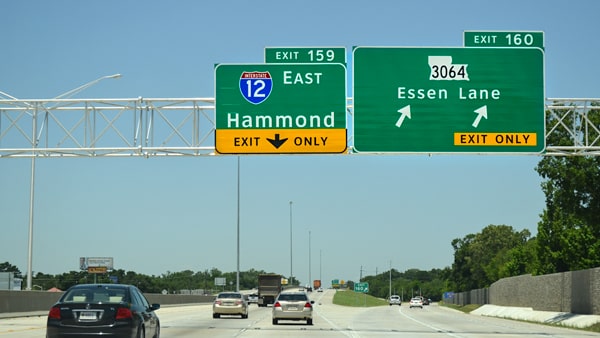
If you remain in a freeway lane marked by a yellow “EXIT ONLY” panel, you must:

If you see this sign above your lane, you:
  1. A Continue through the interchange
  2. B Choose either the exit or the through roadway
  3. C Stop before the exit ramp
  4. D Leave the freeway at that exit

Correct answer: D – Leave the freeway at that exit

An EXIT ONLY panel identifies a lane that leaves the freeway rather than continuing through the interchange. Dotted white markings may also identify an exit-only lane. If you intend to remain on the freeway, move safely into a continuing lane before the exit lane separates.

Source: Nevada Driver’s Handbook — Ch. 3, “Signs, Signals and Markings”

Question 5

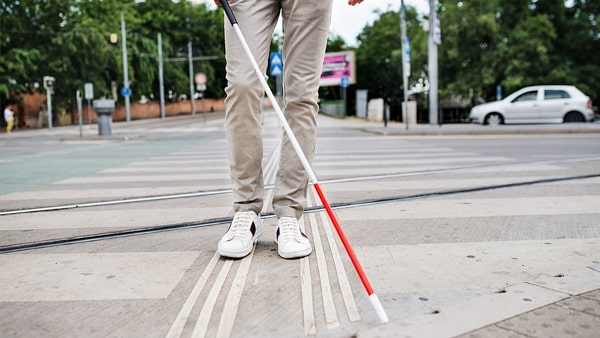
When approaching a pedestrian using a white cane or service animal, what must a driver do?

When driving near a blind pedestrian who is carrying a white cane or using a guide dog, you should:
  1. A Yield and stop if necessary to prevent a crash or injury
  2. B Proceed first because vehicles have priority
  3. C Continue at the same speed if outside a crosswalk
  4. D Sound the horn and pass quickly

Correct answer: A – Yield and stop if necessary to prevent a crash or injury

In Nevada, a person who is blind and is using a white cane, a white cane tipped with red or a service animal has the right-of-way when entering or using a road. An approaching driver must yield, come to a full stop if necessary and take precautions before proceeding to avoid a crash or injury.

Source: NRS 484B.290 – Right-of-way of person who is blind; penalty

Question 6

A single broken white or yellow line may be crossed only when:

  1. A The movement is permitted and can be made without interfering with traffic
  2. B You are turning into any driveway
  3. C The vehicle ahead is traveling below the speed limit
  4. D You want to avoid waiting behind traffic

Correct answer: A – The movement is permitted and can be made without interfering with traffic

Broken lane markings generally permit an appropriate lane change or pass, but the movement must still be lawful and safe. Before changing lanes, check the mirrors, signal, look over your shoulder and wait until traffic is clear. A broken yellow line permits passing only when roadway conditions and oncoming traffic allow it.

Source: Nevada Driver’s Handbook — Ch. 3, “Highway Markings”, Nevada Driver’s Handbook — Ch. 3, “Lane Changes”