


Nevada DMV Sign Test 3

4.9 out of 5 (157 votes)
80% Passing score
20 Questions
4 Mistakes allowed
Nevada road signs are easy to recognize in theory, which is exactly why people sometimes give them less attention than they deserve. The actual Nevada Class C knowledge test is not a separate road-sign exam tucked off in its own little corner. Road sign questions are folded into the main permit knowledge test, along with Nevada traffic laws, pavement markings, traffic signals, DUI rules, licensing requirements, defensive driving, and the usual safe-driving material pulled from the Nevada Driver’s Handbook. This Nevada road signs practice test gives you a more focused way to study that part of the exam. You’ll work through 20 questions built around the signs and visual cues Nevada drivers are expected to understand: highway signs, warning signs, regulatory signs, lane markings, traffic signals, pavement markings, and safe responses to what those signs are telling you to do. A stop sign is not just “red means stop,” not really. A yield sign is not just a triangle. A lane marking is not decoration. The DMV, in its own quiet way, expects you to know what these things mean while traffic is moving and nobody is politely pausing so you can think it over. On the official Nevada permit test, you’ll get 25 multiple-choice questions. You need an 80% score to pass, which means 20 correct answers. You can miss 5, but the test ends once you either reach 20 correct answers or hit 6 incorrect answers. That detail matters, because road sign questions count toward the same total as everything else. There is no separate road-sign-only test for the standard Class C permit, and no special number of signs you’re allowed to miss. A missed sign question is simply a missed question. Nevada applicants can take the official knowledge test online through KnowTo Drive Nevada or in person at a DMV office. The online version is available 24/7 in English and Spanish, requires a desktop or laptop with a front-facing camera, has a 60-minute time limit, and does not support touch-screen devices. There is also a separate $6.75 vendor fee each time you take it. If you pass online, the results go to the DMV automatically, but you still have to finish the regular credential steps: documents, vision screening, fees, and all the rest of that paperwork-heavy business. Use this Nevada DMV practice test as a concentrated run-through before the real permit test. It will not replace the handbook. Fine, fair enough. But it can make the sign and marking questions feel a lot less slippery when they show up inside the full 25-question exam.
FREE DMV Practice Test App
Study for your Nevada permit test or driver’s license with the NextDoorDriving app. 700+ DMV questions and answers, 100% free!
Download on the App Store

Sample Nevada Permit Test Questions

Question 1

How does a red turn arrow differ from a circular red signal?
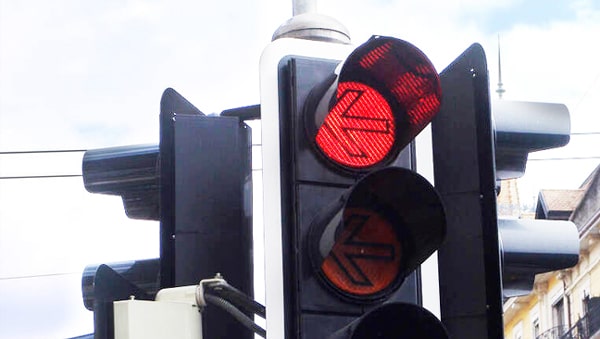
What is the difference between traffic lights with red arrows and those with solid red lights?
  1. A You may not make the arrow’s movement, even after stopping
  2. B It applies only to left-turn lanes
  3. C It requires turning drivers to slow without stopping
  4. D It permits the turn whenever cross traffic is clear

Correct answer: A – You may not make the arrow’s movement, even after stopping

The Nevada handbook states that a red arrow prohibits the movement shown and requires drivers to stop unless another signal permits a different movement. A circular red signal also requires a stop, but certain right turns—and some left turns between one-way streets—may be allowed after stopping and yielding. Posted signs or arrow signals may prohibit those turns.

Source: NRS 484B.307(8)(a), (c) — Traffic controlled by official traffic-control devices exhibiting different colored lights, Nevada Driver’s Handbook — Ch. 3, “Signals”
Question 2

Why should you scan left and right before entering an intersection on green?

  1. A To identify cross traffic that may be entering your path
  2. B To determine whether your lane ends after the intersection
  3. C To check whether the green signal is malfunctioning
  4. D To confirm that vehicles behind you have stopped

Correct answer: A – To identify cross traffic that may be entering your path

A green signal permits movement, but a driver should still check the intersection before entering. The Nevada handbook directs drivers to look in all directions and specifically to look left, right, and left again. This scan helps identify cross traffic or another hazard in the intended path.

Source: Nevada Driver’s Handbook — Ch. 3, “Defensive Driving Tips”

Question 3

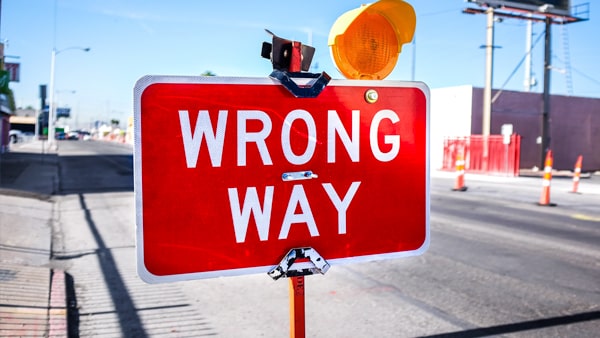
The red-and-white WRONG WAY sign shown warns that:

This red and white sign means:
  1. A You may enter after yielding
  2. B The entire roadway is closed
  3. C U-turns are prohibited ahead
  4. D You are traveling in a direction prohibited for traffic

Correct answer: D – You are traveling in a direction prohibited for traffic

A WRONG WAY sign warns that your direction of travel is not permitted. Nevada law requires vehicles on a one-way roadway to travel only in the designated direction. The sign does not indicate that the road is closed to traffic traveling correctly in the opposite direction.

Source: NRS 484B.220 — One-way highway; rotary traffic island

Question 4

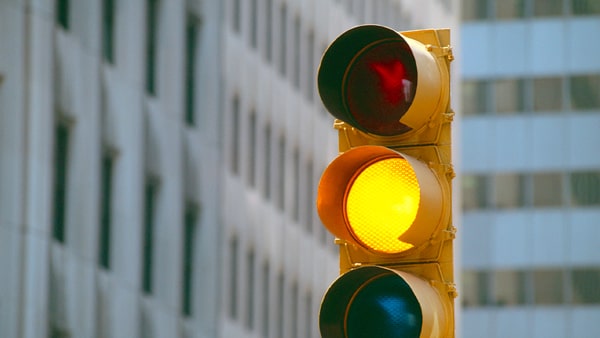
What action is required at a flashing yellow traffic signal?

  1. A Merge with traffic
  2. B Proceed cautiously
  3. C Stop for pedestrians regardless of their location
  4. D Come to a complete stop

Correct answer: B – Proceed cautiously

A flashing yellow signal permits a driver to continue through the intersection or hazardous location only with caution. Reduce speed when conditions require it and watch for conflicting traffic or other hazards. Unlike a flashing red signal, it does not automatically require a complete stop.

Source: NRS 484B.310(2) — Flashing signals, Nevada Driver’s Handbook — Ch. 3, “Signals”

Question 5

Your signal changes from red to green. When may you begin moving?

  1. A Immediately, because all other traffic must stop
  2. B After yielding to anyone lawfully remaining in the intersection or crosswalk
  3. C Only after the vehicle behind you starts moving
  4. D Immediately, but only when traveling straight

Correct answer: B – After yielding to anyone lawfully remaining in the intersection or crosswalk

A green signal permits movement but does not eliminate the duty to yield to people already using the intersection lawfully. Nevada law requires drivers to yield to vehicles in the intersection and pedestrians in the intersection or adjacent crosswalk. Check the path before accelerating.

Source: NRS 484B.307(2)(a) — Traffic controlled by official traffic-control devices exhibiting different colored lights, Nevada Driver’s Handbook — Ch. 3, “Signals”

Question 6

The signal changes from green to steady yellow as you approach an intersection. What should you do?

As you near an intersection, the traffic light changes from green to yellow. Your best action would be to:
  1. A Accelerate to enter before the red signal
  2. B Brake abruptly regardless of following traffic
  3. C Plan to stop in the intersection
  4. D Prepare to stop before entering the intersection

Correct answer: D – Prepare to stop before entering the intersection

A steady yellow signal warns that the green movement is ending or a steady red indication will appear immediately afterward. Prepare to make a controlled stop before entering rather than accelerating to beat the signal. If you are already within the intersection, continue moving and clear it safely.

Source: NRS 484B.307(6)(a) — Traffic controlled by official traffic-control devices exhibiting different colored lights, Nevada Driver’s Handbook — Ch. 3, “Signals”