


Colorado DMV Practice Test 7

5 out of 5 (59 votes)
80% Passing score
20 Questions
4 Mistakes allowed
Colorado does not hand out learner’s permits because someone feels “pretty good” about road signs. You have to prove you know the rules, and the official Colorado Class D Knowledge Test gives you 25 questions to do it. You need 20 correct answers to pass, which sounds manageable until you remember that five misses is the whole cushion. Not a huge cushion. More like a folded-up jacket on a hard bench. This Colorado DMV practice test gives you 20 questions built to sharpen the same kind of judgment you will need on the real written test: road signs, traffic signals, pavement markings, lane controls, right-of-way rules, safe driving habits, insurance requirements, and the little Colorado-specific details that tend to show up when you were hoping they would not. Road sign questions are not kept off in some separate, tidy road-sign-only test, either. They are part of the main knowledge test, mixed in with traffic laws and safety topics, so it pays to study them that way. And because this is Colorado, the driving knowledge cannot be too generic. Denver traffic, mountain weather, icy grades, bright sun, dry western roads near Grand Junction (hopefully not all in one afternoon, but you never know). The state definitely expects drivers to understand more than the bare minimum. This DMV permit practice test helps you get used to that broader view before the actual test clock is running. You can take the practice test more than once, review what you missed, and read through the explanations without the DMV waiting room energy hovering over you. That part is useful, honestly. It is also a good test to keep open while you are getting the rest of the licensing pieces sorted out: the vision screening, permit fees, proof documents, and, for teen drivers, the 12-month permit period, 50 supervised driving hours, and 10 required night hours. Colorado also offers online testing through Colorado @Home, with a 60-minute limit, English and Spanish options, and a $6.50 attempt fee. So yes, the real thing is organized and official and a bit unforgiving. This Colorado permit test practice is where you get the messy mistakes out of the way first.
FREE DMV Practice Test App
Study for your Colorado permit test or driver’s license with the NextDoorDriving app. 700+ DMV questions and answers, 100% free!
Download on the App Store

Sample Colorado Permit Test Questions

Question 1

A traffic signal changes from green to steady yellow before you enter the intersection. What is the best response?
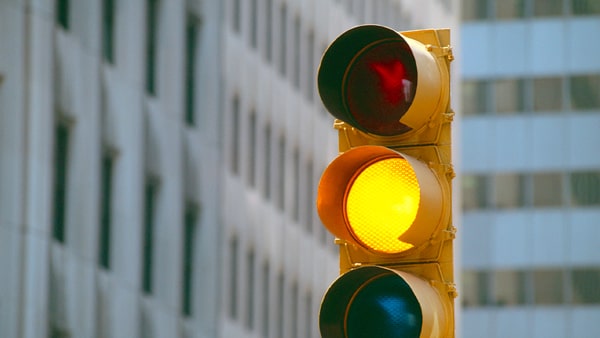
As you near an intersection, the traffic light changes from green to yellow. Your best action would be to:
  1. A Accelerate to enter before the red light
  2. B Brake sharply regardless of following traffic
  3. C Plan to stop in the middle of the intersection
  4. D Prepare to stop before entering the intersection

Correct answer: D – Prepare to stop before entering the intersection

A steady yellow signal warns that the green movement is ending or that a red indication will appear immediately. The Colorado handbook instructs drivers to stop unless they are already in the intersection. Avoid accelerating to beat the red signal or braking so abruptly that you lose control.

Source: C.R.S. § 42-4-604(1)(b)(I) – Traffic control signal legend, Colorado Driver Handbook — “Traffic Signals,” “Steady Yellow Light”
Question 2

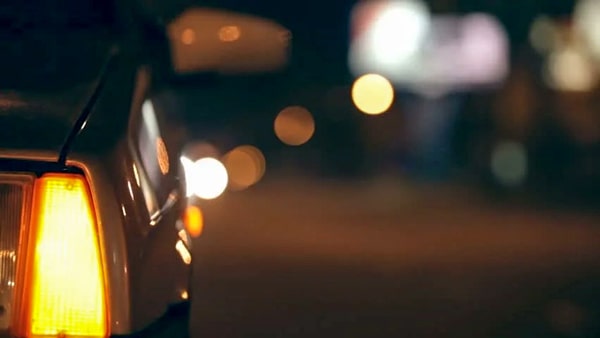
A moving vehicle ahead has its four-way emergency flashers operating. What should you recognize?

If you see warning hazard lights on a moving passenger vehicle, it means:
  1. A You must turn around immediately
  2. B You must stop on the shoulder
  3. C The vehicle may be moving unusually slowly or warning of trouble ahead
  4. D The flashing vehicle automatically has the right-of-way

Correct answer: C – The vehicle may be moving unusually slowly or warning of trouble ahead

Emergency flashers are used to alert following drivers to a vehicle that is moving very slowly, is stopped, or is warning of trouble ahead. Reduce speed as needed, increase your awareness, and determine what condition is creating the warning before passing or changing lanes.

Source: Colorado Commercial Driver License Manual — § 2.5, “Communicating”

Question 3

At a four-way stop, you arrived before the other vehicles. After checking that the intersection is clear, what should you do?

  1. A Wave every other driver through first
  2. B Proceed according to the right-of-way rule while watching for hazards
  3. C Remain stopped until no other vehicles are visible

Correct answer: B – Proceed according to the right-of-way rule while watching for hazards

The Colorado handbook states that the first vehicle to reach a four-way stop proceeds first. If vehicles arrive together, the driver on the left yields to the driver on the right. Automatically surrendering your turn does not follow that established order. Regardless of arrival order, every driver remains responsible for avoiding a crash.

Source: Colorado Driver Handbook — “Right-of-Way—Four-Way Stop”

Question 4

When parking downhill beside a curb, how should you position the front wheels?

  1. A Turn them toward the curb
  2. B Turn them away from the curb
  3. C Keep them parallel with the curb
  4. D Wheel direction does not matter

Correct answer: A – Turn them toward the curb

Turn the front wheels toward the curb when parking downhill. Allow the front tire to rest against the curb so the curb can help block the vehicle if it begins to roll. Set the parking brake and properly secure the transmission before leaving the vehicle.

Source: Colorado Driver Handbook — “Parking”

Question 5

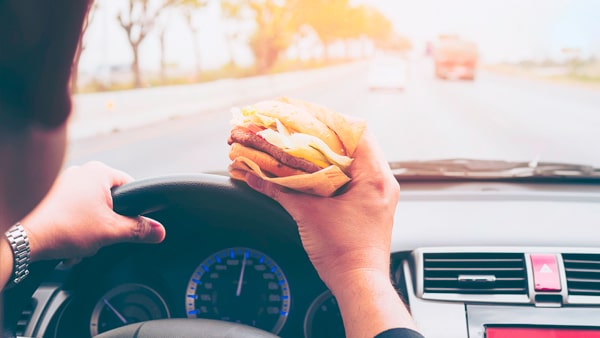
Eating or drinking while driving creates which safety risk?

Drivers who eat and drink while driving:
  1. A It eliminates common driving errors
  2. B It prevents the driver from maintaining a slow speed
  3. C It improves concentration by preventing hunger
  4. D It diverts attention and can reduce vehicle control

Correct answer: D – It diverts attention and can reduce vehicle control

A distraction may take a driver's eyes off the road, hands off the wheel, or mind off driving. Eating and drinking can create one or more of these risks and interfere with safe control of the vehicle. The handbook directs drivers not to attempt these activities while driving and to make driving their priority.

Source: Colorado Driver Handbook — “Careless/Reckless Driving—Distracted Driving”

Question 6

Which area is considered a vehicle's blind spot?

  1. A The area fully visible through the rear window
  2. B Everything shown in the rearview mirror
  3. C Everything shown in the side mirrors
  4. D An area slightly behind and beside the vehicle that mirrors do not show

Correct answer: D – An area slightly behind and beside the vehicle that mirrors do not show

Blind spots are areas slightly to the sides and rear that cannot be seen in the rearview or side mirrors. Before changing lanes, check traffic ahead and in your mirrors, then look over your shoulder to check the blind spot. Move only after verifying that the intended lane is clear.

Source: Colorado Driver Handbook — “Changing Lanes”