Massachusetts Drivers Ed Practice Test 8

4.8 out of 5 (375 votes)
80% Passing score
20 Questions
4 Mistakes allowed
Intersection questions are where a lot of Massachusetts permit test prep gets exposed. Not because the rules are impossible, but because they are easy to blur together when the question starts stacking details: who stopped first, who is turning left, who has the right-of-way, whether a pedestrian or bicycle changes the situation. This Massachusetts permit practice test keeps the focus there, on purpose, because those little judgment calls are not filler material. They are the stuff the RMV expects you to understand before you are handed a learner’s permit. This eighth Massachusetts drivers ed permit practice test includes 20 multiple-choice questions built around intersection management, four-way stops, yielding, turning, and the kind of traffic-flow decisions that look simple until you actually have to choose one answer and move on. The point is not to memorize a cute trick. It is to get comfortable reading the full scenario, slowing down for the detail that matters, and eliminating the answers that are close but still wrong—which, yes, is a real skill on this exam. The official Massachusetts Class D learner’s permit exam is administered by the Registry of Motor Vehicles and is based on the Massachusetts Driver’s Manual. The real Mass permit test gives you 25 questions in 25 minutes, and you need 18 correct answers to pass. That is a 72% passing score, meaning you can miss up to 7 questions. There is room for a few mistakes, technically, but not enough room to treat right-of-way rules, roadway signs, safe driving practices, impaired-driving penalties, hands-free driving laws, or sharing the road with bicyclists as background noise. The same Class D knowledge exam applies whether you are under 18 or already an adult. Applicants under 18 can apply at age 16 with written parent or guardian consent and then follow Junior Operator License requirements after receiving the permit. Applicants 18 and older still need to pass the learner’s permit exam before moving on to the road test, though adults are not required to complete a Massachusetts driver education program first. Use this Massachusetts RMV practice test as a focused rehearsal, not a casual skim. Work through the questions, review the ones you miss, and pay attention to the answers that almost fooled you. That “almost” is usually where the test is doing its work.
FREE DMV Practice Test App
Study for your Massachusetts permit test or driver’s license with the NextDoorDriving app. 700+ DMV questions and answers, 100% free!
Download on the App Store

Sample Massachusetts Permit Test Questions

Question 1

A center lane marked with left-turn arrows for traffic in both directions is reserved for:
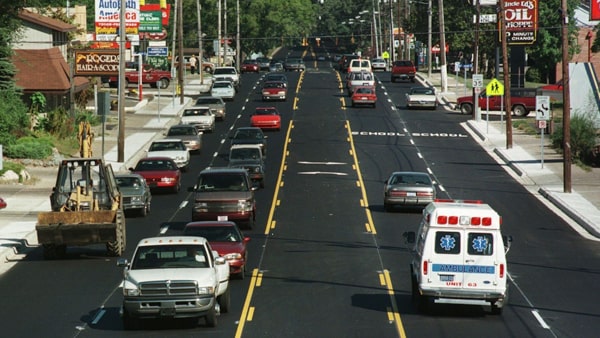
The center lane in the illustration is used for:
  1. A. Ordinary through travel
  2. B. Left-turn maneuvers
  3. C. Passing slower vehicles
  4. D. Emergency vehicles

Correct answer: B. – Left-turn maneuvers

In Massachusetts, a shared center turning lane is used by vehicles preparing to turn left. Drivers traveling in either direction may enter it for the turn, but they may not use it as an ordinary travel or passing lane. Watch for vehicles entering the lane from the opposite direction.

Source: Massachusetts Driver’s Manual — Ch. 4, “Left Turns from Center Lanes”

Question 2

In Massachusetts, when following another vehicle at night, you must switch from high beams to low beams within:

When approaching another vehicle from the rear at night, you must dim your bright headlights within:
  1. A. 100 feet
  2. B. 200 feet
  3. C. 300 feet
  4. D. 500 feet

Correct answer: B. – 200 feet

High beams can reflect in the mirrors of a vehicle ahead and interfere with its driver’s vision. The Massachusetts manual requires low beams when you are within 200 feet of a vehicle traveling ahead. High beams must also be lowered within 500 feet of an oncoming vehicle.

Source: Massachusetts Driver’s Manual — Ch. 5, “High Beam Headlights”

Question 3

On a Massachusetts road wide enough for two lines of moving vehicles, when may you pass a vehicle on the right?

  1. A. When it is preparing to turn right
  2. B. When it is making or preparing to make a left turn
  3. C. Whenever it is traveling below the speed limit
  4. D. Whenever the shoulder is clear

Correct answer: B. – When it is making or preparing to make a left turn

Passing on the right is permitted when the roadway is unobstructed and wide enough for at least two lines of moving vehicles and the vehicle ahead is making or preparing to make a left turn. State law also permits passing on the right on a one-way street or another roadway restricted to one direction of travel.

Source: M.G.L. c. 89, § 2 – Passing vehicle traveling in same direction

Question 4

Before entering moving traffic from a stopped position, what must you verify?

  1. A. That you can remain below traffic speed for 200 feet
  2. B. That a large enough gap exists to enter safely and reach traffic speed
  3. C. That only one vehicle has passed your position
  4. D. That your signal will require other drivers to let you enter

Correct answer: B. – That a large enough gap exists to enter safely and reach traffic speed

Before entering a roadway, signal and wait for enough space to complete the maneuver safely. The gap must give you time to enter the lane and accelerate to an appropriate speed. A turn signal communicates your intention, but you must still make sure the lane is clear.

Source: Massachusetts Driver’s Manual — Ch. 4, “Entering and Exiting the Highway”

Question 5

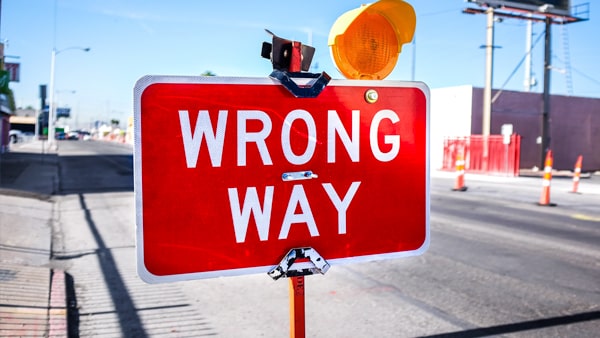
A rectangular red sign displaying the words WRONG WAY warns that:

This red and white sign means:
  1. A. You may proceed if no traffic is approaching
  2. B. The entire roadway is closed in every direction
  3. C. U-turns are prohibited at the next intersection
  4. D. You are traveling against the permitted direction of traffic

Correct answer: D. – You are traveling against the permitted direction of traffic

A WRONG WAY sign indicates that your vehicle is facing or traveling against the lawful traffic direction. Move out of the traffic path and stop as safely as possible. When conditions permit, turn around or return to the roadway from which you entered.

Source: Massachusetts Driver’s Manual — Ch. 4, “Regulatory Signs”

Question 6

Before descending a steep hill covered with snow or ice, you should:

  1. A. Follow another vehicle closely for traction
  2. B. Wait until your speed increases, then brake firmly
  3. C. Reduce speed and select a lower gear before starting downhill
  4. D. Accelerate quickly to keep the wheels turning

Correct answer: C. – Reduce speed and select a lower gear before starting downhill

Snow and ice reduce tire traction and increase stopping distance. Slow before reaching the downgrade and select a lower gear before your speed builds. A lower gear can help control speed and reduce the amount of braking needed, while sudden acceleration or braking may cause a skid.

Source: Massachusetts Driver’s Manual — Ch. 5, “Driving in Winter”