


Massachusetts DMV Practice Test 9

4.8 out of 5 (290 votes)
80% Passing score
20 Questions
4 Mistakes allowed
School bus questions deserve more attention than most people give them, mostly because Massachusetts does not treat them like a tiny footnote in the Driver’s Manual. They sit right in that serious part of driving knowledge where the rule is simple in theory, but the real-world responsibility is much bigger: children stepping into the road, traffic stacking up behind you, lights flashing, and drivers needing to make the correct decision without improvising. This MA RMV permit practice test stays locked on that exact topic. The practice test includes 20 questions focused on how Massachusetts drivers should respond around school buses, especially when children are loading, unloading, or crossing nearby. To pass this Massachusetts practice permit test, you need at least 16 correct answers, which is an 80% score. That is a little stricter than the real Class D learner’s permit exam, and honestly, that is the point. School bus laws are not an area where “close enough” is a great study strategy. The official Massachusetts learner’s permit exam is administered by the Registry of Motor Vehicles and is based on the Massachusetts Driver’s Manual. The real RMV permit test covers a wider mix of material: motor vehicle laws, rules of the road, safe driving practices, roadway signs, impaired-driving penalties, sharing the road with bicyclists, and hands-free driving laws. Applicants get 25 questions and 25 minutes, and they need 18 correct answers to pass. That comes out to a 72% passing score, with up to 7 missed questions allowed. So, yes, the official test gives you some room to miss a few—but not enough room to wander in half-prepared. What makes this Mass permit test practice useful is the feedback after each question. Miss one, and you do not just get a cold “wrong” slapped on the screen and then move along like nothing happened. You get an explanation, which is where the actual studying happens. The small corrections matter: when to stop, where to stop, what the bus signals mean, and how your responsibility changes depending on the road situation. Use this DMV practice test with the official manual, with a driver education course, or as a focused review before the real exam. And one more detail worth knowing: a Massachusetts learner’s permit is generally valid for 2 years, or for the length of the applicant’s stay in the United States when that applies. If it expires, you have to apply again and retake the permit exam. Better to prepare carefully now, especially on school bus rules, than give the RMV another chance to put you back under the clock.
FREE DMV Practice Test App
Study for your Massachusetts permit test or driver’s license with the NextDoorDriving app. 700+ DMV questions and answers, 100% free!
Download on the App Store

Sample Massachusetts Permit Test Questions

Question 1

When a truck begins passing you on the left, what should you do with your speed?

When a truck driver behind you wants to pass your vehicle, your speed should:
  1. A Do not increase it; slow if necessary to permit a safe pass
  2. B Vary it throughout the passing maneuver
  3. C Increase it until the truck falls behind
  4. D Match the truck’s speed and remain beside it

Correct answer: A – Do not increase it; slow if necessary to permit a safe pass

Massachusetts law requires an overtaken driver to give way to the right when properly signaled and not increase speed until completely passed. The driver’s manual also directs a driver being passed to slow down, stay right, and allow the maneuver to be completed safely. These duties apply whether the passing vehicle is a truck or another vehicle.

Source: M.G.L. c. 89, § 2 — Passing Vehicle Traveling in Same Direction, Massachusetts Driver’s Manual — Ch. 4, “Being Passed”

Question 2

A tractor-trailer is traveling in the center lane of a three-lane highway. If you pass it, which method is appropriate?

  1. A Use the left lane, obey the speed limit, and return only after safely clearing the truck
  2. B Use the left lane but remain beside the truck for several minutes
  3. C Use the right lane and exceed the speed limit
  4. D Stay in the truck’s right-side blind area

Correct answer: A – Use the left lane, obey the speed limit, and return only after safely clearing the truck

Drivers should normally pass on the left and maintain a safe distance from the vehicle being overtaken. Do not exceed the speed limit, and do not return to the original lane until safely clear. The driver’s manual cautions against passing trucks or buses on the right because large vehicles have substantial blind spots and make wide turns.

Source: M.G.L. c. 89, § 2 — Passing Vehicle Traveling in Same Direction, Massachusetts Driver’s Manual — Ch. 4, “Rules for Passing” and “Trucks and Other Large Vehicles”

Question 3

Under Massachusetts state-highway rules, what does a downward green arrow above a travel lane indicate?

This green arrow on a lane use control signal means that:
  1. A Vehicles may travel in that lane
  2. B The lane is closed to all traffic
  3. C Drivers in the lane have an unrestricted right-of-way
  4. D Every driver must merge into that lane

Correct answer: A – Vehicles may travel in that lane

A downward-pointing illuminated green arrow means a driver may operate in the lane beneath the signal. It indicates that the lane is open for travel; it does not give an unrestricted right-of-way over other traffic controls or road users. A red X over a lane has the opposite meaning and prohibits travel in that lane.

Source: 700 CMR 9.06(11) — Operation of Vehicles

Question 4

What is the proper way to direct your vision while driving?

  1. A Keep your eyes fixed straight ahead
  2. B Watch only the vehicle directly in front
  3. C Look ahead only when no vehicle is behind you
  4. D Shift your attention near and far while checking the sides and mirrors

Correct answer: D – Shift your attention near and far while checking the sides and mirrors

Drivers need to know what is happening ahead, beside, and behind their vehicles. Shift your attention between nearby conditions and hazards farther down the road rather than staring at one point. Check your mirrors regularly and look around the vehicle so changing traffic conditions can be recognized early.

Source: Massachusetts Driver’s Manual — Ch. 3, “Driving Defensively”, Massachusetts Commercial Driver’s License Manual — § 2.4, “Seeing”

Question 5

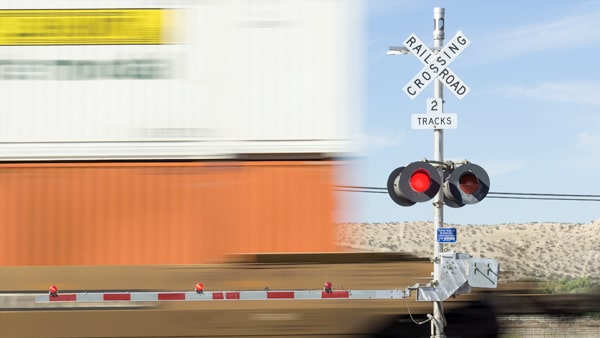
A train has just cleared a railroad crossing. What should you do before driving across?

After a train has passed, you should:
  1. A Proceed as soon as the last railcar clears your lane
  2. B Wait until the train is completely out of sight
  3. C Sound the horn and cross immediately
  4. D Check for another train and proceed only when the signals and tracks are clear

Correct answer: D – Check for another train and proceed only when the signals and tracks are clear

A passing train can hide another train approaching from the opposite direction, particularly at a multiple-track crossing. Check the tracks again and obey any flashing lights, gates, or railroad employee’s signal. Massachusetts law requires reasonable care when crossing and prohibits proceeding while warning lights flash or a gate remains lowered.

Source: M.G.L. c. 90, § 15 — Precautions at Railroad Crossings, Massachusetts Driver’s Manual — Ch. 4, “Railroad Crossings”

Question 6

After stopping at a stop line, you cannot see approaching cross traffic clearly. What should you do next?

  1. A Wait five seconds and then enter
  2. B Sound the horn before continuing
  3. C Listen through an open window and proceed without looking
  4. D Edge forward cautiously, check for road users, and proceed when clear

Correct answer: D – Edge forward cautiously, check for road users, and proceed when clear

Massachusetts law requires the initial full stop at the marked stop line. After stopping, move forward cautiously only as needed to obtain a clear view, watching for pedestrians, bicyclists, and cross traffic. Yield to any vehicle in or approaching the intersection closely enough to create an immediate hazard, and enter only when the way is clear.

Source: M.G.L. c. 89, § 9 — Designation of Highways as Through Ways; Traffic Control Signs and Devices, Massachusetts Driver’s Manual — Ch. 4, “Stop Signs”