


Michigan Driving Test Practice

4.7 out of 5 (678 votes)
80% Passing score
20 Questions
4 Mistakes allowed
A Michigan driving test practice should prepare you for the actual test structure, not just toss a few road-sign questions at you and call it a day. The official standard-driver manual, What Every Driver Must Know, comes from the Michigan Department of State, Secretary of State, and that is the material the real exam is built around: traffic laws, safe vehicle operation, road signs, signals, right-of-way rules, and the small judgment calls that separate a lucky guess from an answer you actually understand. For adults 18 and older, the Michigan driver knowledge test is a 50-question multiple-choice exam split into two equal parts. There are 25 operator/rules questions and 25 signs questions. You need 80% to pass, which means 20 correct answers in each section, 40 correct answers total, and no more than five misses on either side. That last detail is worth paying attention to because the signs section and the operator section are scored separately; doing great on one does not fully rescue a rough showing on the other. The online version is the same test given at Secretary of State offices, with the operator portion taking about 45 minutes and the signs segment about 15 minutes. If you fail, the testing process ends for the day and you reschedule. Not dramatic, exactly, but not something you want to repeat because you skimmed past sign shapes or misunderstood a right-of-way setup. This Michigan DMV practice test is built to make that official format feel less unfamiliar. The questions focus on the rules and road-sign knowledge you are expected to carry into the real Michigan drivers permit test, while still keeping the material tied to normal driving: changing lanes in traffic, reading signals before you are already in the intersection, knowing who goes first, and recognizing signs quickly enough that you are not mentally translating them half a mile later. Teen applicants have a different route. Most drivers under 18 begin with Segment 1 driver education, pass the Segment 1 written exam, and then apply for a Level 1 Learner’s License with a parent or legal guardian at a Secretary of State office. Adults apply for a Temporary Instruction Permit, or TIP, after passing the written knowledge exam, completing the vision exam, providing documents, taking a license photo, and paying the $25 fee. After that, they must practice with a licensed adult for at least 30 days before the road skills test. Use this Michigan practice drivers permit test as a focused rehearsal. Learn the rules, learn the signs, and get comfortable with the way Michigan asks questions before the official test is the one keeping score.
FREE DMV Practice Test App
Study for your Michigan permit test or driver’s license with the NextDoorDriving app. 700+ DMV questions and answers, 100% free!
Download on the App Store

Sample Michigan Permit Test Questions

Question 1

When approaching a sharp curve, when should you reduce your speed?

When you approach a sharp curve in the road, you should:
  1. A Only after entering the curve
  2. B Before entering the curve
  3. C After reaching the middle of the curve
  4. D Only if another vehicle is visible

Correct answer: B – Before entering the curve

Reduce speed before entering a sharp curve and obey any posted advisory speed. Entering too fast may leave insufficient time or distance to respond to a hazard beyond your view. Michigan’s basic speed law also requires a careful and prudent speed that accounts for roadway and other existing conditions.

Source: MCL § 257.627(1) – Speed limits, What Every Driver Must Know — Ch. 5, “Traffic sign challenge answers”
Question 2

If proceeding with the right-of-way would risk a collision, what is the safest response?

  1. A Proceed because the other driver must stop
  2. B Yield rather than insist on going first
  3. C Always surrender the right-of-way, even when no conflict exists

Correct answer: B – Yield rather than insist on going first

Right-of-way rules determine who should yield, but they do not make an unsafe movement safe. If another road user fails to yield and a collision may occur, give up the right-of-way rather than insist on it. Continue only when the conflict has cleared and it is safe to proceed.

Source: What Every Driver Must Know — Ch. 4, “Right-of-way”

Question 3

Which action helps prevent a skid on a slippery road?

  1. A Braking suddenly to reduce speed quickly
  2. B Slowing down gradually and avoiding sudden stops
  3. C Making quick steering corrections
  4. D Using cruise control to maintain a constant speed

Correct answer: B – Slowing down gradually and avoiding sudden stops

On snow, ice, or another slippery surface, reduce speed gradually. Sudden stopping or turning can cause the tires to lose traction and begin skidding. Increase your following distance and use smooth steering, acceleration, and braking inputs.

Source: What Every Driver Must Know — Ch. 7, “Ice, snow and other slippery conditions”

Question 4

The solid white edge line on your right begins tapering toward the center of the roadway. What does this indicate?

  1. A A four-way intersection is ahead.
  2. B A passing lane begins ahead.
  3. C Traffic must turn left.
  4. D The roadway becomes narrower ahead.

Correct answer: D – The roadway becomes narrower ahead.

A white edge line marks the boundary between the travel lane and the roadway edge or shoulder. When that line angles inward toward the center, the available roadway is narrowing. Remain within the travel lane and be prepared for the reduced width ahead.

Source: What Every Driver Must Know — Ch. 5, “Solid white lines”

Question 5

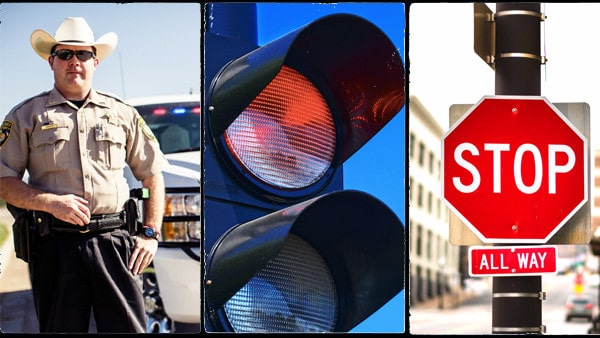
Which instruction takes priority over the other choices?

Which of the following must you obey over the other three?
  1. A A steady red traffic signal
  2. B A lawful direction from a police officer controlling traffic
  3. C A stop sign
  4. D A flashing red traffic signal

Correct answer: B – A lawful direction from a police officer controlling traffic

In Michigan, a driver must comply with a lawful order from a police officer directing or controlling traffic. This applies even when the officer’s instruction differs from a traffic sign or signal. For example, stop when directed at a green light or proceed when lawfully directed through a red light.

Source: MCL § 257.602 – Compliance with order or direction of police officer

Question 6

Traffic is moving at 50 mph on a road posted at 45 mph. What is the fastest you may legally drive?

  1. A 50 mph, because that is the traffic flow
  2. B Any speed between 45 and 50 mph
  3. C 45 mph

Correct answer: C – 45 mph

A posted 45 mph limit remains the maximum even when surrounding traffic is moving faster. Michigan’s basic speed law may require you to drive below the posted limit when traffic, weather, visibility, or roadway conditions make 45 mph unsafe. The speed of other vehicles does not authorize speeding.

Source: MCL § 257.627 – Speed limits, What Every Driver Must Know — Ch. 4, “Speed limits”