


Oklahoma Road Signs Test 2

4.8 out of 5 (230 votes)
80% Passing score
20 Questions
4 Mistakes allowed
Oklahoma folds road sign knowledge into the regular Class D written knowledge test, which is worth knowing before you spend all your time drilling signs and forget the rest of the exam is still sitting there, waiting. Service Oklahoma bases the test on the Oklahoma Driver Manual, and the official written exam covers traffic laws, road signs, safe driving practices, signals, pavement markings, lane use, right-of-way rules, work zones, school zones, and the basic judgment calls every driver is expected to make without turning it into a full courtroom analysis. The current online Oklahoma written knowledge test has 20 multiple-choice questions. You need 15 correct answers to pass, so you can miss up to 5. There is a 60-minute time limit, and results are given right away. Service Oklahoma allows two online attempts; after two failed online attempts, you have to test in person at a Service Oklahoma location. Failed written tests may also add a $4 fee to your account, due when the permit or license is issued. Small detail, yes, but still the kind of small detail people usually wish they had known earlier. This Oklahoma DMV road signs practice test is designed to help with the sign-related part of that broader exam. The official test does not publish a separate road-sign-only question count, so the sensible approach is to study road signs as one important piece of the full Oklahoma permit test, not as some neatly fenced-off category. You will want to recognize regulatory signs, warning signs, directional signs, school zone signs, work zone signs, traffic signals, pavement markings, and lane-use signs with enough confidence that you are not decoding them one shape at a time. The questions in this Oklahoma DMV practice test use multiple-choice wording and realistic sign situations, the sort of thing that feels simple only if you actually know the rule behind the sign. You may also run into Oklahoma-specific driving responsibilities, including the Move Over law. When a stationary emergency vehicle has flashing lights, Oklahoma drivers must move over a lane when it is safe, or slow down to a reasonable speed when they cannot move over. Use the hints if you need a little push, and read the explanations when you miss a question. That is where the practice test does the heavier lifting. The point is not just to pass a screen of questions; it is to recognize the sign quickly, understand what it requires, and carry that knowledge into the official Oklahoma written test and, more importantly, onto the road.
FREE DMV Practice Test App
Study for your Oklahoma permit test or driver’s license with the NextDoorDriving app. 700+ DMV questions and answers, 100% free!
Download on the App Store

Sample Oklahoma Permit Test Questions

Question 1

A steady yellow signal warns that which indication will appear next?

  1. A. A flashing yellow signal
  2. B. A steady green signal
  3. C. A steady red signal
  4. D. A flashing red signal

Correct answer: C. – A steady red signal

A steady yellow indication warns that the related green movement is ending and a red indication will appear immediately afterward. The Oklahoma Driver Manual advises stopping when you can do so safely before entering the crosswalk. Do not accelerate in an attempt to beat the red signal.

Source: 47 O.S. § 11-202(2)(a) – Traffic-Control Signal Legend, Oklahoma Driver Manual — Ch. 4, “Traffic Signals”

Question 2

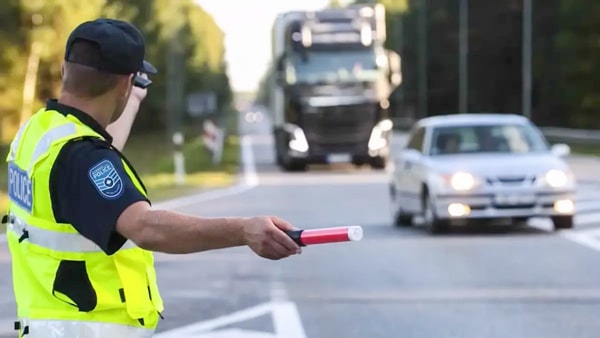
A police officer directs you through an intersection while the signal is red. What should you do?

A traffic light is red, but a police officer is telling you to go ahead anyway. What should you do?
  1. A. Remain stopped until the signal turns green
  2. B. Change lanes before proceeding
  3. C. Follow the officer's direction
  4. D. Wait for the officer to approach your vehicle

Correct answer: C. – Follow the officer's direction

Oklahoma law requires drivers to comply with lawful orders or directions given by police officers authorized to control traffic. The officer's direction controls even when it differs from the traffic signal. Waiting for the light to turn green would conflict with the officer's instruction to proceed.

Source: 47 O.S. § 11-103 – Obedience to Police Officers, Oklahoma Driver Manual — Ch. 4, “Traffic Signals”
Question 3

When may you use the left half of a two-way roadway?

On a two-way highway, you are allowed to drive on the left half of the roadway when:
  1. A. Whenever the centerline consists of double yellow lines
  2. B. When a solid yellow line is on your side
  3. C. When legally overtaking and passing under safe conditions
  4. D. Whenever you plan to turn at the next corner

Correct answer: C. – When legally overtaking and passing under safe conditions

On an Oklahoma roadway of sufficient width, vehicles generally must remain on the right half. One exception permits moving left of center to overtake another vehicle when the maneuver complies with the passing laws. No-passing markings, restricted locations, inadequate visibility, or unsafe conditions prevent use of that exception.

Source: 47 O.S. § 11-301(A)(1) – Drive on Right Side of Roadway—Exceptions, Oklahoma Driver Manual — Ch. 6, “Passing”

Question 4

When your signal turns green, may you enter the intersection immediately?

  1. A. No; you must always wait five seconds
  2. B. Yes; delaying is always a traffic violation
  3. C. You may proceed after yielding to anyone lawfully still in the intersection
  4. D. Yes; a green signal gives you an unrestricted right-of-way

Correct answer: C. – You may proceed after yielding to anyone lawfully still in the intersection

A green signal permits movement, but drivers must yield to vehicles and pedestrians lawfully within the intersection or an adjacent crosswalk. Do not move merely because the signal changed if someone remains in your path. Proceed after yielding and confirming that the intended movement can be completed safely.

Source: 47 O.S. § 11-202(1)(a) – Traffic-Control Signal Legend

Question 5

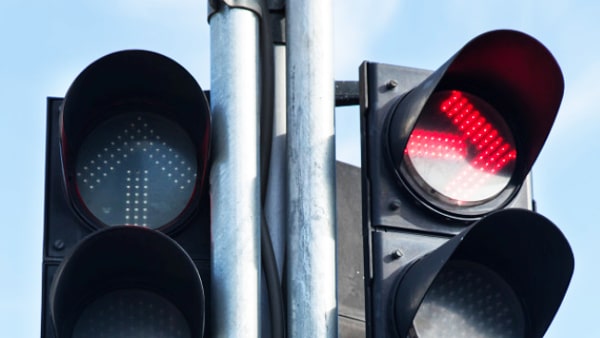
According to the Oklahoma Driver Manual, what does a red arrow pointing right require?

A red arrow pointing to the right on a traffic light means you may:
  1. A. Turn right after making a complete stop
  2. B. Remain stopped until a signal permits the right turn
  3. C. Slow down and turn if traffic is clear
  4. D. Turn if vehicles behind you are being delayed

Correct answer: B. – Remain stopped until a signal permits the right turn

The Oklahoma Driver Manual instructs drivers facing a red arrow to stop and wait for a green signal before turning in the arrow's direction. Merely slowing down does not satisfy that instruction. Traffic waiting behind you does not authorize movement against the arrow.

Source: Oklahoma Driver Manual — Ch. 4, “Traffic Signals”

Question 6

Your signal turns green, but vehicles remain in your path within the intersection. What should you do?

  1. A. Wait until they clear your path before entering
  2. B. Enter if you can drive around them
  3. C. Enter and wait inside the intersection
  4. D. Sound the horn and proceed

Correct answer: A. – Wait until they clear your path before entering

Under Oklahoma's green-signal rule, a driver must yield to other vehicles lawfully within the intersection. If vehicles remain in your path, wait rather than entering and attempting to maneuver around them. Proceed after your path has cleared and the movement can be completed safely.

Source: 47 O.S. § 11-202(1)(a) – Traffic-Control Signal Legend, Oklahoma Driver Manual — Ch. 4, “Traffic Signals”