Oklahoma Permit Practice Test 2

4.6 out of 5 (2634 votes)
80% Passing score
20 Questions
4 Mistakes allowed
For Oklahoma drivers, the written knowledge test is where the licensing process starts to feel real. You do not want to walk in relying on half-remembered road signs and whatever seemed obvious the last time you rode in the passenger seat. This Oklahoma permit practice test is built around the same core material Service Oklahoma uses for the standard Class D written knowledge test: the official Oklahoma Driver Manual, traffic laws, road signs, safe driving practices, safety procedures, and the rules that apply to passengers and seat belts. The official online written exam currently gives you 20 multiple-choice questions. You need 15 correct answers to pass, which means five misses is the limit. There is also a 60-minute time limit, and results are provided after the test. So, yes, it is a short test, but short does not automatically mean easy. A few questions can go fast when the wording gets a little official-sounding, or when two answers look close enough that you start negotiating with yourself. This Oklahoma DMV practice test gives you a way to work through that material before the official attempt. The questions are designed to feel like the real Oklahoma permit test, not just a loose review of driving trivia. You will see the kinds of topics that matter on the road: who has the right-of-way, what signs are telling you before you are close enough to panic-read them, how seat belt rules apply, and how safe driving choices change when the weather or traffic stops cooperating. The study aids are useful without making the practice feel watered down. If you get stuck, a hint can point you in the right direction. If you miss a question, the explanation gives you the rule behind the answer, which is the part that actually helps later. That is especially helpful because Service Oklahoma allows the online written test to be taken twice online; after two failed online attempts, you have to test in person at a Service Oklahoma location. Applicants under 18 generally need a learner permit before the drive test, and a parent or guardian must verify identity before an online test begins. Adults 18 and older may move through the written, vision, and drive tests for a first Class D license, though they can choose a learner permit for practice. Either way, taking this Oklahoma permit practice test more than once is not overpreparing. It is just a cleaner way to find the weak spots before the official test does it for you.
FREE DMV Practice Test App
Study for your Oklahoma permit test or driver’s license with the NextDoorDriving app. 700+ DMV questions and answers, 100% free!
Download on the App Store

Sample Oklahoma Permit Test Questions

Question 1

While traveling in the right lane of an expressway, which situation should you anticipate?

  1. A. All vehicles in that lane must travel below the traffic flow
  2. B. Vehicles may enter the lane from acceleration and merging areas
  3. C. Entering vehicles automatically have the right-of-way
  4. D. Vehicles in that lane must travel faster than other traffic

Correct answer: B. – Vehicles may enter the lane from acceleration and merging areas

Vehicles entering an Oklahoma expressway use an acceleration lane and merge into the right lane when a sufficient opening is available. Drivers already in the right lane should watch entrance and merging areas carefully. Entering traffic does not automatically receive the right-of-way.

Source: Oklahoma Driver Manual — Ch. 6, “Entering and Leaving an Expressway”
Question 2

Driving faster than surrounding traffic and repeatedly changing lanes to pass:

  1. A. Makes the trip safer by avoiding slower vehicles
  2. B. Creates more opportunities for a collision
  3. C. Prevents congestion by spreading traffic among lanes
  4. D. Is permitted only on controlled-access highways

Correct answer: B. – Creates more opportunities for a collision

Repeated passing requires repeated lane changes and interactions with nearby vehicles. Before every lane change, a driver must verify clearance, check mirrors and blind spots, and signal. Traveling faster than surrounding traffic also increases closing speeds and reduces the time available to respond, raising the risk of a crash.

Source: Oklahoma Driver Manual — Ch. 6, “Changing Lanes”

Question 3

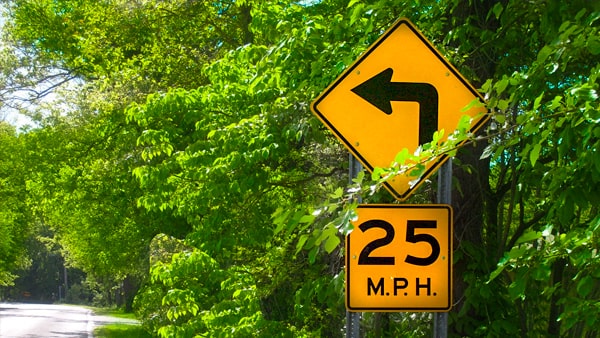
A yellow left-curve sign with a “25 MPH” advisory plaque means:

This sign means:
  1. A. The road curves left, and vehicles must travel at least 25 mph
  2. B. The road curves right, and vehicles must travel at least 25 mph
  3. C. The road curves right, with an advised speed of 25 mph
  4. D. The road curves left, with an advised speed of 25 mph

Correct answer: D. – The road curves left, with an advised speed of 25 mph

The warning sign shows that the roadway bends to the left. The supplemental plaque advises a speed of 25 mph for the curve under favorable conditions; it is not a minimum speed. Reduce speed further when weather, visibility, traffic, or pavement conditions require it.

Source: Oklahoma Driver Manual — Ch. 4, “Warning Signs—Black on a Yellow Background”

Question 4

An orange diamond-shaped sign showing a worker with a shovel warns that:

This sign means that:
  1. A. A volunteer litter crew is scheduled nearby
  2. B. Workers may be on or close to the roadway ahead
  3. C. Children may be playing beside the roadway
  4. D. A pedestrian crosswalk is immediately ahead

Correct answer: B. – Workers may be on or close to the roadway ahead

Orange construction signs warn of work-zone conditions. Workers, equipment, barricades, or lane changes may be on or near the roadway, so drivers must pay close attention and be prepared to slow or stop. In Oklahoma, speeding fines are doubled in a construction or maintenance zone when workers or equipment are present.

Source: Oklahoma Driver Manual — Ch. 4, “Construction and Maintenance Signs—Orange = Work Zone = Danger”

Question 5

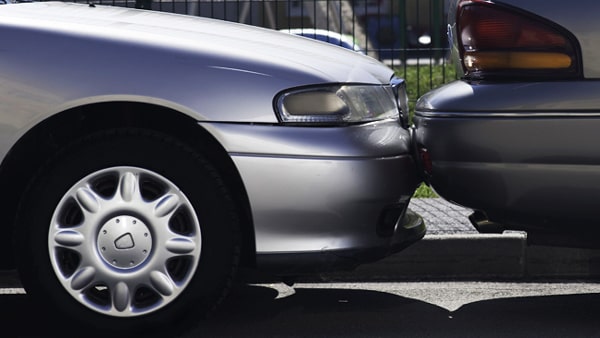
After striking an unattended parked vehicle in Oklahoma, you cannot locate its owner. What must you do?

If you hit a parked car and cannot find the owner, you:
  1. A. Notify only your insurance company and leave
  2. B. Leave if the damage appears minor
  3. C. Leave the required identifying information conspicuously on the vehicle
  4. D. Wait until the owner returns, regardless of how long it takes

Correct answer: C. – Leave the required identifying information conspicuously on the vehicle

The driver must stop immediately and attempt to locate and notify the unattended vehicle's operator or owner. If that person cannot be found, the driver must leave a written notice containing the legally required identifying information in a conspicuous place on the vehicle. Driving away without taking either step violates the law.

Source: 47 O.S. § 10-105 – Duty upon striking unattended vehicle

Question 6

What does a steady yellow traffic signal tell a driver?

  1. A. The signal will remain green for cross traffic
  2. B. Proceed without reducing speed
  3. C. The green movement is ending; stop if it can be done safely
  4. D. Stop immediately, even if already within the intersection

Correct answer: C. – The green movement is ending; stop if it can be done safely

A steady yellow signal warns that the related green movement is ending and a red indication will follow. Stop before entering the intersection when you can do so safely. If you are too close to stop safely or are already in the intersection, proceed cautiously rather than stopping abruptly within it.

Source: 47 O.S. § 11-202 – Traffic-control signal legend, Oklahoma Driver Manual — Ch. 4, “Traffic Signals”