Oklahoma Permit Test Simulator

4.8 out of 5 (309 votes)
80% Passing score
50 Questions
10 Mistakes allowed
Preparing for the Oklahoma permit test is mostly about knowing what Service Oklahoma expects you to know, and then practicing it enough that the real written exam does not feel unfamiliar. The test is based on the Oklahoma Driver Manual, and it focuses on the material new drivers actually need: traffic laws, road signs, safe driving habits, right-of-way rules, signals, pavement markings, work zones, and the rules that come up when real driving gets a little less tidy than the handbook examples. The current Oklahoma Class D online written test has 20 multiple-choice questions, with 15 correct answers required to pass. You get 60 minutes, immediate results, and two online attempts before any further testing has to be done in person. Five missed questions is the limit, which is enough room to recover from a mistake or two, but not enough to treat the exam like a casual click-through. This Oklahoma permit practice test gives you a practical way to study before you use one of those attempts. Each session serves up a fresh mix of practice questions, so you are not just memorizing the same answers in the same order and mistaking that for real preparation. You will work through the same kinds of topics that appear on the Oklahoma DMV written test, including road signs, traffic signals, lane use, school zones, work zones, DUI laws, insurance and registration basics, and what to do after a crash. Road signs are worth studying carefully, but they are not handled as a separate official road-sign-only test for the standard Oklahoma Class D license. They are part of the regular written knowledge test, mixed in with the rules of the road and safe-driving questions. That is why a good Oklahoma practice permit test should make you think about signs in context, not just match shapes and colors from memory. There are licensing details to keep straight as well. Teens take the written test as part of the learner permit process and move through Oklahoma’s graduated driver license system, including a 180-day learner permit holding period, 50 supervised driving hours, and 10 nighttime hours before the intermediate license. Adults 18 and older follow a different first-time Class D license process and may not need a learner permit before the drive test, though they can choose one for practice. Use this free Oklahoma drivers license test online as a steady rehearsal for the real thing. The point is to walk into the Oklahoma DMV test already comfortable with the rules, the signs, and the way the questions are likely to be asked.
FREE DMV Practice Test App
Study for your Oklahoma permit test or driver’s license with the NextDoorDriving app. 700+ DMV questions and answers, 100% free!
Download on the App Store

Sample Oklahoma Permit Test Questions

Question 1

At a location marked NO PARKING, which action is generally permitted?

  1. A. Stopping there for any reason
  2. B. Stopping briefly while actively loading or unloading passengers
  3. C. Leaving the vehicle parked while the driver remains inside
  4. D. Leaving the vehicle unattended for less than five minutes

Correct answer: B. – Stopping briefly while actively loading or unloading passengers

Oklahoma defines parking as standing a vehicle, occupied or not, except while it is temporarily and actually being used to load or unload merchandise or passengers. A no-parking restriction does not by itself prohibit a brief stop for active passenger loading or unloading. Remaining in the driver’s seat does not make ordinary parking lawful.

Source: 47 O.S. § 1-142 – Park, Parking, and Public Parking Lot

Question 2

Whenever you park on a hill, which step should you take?

  1. A. Place one rear tire against the curb
  2. B. Set the parking brake and shift into Park or the proper gear
  3. C. Keep the front wheels straight when there is no curb
  4. D. Turn the wheels toward the curb in every situation

Correct answer: B. – Set the parking brake and shift into Park or the proper gear

The Oklahoma manual directs drivers parking on a hill to set the parking brake and place the vehicle in Park or the proper gear. Wheel direction depends on whether the vehicle faces uphill or downhill and whether a curb is present. Securing the transmission and parking brake helps prevent the vehicle from rolling.

Source: Oklahoma Driver Manual — Ch. 9, “Parking and Starting on a Hill”

Question 3

When driving on a narrow mountain highway in Oklahoma, you must:

  1. A. Accelerate through narrow sections
  2. B. Keep the vehicle under control and near the right-hand edge
  3. C. Drive near the center for better visibility
  4. D. Yield only when meeting a truck

Correct answer: B. – Keep the vehicle under control and near the right-hand edge

Oklahoma law requires a driver traveling through canyons or on mountain highways to keep the vehicle under control. The vehicle must also remain as near the highway’s right-hand edge as reasonably possible. This rule is especially important where the roadway is narrow or visibility is limited.

Source: 47 O.S. § 11-1106 – Driving on Mountain Highways

Question 4

What is the top-to-bottom order of a standard vertical traffic signal?

From top to bottom, the following is the proper order for traffic lights:
  1. A. Red, yellow, green
  2. B. Red, green, yellow
  3. C. Green, red, yellow
  4. D. Green, yellow, red

Correct answer: A. – Red, yellow, green

In a vertical traffic signal, red is at the top, yellow is in the middle, and green is at the bottom. This arrangement helps drivers recognize an indication by its position as well as its color. Drivers must obey the signal unless a traffic officer directs otherwise.

Source: Oklahoma Driver Manual — Ch. 4, “Traffic Signals”

Question 5

Which color combination is normally used for signs warning of curves, narrow bridges, and similar hazards?

  1. A. Black on white
  2. B. Black on yellow
  3. C. White on blue
  4. D. White on green

Correct answer: B. – Black on yellow

Standard roadway-hazard warning signs generally use black letters or symbols on a yellow background and are diamond-shaped. They alert drivers to conditions ahead, including curves, narrow bridges, steep grades, and merging traffic. Be prepared to adjust your speed or position when you see one.

Source: Oklahoma Driver Manual — Ch. 4, “Warning Signs—Black on a Yellow Background”

Question 6

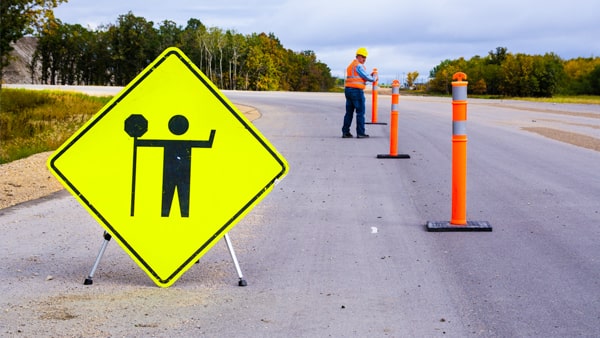
An orange diamond sign showing a person holding a flag or paddle warns of:

This sign means:
  1. A. A pedestrian crossing
  2. B. The end of a work zone
  3. C. A school crossing
  4. D. A flagger controlling traffic ahead

Correct answer: D. – A flagger controlling traffic ahead

Orange diamond signs identify construction and maintenance warnings. The flagger symbol tells drivers that a flagger is controlling traffic ahead. The Oklahoma manual instructs drivers to slow down, watch for directions, and be prepared to stop while traveling through the work area.

Source: Oklahoma Driver Manual — Ch. 4, “Construction and Maintenance Signs”