


Vermont Permit Practice Test 4

4.8 out of 5 (39 votes)
80% Passing score
20 Questions
4 Mistakes allowed
Vermont’s permit process gives you plenty to study, and not all of it is the obvious stuff. This Vermont permit practice test helps you work through the rules the way they tend to appear on the real DMV test: practical, specific, and sometimes a little more detailed than people expect when they first open the driver’s manual. The test includes 20 multiple-choice questions based on the official Vermont driver’s manual, with extra attention on child safety seats along with general driving knowledge, licensing rules, and safe-driving judgment. You’ll need at least 16 correct answers to pass this practice version, so it is not a casual skim-and-click exercise. It is meant to make you slow down just enough to notice the details that matter — seat belt rules, passenger safety, supervising-driver requirements, and the kind of wording that can separate a decent guess from the correct answer. For teen drivers, Vermont’s licensing path is especially worth knowing. A learner permit is available at age 15, and applicants who are 15, 16, or 17 usually need parent or guardian permission unless they are emancipated. Once you have that permit, you cannot just drive around with any licensed friend who happens to have a pulse and a set of keys. Vermont requires a qualified supervising driver in the front seat, such as a licensed and unimpaired parent or guardian, an approved driving instructor, or a licensed and unimpaired adult who is at least 25. The rules continue after the permit stage, too. Drivers who are 16 or 17 must complete an approved driver education course before licensing, including classroom instruction, behind-the-wheel training, and observation. They also need 40 hours of practice driving, with at least 10 hours at night. And Vermont defines nighttime driving as 30 minutes after sunset to 30 minutes before sunrise, which is one of those details that sounds minor until it shows up in a licensing question. This Vermont DMV practice test also touches the bigger picture: the one-year learner permit requirement, clean-record expectations before a Junior Driver’s License, passenger limits during the first months of junior licensing, and restrictions on driving for work or carrying passengers for hire. Visual learning aids are included where they help, especially with child safety seats and real-world driving situations. Use this VT permit test practice as a focused run-through before the official exam, not a last-minute panic button dressed up as studying.
FREE DMV Practice Test App
Study for your Vermont permit test or driver’s license with the NextDoorDriving app. 700+ DMV questions and answers, 100% free!
Download on the App Store

Sample Vermont Permit Test Questions

Question 1

What should you do before changing lanes on a multilane highway?
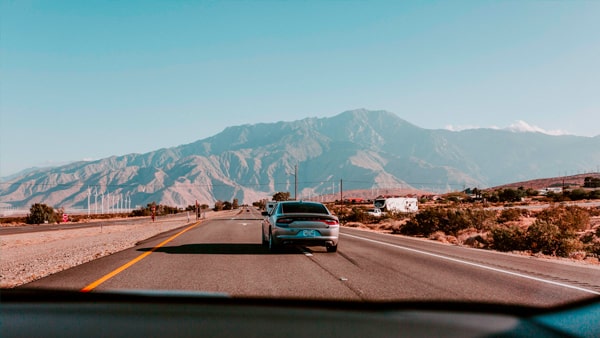
Before changing lanes on a multi-lane highway you should:
  1. A Sound the horn
  2. B Flash the headlights
  3. C Slow sharply in your current lane
  4. D Check the mirrors and look over your shoulder for vehicles in the blind spot

Correct answer: D – Check the mirrors and look over your shoulder for vehicles in the blind spot

Before leaving a lane, signal and check traffic in front, behind, and beside your vehicle. Use the mirrors and glance over the appropriate shoulder to check the blind spot. Vermont law requires a driver to ascertain that a lane movement can be made safely before beginning it.

Source: 23 V.S.A. § 1038(1) — Driving on roadways laned for traffic, Vermont Driver’s Manual — “Changing Lanes”

Question 2

When may you drive through, around, or under a railroad crossing gate that is being raised or lowered?

  1. A When a train appears far from the crossing
  2. B When your vehicle will not touch the gate
  3. C After looking in both directions
  4. D Under no circumstances

Correct answer: D – Under no circumstances

Vermont law prohibits driving through, around, or under a railroad crossing gate or barrier while it is closed, opening, or closing. If a gate is lowered or another warning shows an approaching train, stop between 15 and 50 feet from the nearest rail. Do not proceed until permitted and safe.

Source: 23 V.S.A. § 1071(a)(2), (b) — Railroad grade crossings

Question 3

Before crossing a single solid white line between lanes traveling in the same direction, what must be true?

  1. A You may cross whenever you prefer another lane
  2. B The movement can be made safely and no traffic-control device prohibits it
  3. C You are entering a private driveway
  4. D You are making a U-turn

Correct answer: B – The movement can be made safely and no traffic-control device prohibits it

A single solid white lane line indicates that crossing is discouraged or restricted, depending on its use and accompanying controls. Before changing lanes, a driver must ascertain that the movement can be made safely. Drivers must also obey any official device that prohibits changing lanes at that location.

Source: 23 V.S.A. § 1025 — Standards, 23 V.S.A. § 1038(1), (4) — Driving on roadways laned for traffic, Manual on Uniform Traffic Control Devices for Streets and Highways, 11th ed. — Part 3, “Markings”

Question 4

What should you do if you become drowsy during a long drive?

  1. A Turn up the radio and continue
  2. B Drive more slowly while fighting the fatigue
  3. C Stop in a safe place and rest
  4. D Move your eyes constantly from side to side

Correct answer: C – Stop in a safe place and rest

Fatigue slows reaction time, reduces awareness, and impairs judgment. If you become tired, stop and rest in a safe location as soon as possible rather than attempting to force yourself to remain awake. Radio volume, open windows, or similar short-term measures do not eliminate the effects of drowsiness.

Source: Vermont Driver’s Manual — “Fatigue”, Vermont Driver’s Manual — “Interstate Driving”

Question 5

What must you do before entering a public roadway from a private road or driveway?

  1. A Sound the horn and enter
  2. B Move partway into the roadway to claim space
  3. C Accelerate quickly ahead of approaching traffic
  4. D Yield to pedestrians and traffic approaching on the roadway

Correct answer: D – Yield to pedestrians and traffic approaching on the roadway

A driver emerging from a private road or driveway must stop before driving onto a sidewalk or the sidewalk area. The driver must yield as necessary to avoid contact with pedestrians and must yield to vehicles and vulnerable users approaching on the roadway. Enter only when the movement can be completed safely.

Source: 23 V.S.A. § 1074 — Vehicle entering roadway, 23 V.S.A. § 1049 — Vehicle entering from private road

Question 6

According to the Vermont Driver’s Manual, as little as how much floodwater can make walking difficult and hide hazards?

  1. A Two inches
  2. B Six inches
  3. C Four inches
  4. D Eight inches

Correct answer: C – Four inches

The manual warns that as little as four inches of water can make walking difficult and conceal hazards beneath the surface. Floodwater on a roadway may be deeper or faster-moving than it appears. Check weather and flood warnings and avoid entering areas where the depth or condition of the roadway cannot be determined.

Source: Vermont Driver’s Manual — “Driving in Bad Weather”